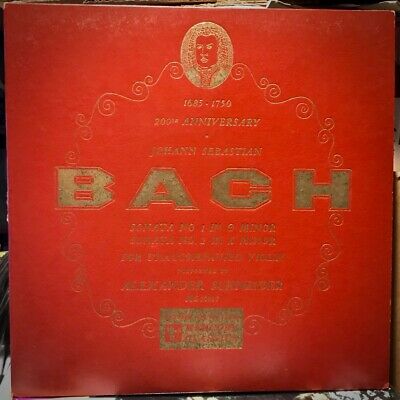
MERCURY LP MG-10017: J.S. BACH - Sonatas Nos 1 & 2 Alexander SCHNEIDER, 1950 USA
$
100

$ 100
Sold For
Aug 23, 2020
Sold Date
May 24, 2019
Start Date
1
Number Of Bids
USA
Country Of Seller
eBay
Sold at
Favourite Auctions
To save auctions to your favourites, please login
If you don't have an account, please register
Description
****Welcome to our listing, thanks very much for looking!
****See our own website! We have lots of out of print LPs and CDs! Find us on the web at -
hearthedifference.net
****Shipping cost is only an estimate - it depends on the actual weight and size of the package as well as the service required. We do not profit from shipping costs, so if we overcharge, we will refund the difference back to you. It's always best to wait for our invoice before paying for your item. We will combine shipping for multiple items purchased.
****Please see our other listings - new items added daily!
****To access our eBay store click on the little red door at the top right section of any of our eBay listings or, click on -
http://stores.ebay.com/Hear-The-Difference
Background -
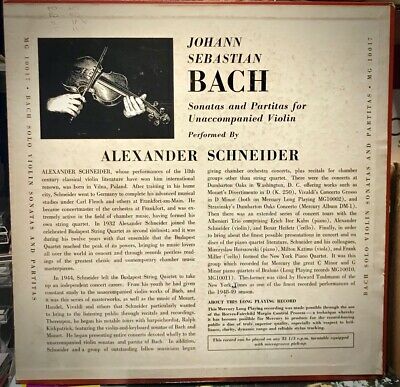
One of the earliest original Mercury sound recordings was of the Sonatas and Partitas for Solo Violin of Johann Sebastian Bach performed by Alexander Schneider on the Mercury label. This was Mercury's first boxed set (each record had its own outer jacket), recorded in 1949 at Reeves Sound Studios, New York City, by Robert Fine (engineer) and Mitchell Miller (recording director). The set with notes written by David Hall was issued in 1950, the Bach year (200th anniversary of his death).Alexander (born Abraham) Schneider, an extroverted, old-school violinist who specialized in chamber music, was long a mainstay of the Budapest Quartet; he brought Pablo Casals out of retirement in the 1950s, and worked tirelessly on behalf of chamber music in America.
Born in Vilnius, Schneider enrolled in the conservatory there at age 10, transferring to the Frankfurt Hochschule für Musik six years later. His violin teachers included Adolf Rebner in Frankfurt and, later, Carl Flesch in Berlin. Schneider became concertmaster of the Frankfurt Museum Orchestra while still a teenager, serving there from 1925 to 1933. In 1932 he joined his cellist-brother Mischa in the Budapest Quartet as second violinist. He and the group settled in the United States in 1938, but Schneider parted company with the ensemble in 1944. During the next 10 years, he performed in the Albeneri Trio and New York (Piano) Quartet, played duos with Ralph Kirkpatrick and Eugene Istomin, and led his own chamber orchestra. In 1945 he received the Elizabeth Sprague Coolidge Medal for his chamber music work.
In 1950 he brought Pablo Casals out of retirement for commemorations of the 200th anniversary of Bach's death; the result was a music festival in Prades. Schneider also worked with Casals at festivals in Perpignan, Puerto Rico, Israel, and Marlboro, VT, in the United States. Chamber music was the chief focus of all these efforts.
Schneider formed his own string quartet in 1952, performing and recording most of the Haydn quartets, but in 1955 he was lured back to the Budapest Quartet, where he remained until the group disbanded in 1967. During this period and thereafter, Schneider worked extensively as a teacher, and began conducting more actively. He formed yet another ensemble, the Brandenburg Players, in 1972. - James Reel
-
LP made by MERCURY Records, in the USA
-
LP released in 1950 - first edition
-
LP is recorded in MONO
-
Record Catalog Number: MG 10017
-
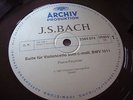
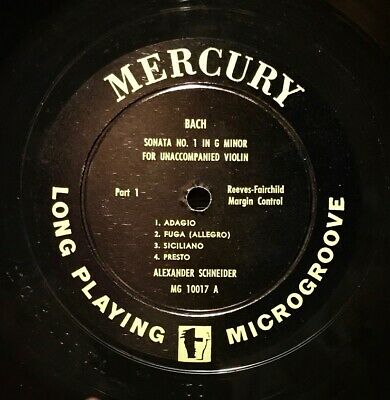
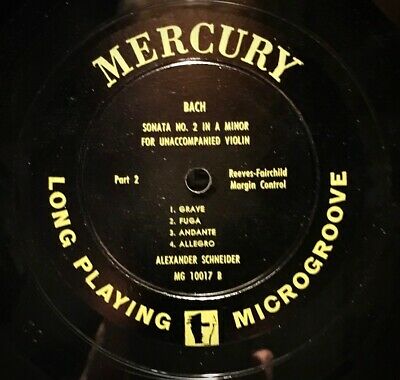
Record Labels are primarily BLACK with WHITE lettering, with the early MERCURY logo on the labels.
J.S. Bach // Alexander Schneider
LP Title & Music on this item -
Johann Sebastian Bach - Alexander Schneider ?– 1685-1750, 200th Anniversary · Sonatas Nos. 1 & 2 for Unaccompanied Violin
Sonata No. 1 In G Minor For Unaccompanied Violin
A1. Adagio
A2. Fuga (Allegro)
A3. Siciliano
A4. Presto
Sonata No. 2 In A Minor For Unaccompanied Violin
B1. Grave
B2. Fuga
B3. Andante
B4. Allegro
Performers / Credits and Other Information -
• Composed By – Johann Sebastian Bach
• Violin – Alexander Schneider
• Matrix / Runout (A runout): MG 10017A 50
• Matrix / Runout (B runout): MG 10017B 50
• Recorded in 1949 at Reeves Sound Studios, New York City • Recording Engineer - Robert Fine • Recording Director - Mitchell Miller • The set with notes written by David Hall was issued in 1950
CONDITION Details:
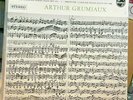
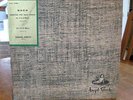
The LP JACKET is in excellent plus condition. Incredibly, the LP jacket has NO splits - it's nice and solid and shows only some light shelf wear along the seams and corners. Jacket has no cut out marks but does have some pencil writing on the back cover. The colors are clean and clear - see pictures with this listing as they are of the ACTUAL ITEM.
The LP is in very good plus overall condition. We wish we could say this LP was mint, but it isn't. We found that the vinyl looked very good on this super early vintage LP (first edition)! There are some light marks on the vinyl (spider marks mostly). These types of marks are caused by sliding the LP in and out of the inner sleeve. They may be audible on some audio systems, but that really depends on the sensitivity of your gear. Further, very early vintage vinyl is not generally considered of audiophile quality. Like the rare Remington's and Westminster's of their day, the vinyl is sought after for the performances, not for the sound quality. The LP retains some of the original gloss and sheen. The vinyl may have a bit of dust and perhaps a finger print or two on the vinyl so it should be cleaned before playing for best results. There are NO serious spindle marks on the record labels. If you want an LP with NO marks and is dead quiet, then this first edition LP is NOT for you (they just don't exist).A Short Note About LP GRADING -
- Mint = Only used for sealed items.
- Near Mint = Virtually flawless in every way.
- Near Mint Minus = Item has some minor imperfections, some audible.
- Excellent = Item obviously played and enjoyed with some noise.
- Very Good Plus = Many more imperfections which are noticeable and obtrusive.
For best results, always properly clean your LPs before playing them.
The LP is an audiophile quality pressing (any collector of fine MFSL, half speeds, direct to discs, Japanese/UK pressings etc., can attest to the difference a quality pressing can make to an audio system).
Don't let this rarity slip by!!!
price rating