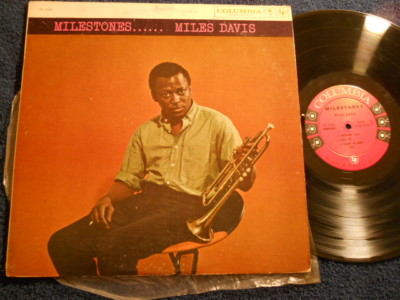
MILES DAVIS - Milestones Columbia 6 eye, COLTRANE NM
$
50


Favourite Auctions
To save auctions to your favourites, please login
If you don't have an account, please register
Description
PLEASE TAKE A LOOK AT MY OTHER eBAY AUCTION AND STORES LISTINGS - ALWAYS EXPECT THE UNEXPECTED
CHECK OUT THE RARE JAZZ ALBUMS NEWLY LISTED THIS WEEK
Miles Davis - "'Milestones" in mono on Columbia CL 1193. From 1958, with John Coltrane.
Record Grade: Near Mint, a 9 on a 1-10 scale, gorgeous
Cover Grade: VG+, minor to average wear, 2" top seam split at the opening, some fraying of the bottom seam, named stamped on back cover in small letters top right corner
Labels: "6 eye"
About the Album: by Thom Jurek
What is immediately noticeable upon listening to this delicately and superbly remastered version of Miles Davis classic first -- and only -- album with his original sextet is how deep the blues presence is on it. Though it is true that the album's title cut is rightfully credited with introducing modalism into jazz, and defining Davis' music for years to come, it is the sole selection of its kind on the record. The rest is all blues in any flavor you wish you call your own. For starters, there's the steaming bebop blues of "Dr. Jackie" -- recorded in 1955 for a Prestige session with Jackie McLean. Davis is still in his role as a trumpet master, showing a muscularity of tone that reveals something more akin to Roy Eldridge or Louis Armstrong than Dizzy or Fats Navarro. The tempo is furious as all the members of the sextet solo except for Jones. The saxophonists trade choruses and come off sounding like mirrored images of one another in the slower, post-bop blues that is "Sid's Ahead." With a slippery melody line that quotes two harmonic lines from early New Orleans-styled blues, Davis drives the band into the rhythm section's garage. It's Cannonball first with his stuttered, angular lines, hiccuping halfway through the interval before continuing on with a squeak here and the slightest squawk there. Next up is Davis, blowing fluid and straightened lines, ribbons through the rhythm section's center as Red Garland lays out and leaves it to Paul Chambers and Philly Joe Jones to provide the earnest, time-keeping 4/4 that Davis sidles to in the tune. When Coltrane solos, all best are off as he plays as pure a blues as he was capable at the time. Nonetheless, there are the long lines of slurred notes, smattered against Garland's harmonies and he slips into quoting "Skip to my Lou" before knotting it back down to the basics and even then not for long. Coltrane was already exploring the edges of mode and harmony; he used an intervallic invention in the choruses to juxtapose his solo against the rhythm section and it worked -- but it must have made Davis raise an eyebrow. Chambers' solo is as tasteful and as breezy and free as only he could be. His contrapuntal soloing rides the rhythm out, Garland striding along quietly until the tune returns. "Sid's Ahead" is followed by the track "Two Bass Hit," written by Dizzy and John Lewis. It's an off-kilter blues with a wide middle section, no doubt for Lewis' piano to fill. It's a wonderful ensemble showcase but Davis blows his ass off in his solo, riding through the two saxophonists and challenging them at the same time. But then comes "Milestones" with its modal round and interval, where harmony is constructed from the center up. It is a memorable tune for not only its structure and how it would inform not only Davis' own music, but jazz in general for the next seven years. It would also change John Coltrane's life. The exploratory style of soloing was already revealing itself in Trane's playing, but he loosens it up even more here. More importantly, this is the first place we get to see it in Davis, where there is no goal at the end of the rainbow, there is merely the solo itself in the heart of the mode. The alternate take of this tune, which is featured at the end of the album, tagged on with two others of "Two Bass Hit" and "Straight, No Chaser," has an even longer and weirder solo by Davis where he plays notes he probably never played again. The album's closer is Monk's "Straight, No Chaser," which became a signature tune for the sextet even when Garland and Jones left to be replaced by Bill Evans and Jimmy Cobb and later Evans by Wynton Kelly. Like "My Funny Valentine," it was a Davis staple that accented how intuitive the band was with unusual harmonic structures like Monk's. The Adderley solo is remarkable for its fluid, bebop-style runs over Garland's extended chords and flatted sevenths. Cannonball quotes the melody in a myriad of ways and goes off the deep end each time he does, taking the new rendition to its limit, always returning it to the blues root. Davis plays it cool, slithering around the rhythm section staying firmly in blues phraseology, even quoting a reverse harmonic melodic read of "When the Saints Go Marching In," bringing it in and out three times while pushing the blues line to its edge. Coltrane's solo is all over the place, slurring notes as he plays weird scales all over the blues and triple times the rhythm section. But he knows the tune better than anyone here -- he spent six months with Monk just previous to this playing it every night. Coltrane knows how much he can stretch the intervals without breaking apart the body. He inserts his own modal interpretation on the blues halfway through his solo before slipping into the straight, swinging groove of his Blue Train album, finished only two months before. Garland, oddly enough, is the one to travel the furthest from Monk here, coming off with a Bud Powell-esque blues muscle that shifts the entire tune into a straight bebop blues before sifting in a few Errol Garland quotes as the bass solos and then the front line comes in to take it out. The alternate take is even stranger as Garland falters in his time not once but twice and has to find his way back in. Legacy has done it proud on this series of reissues, as the sound is as fine as technology can currently make it, the notes are terrific, and the alternate takes offer additional delights to fans of the original recordings. They should also be commended for leaving them at the bottom of the album instead of placing them in with the original album's sequence, a practice that though widely used is distracting nonetheless. This is a fine issue of a classic, and treated like the piece of art it is.
All of my records are shipped in sturdy cardboard LP or 45 rpm mailers with appropriate padding (heavy cardboard fillers or bubble wrap or "peanuts" or some combination thereof". With the exception of sealed LP's, all LP's are removed from their outer sleeves to prevent seam splitting. Upon request, I will give your sealed LP's the same treatment. (once an LP is shipped sealed, it cannot be returned once opened).
All records are carefully graded. In an attempt to give customers an accurate impression of condition rather than adhere to somewhat arbitrary criteria, I give an "overall presentation" grade, supplemented when necessary with additional remarks. Please refer to my grading system below for a more detailed explanation.
MY GRADING SYSTEMS: I’ve been told that I grade conservatively. My NM (near mint) is my highest grade for opened records (which would also include unplayed records). It’s a 9 or 10 on a 1-10 scale. M- would be equivalent to an 8; VG++ to a 7; VG+ to a 6; VG to a 5; VG- to a 4; G to a 3; F to a 2 and P to a 1. The same scale applies when I grade covers (jackets). Significant defects are specifically noted and taken into consideration in the grade.
GRADING DESCRIPTIONS
RECORDS:
- GRADING Grading is based on the following criteria
- Sealed = store stock new
- Near Mint = like new or near new with only one or two small insignificant defects, a 9 or better on a 1-10 scale
- Mint- = extremely nice. Would be Near Mint, except for a couple of light hairlines or scuffs, which do not affect play
- VG++ = still a very nice record with all or nearly all of its original gloss but may have a few more light, surface marks, hairlines, needle tracks or the like which should not materially effect play
- VG+ = a nice, but used record that may have a series of light scuffs or scratches. It probably plays with a few pops, but has no serious problems.
- VG = a well-used record that still should sound OK when played, but may have moderate surface noise, pops, etc.
- VG- = a very well-worn record that plays through without skipping, but will do until a better copy comes along.
- Good = not actually good at all but probably will play through but with much in the way of surface noise, pops, crackles, etc. Still, will have no cracks, chips or the like
- Fair = you’re getting this record just to own but not to play
- Poor = the sky’s the limit, generally I will discard a record this bad (and sell the cover, jacket or sleeve alone) unless the label holds some particular interest
VISUAL GRADING: All records are visually graded only unless I state that they are play-graded. Some major labels were pressed on better quality vinyl and will sound better than a record which visually appears the same on "budget" labels which were pressed on lower quality vinyl. Recording techniques also varied. The sound on live albums may be far inferior to studio recordings. There may also be defects in the pressing which are invisible. The point is that an album on a high quality label that was visually graded VG+ may sound better than an album on a budget label that was visually graded Mint- or even Near Mint. Please refer to my return policy, below. But please don’t be shocked if a record visually graded Near Mint doesn’t sound state of the art. If I base my grade on a PLAY GRADE, I will state this specifically in my grading section.
COVERS: There are really too many possible defects regarding covers to be as specific in my definitions as I had been with my record grades. But please keep in mind these general grading guidelines:
- I will give greater weight to the condition of the front cover than back cover when assigning an overall grade
- No cover with a cut out hole or saw mark will be graded Near Mint even if it is still in factory shrink and there is no other wear
- I will not reduce the grade of a cover for stickers which are glued to the jacket by the record company (eg. Contains the hit song Expressway to Your Heart); but will reduce the grade for stickers glued on the cover by stores, previous owners, etc.
- If I write that a cover has a bb hole, I’m talking about a small cut out hole
- A saw mark is a narrow cut in the perimeter of the cover, could be anywhere and vary in length from 1/2” to 2” at the most.
- The overall grade takes into consideration any stated defects. For example, if I grade a cover VG+ and then state it has 6” top and bottom seam splits - I’ve already reduced the grade because of the seam splits. If the seams weren’t split, the cover would be graded higher such as VG++ or Mint-.
Shipping Costs: NEW SHIPPING RATES & POLICIES AS OF JANUARY 4, 2010.
The buyer pays for shipping.
DOMESTIC SHIPPING WITHIN THE UNITED STATES: Due to increase in postage rates, I have sometimes been losing money on shipping as I send all records in sturdy professional mailers with one or more fillers. Therefore, I now will be using the eBay postage calculator method. This will also result in a more equitable charge for priority mail shipments. Instead of charging $9 across the board, those who live in the southeast and mid-east will reap the benefit of reduced priority mail rates.
DOMESTIC AND INTERNATIONAL SHIPMENTS: COMBINED SHIPPING - Save money when I mail 2 or more records in the same package.
INTERNATIONAL SHIPMENTS (NEW POLICIES): Overseas customers are welcome to bid. As with U.S. shipments, I will use eBay's postage calculator for all overseas shipments. Postage to Canada is substantially less than to other countries - if you live in Canada and don't see a separate rate for Canada , please e-mail me and I'll modify the invoice to reflect the lower shipping charges. Surface mail is no longer available for overseas. Express Mail International and Priority Mail International are available - rates are substantially higher than first class international and will be quoted for each purchase if buyer requests this service. Express Mail International or Registered mail is now required for purchases over $100. Generally, Express International costs $35 for 1 album and additional albums are about $5-6 more. Registered costs about $26 for 1 album, about $5 more for each additional album. Registered mail may not be available to certain countries. I am sorry but the increased risks and costs must be passed on to the international buyer. On the bright side of things, Express Mail International will get you the package faster and it is safer. Registered mail is the safest form of shipment (but not as fast as express mail international). So there are benefits to the buyer as well as the seller.
Please check out my other eBay auctions and stores listings.
I’ve been listing all types of records - mostly LP’s - including 50’s and 60’s rock ‘n’ roll, country, folk jazz, blues, personalities, new wave and punk, surf, psych, spoken word, comedy, etc., etc....... I try to list unusual, unique or obscure records, not the ones that you see all the time. While a majority of my listings are albums, you’ll often find a nice selection of 45’s, EP’s or picture sleeves...and an occasional 78 or two.
My return policy: . You may return an item if it's not in the conditon described. You may not return items if you decide you don't like the music. I will return the base price of the item unless I make an error in shipment such as sending you the wrong record or cd. In that case, you will be reimbursed for the cost of the item and shipping both ways. In addition, the item must be returned in its original condition , i.e. the way it was shipped when it left my hands. While a very high percentage of my records arrive safe and sound (I use professional mailers and a filler or two, more for 78’s), they occasionally are damaged in transit. If that happens, I won’t accept the return of the record or other item.
Sealed Records: After a sealed record is paid for, I will gladly open it before mailing to make sure that the record is new & unplayed. If the record is not, I will give a full refund. Even though it is easy to spot most resealed records from the 50's and 60's [I will mention that in the desription if it looks like a possibility], not all records from the 70's & 80's are quite as obvious. Please ask for any details about the seal of a particular record & I will be happy to answer.
Any other questions? About anything? Please e-mail me at ibuyvinyl@nc.rr.com .
price rating






![Daniel Lanois - Acadie (Deluxe) [2LP] (180 Gram Vinyl) 7 BONUS Tracks- 2013](https://www.popsike.org/php/thumbnail.php?url=https://www.popsike.pics/pix/20130510/380639733966.jpg)

