MILTON NASCIMENTO CLUBE DA ESQUINA ORIG '72 BRAZIL ODEON 2LP SET+INSERT
$
652
Favourite Auctions
To save auctions to your favourites, please login
If you don't have an account, please register
Description
WE CURRENTLY HAVE NEARLY 500 LISTED ITEMS
►Click here to see ALL our ROCK auctions ►Our PSYCH & PROGRESSIVE auctions ►Our PUNK & NEW WAVE auctions ► Our JAZZ auctions ►Our BLUE NOTE JAZZ auctions ►Our BLUES auctions ►Our CLASSICAL auctions ►Our COUNTRY auctions ►Our FUNK auctions ►Our LATIN auctions ►Our METAL auctions►Our REGGAE auctions ►Our SOUL auctions ► Our STILL SEALED ITEMS ►Our PROMO auctions ►Our ACETATE auctions ►Our TEST PRESSING auctions ►Our AUDIOPHILE auctions
♫♪♫♪♫♪♫♪♫♪♫♪♫♪♫♪♫♪♫♪♫
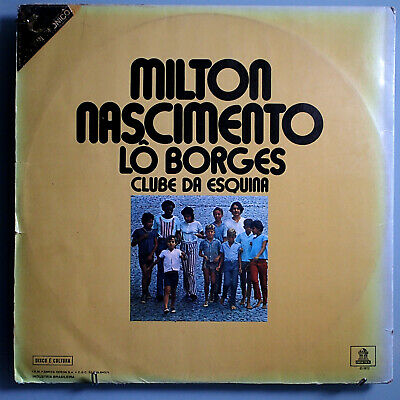
· MILTON NASCIMENTO – CLUBE DA ESQUINA – IMPOSSIBLY RARE ORIGINAL BRAZILIAN PRESSING - ORIGINAL 1972 ODEON (BRAZIL) STEREO 2-LP SET (DOUBLE ALBUM) SMOAB 6005/6
· ORIGINAL BRAZILIAN PRESSING
· ORIGINAL WHITE ODEON (BRAZIL) LABELS WITH BLUE RIM AND BLUE STAR LOGO
· This is A BRUTALLY rare ORIGINAL Brazilian pressing of what many consider the greatest recording in the history of Brazilian music.
· THE ALBUM COMES WITH THE ORIGINAL 4-PAGE LYRICS INSERT/BROCHURE
· THIS IS THE ORIGINAL, AUTHENTIC, FIRST BRAZILIAN PRESSING; THIS IS NOT A REISSUE OR A COUNTERFEIT PRESSING.
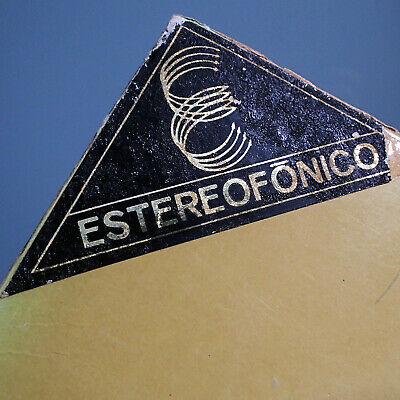
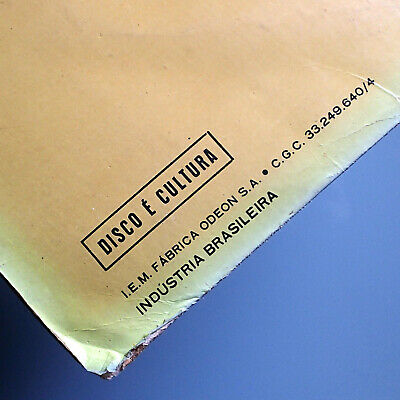
· ORIGINAL GATEFOLD COVER (MONO COVER WITH STEREO STICKER AFFIXED TO THE BACK PANEL; WE DOUBT THAT THE 'PROPER' STEREO COVERS WERE EVER MADE FOR THIS TITLE)
· ORIGINAL, THIN CARDBOARD COVER (EUROPEAN STYLE)
· ORIGINAL LAMINATED COVER
· CLEAN, WEAR-FREE LABELS (A FEW MINOR YELLOWISH MOLD SPOTS NOTED ON ALL LABELS)
· MACHINE-STAMPED MATRIX NUMBER IN TRAIL-OFF VINYL (DEAD WAX) OF THE RECORD
· THICK, HEAVY VINYL PRESSING
(►PLEASE SEE THE IMAGE OF THE COVER, LABEL OR BOTH, SHOWN BELOW)
(Note: this is a REAL image of the ACTUAL item you are bidding on. This is NOT a "recycled" image from our previous auction. What you see is what you’ll get. GUARANTEED!)
♫♪♫♪♫♪♫♪♫♪♫♪♫♪♫♪♫♪♫♪♫
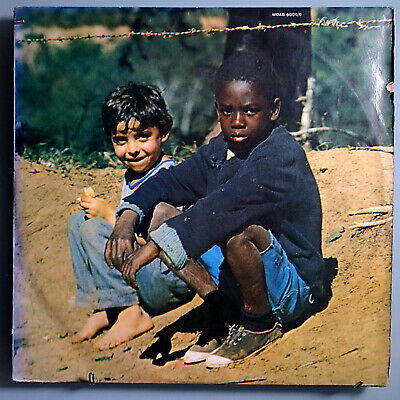
If you grew up in the rural area of Rio Grande de Cima back then, you probably knew the two boys as Tonho and Cacau. Whether they were playing football or marbles, swimming in the river or in one of the nearby waterfalls, they were inseparable. One afternoon, Tonho and Cacau were playing on a dirt hill when photographer Carlos da Silva Assunção Filho (better known as Cafi) drove past in a Volkswagen Bug. He braked, shouted to the boys and as the dust settled, snapped their picture. “It was like lightning,” recalls Cafi. “It’s a strong image. The face of Brazil. And it was at the time when several artists were in exile.”
Cafi didn’t catch either boys’ name that day, but when he later showed the photo to Brazilian musicians Milton Nascimento and Lô Borges, the two knew they had their record cover for their 1972 double album, Clube Da Esquina. And for many years after the fact, people thought the photo was in fact Nascimento and Borges as young boys. For the next 40 years, the boys on the album cover were a mystery throughout Brazil, one requiring a manhunt of sorts to try and track the boys down. “Someone in the car shouted at me and I smiled,” Tonho recalled some 40 years later, as a reporter and photographer had finally tracked him and his childhood friend down, even recreating the iconic photo. “I was eating a piece of bread that someone had given me, because I was starving. And I was barefoot. But I never knew I was on the cover of a record. My mother will be thrilled. We never had a photo of me as a boy.”
While deep in the morass of a brutally repressive military regime, 1972 was a watershed moment for Brazilian pop music, or as it’s often called, MPB: Novos Baianos’ Acabou Chorare, Paulinho da Viola’s A Dança Da Solidão, the duo album from Nelson Angelo E Joyce, not to mention self-titled albums from Tim Maia, Jards Macalé, Tom Zé, and Elis Regina. And after years in exile, Tropicália heroes Gilberto Gil and Caetano Veloso returned home with career highlights in Expresso 2222 and Transa, respectively. Yet looming over them all is Clube Da Esquina, one of the most ambitious records in Brazilian music history, a double album that not only belongs in the same discussion with others in the Western canon—be it Blonde on Blonde or Exile on Main Street—but one that is even more uplifting and mystifying.
A landmark of Brazilian pop, the success of the album confirmed Nascimento as a star of MPB but also launched the careers of Clube bassist Beto Guedes, guitarists Toninho Horta, Nelson Angelo and the younger Borges. And while Nascimento was by far the most prominent member of the club, his name isn’t on the cover and he shared credit with the then-20-year-old Lô Borges, who sings lead on six of the songs. Nor is Nascimento’s face easily seen; you have to hunt through the 150 photos in the gatefold to find a small photo of him. As MPB scholar Charles Perrone wrote: “Because of his extraordinary individual musical talents…the collective aspect of Nascimento’s repertory are often overlooked. Clube Da Esquina emphasizes the notion of encounter and the importance of gathering.”
The magic of Clube Da Esquina is that while one can discern all of Nascimento and friends’ influences, their alchemy elevates it all to vibrate at a higher frequency. Casual and inspired, studied and spontaneous, the album is Pet Sounds, Innervisions and The White Album all rolled into one and it remains beloved even for those who know just a few Brazilian albums. And even for those who don’t speak or understand a lick of Portuguese, the vocal harmonies, hooks, and orchestrations slip the confines of language and strike at the heart.
So while you may not glean the lyrics of “Cais,” with its imagery of the sea, pier, and Nascimento’s plea for happiness, when the haunting ballad drops away at the 1:35 mark after singing about “launching myself,” a minor chord and his wordless harmonizing nevertheless conveys the bittersweet thrill of leaving the shore and drifting towards the unknown. You don’t need to translate the lyrics on “O Trem Azul” to feel the line about “the sun on your head,” so warm, languid, and tangible is its chorus. Same goes for the sensuous and ecstatic “Cravo E Canela,” which blends together sensations of caco honey and gypsy rain.
The album is full of such shifts, moments that act like a refreshing breeze across the skin on a sweltering day, a shaft of sun piercing the clouds, a kind gesture on a crowded bus, reflecting how in our own daily lives the smallest of movements can trigger a reverberation within. In the lyrics, in the subtle switching of a meter, a key shift or a pivot in instrumentation, each song sets you down in a space far different from where you began. That sense of movement is intentional, as trains, roads, and modes of transportation often figure into Nascimento’s writing, and he himself considered his music “a kind of oxcart, something that unrolls and develops.” There’s the burred guitar build-up at the end of the otherwise hushed “Dos Cruces,” the clamor of church bells that punctuate and illuminate “San Vicente,” the mournful cello and strings in the middle section of “Um Girassol Da Cor De Seu Cabelo” that launches into a redemptive chorus about “a sunflower the color of your hair.”
On the spare piano ballad “Um Gosto de Sol,” Nascimento moves through a half-forgotten dream, a stranger smiling in a foreign city, a river that falls to sleep, the sweet flesh of a pear, all of it tactile yet also ineffable. And then the minor key motif from “Cais” return, this time as a string quartet rather than piano and voice. It’s a surreal moment on the album, one worthy of Luis Buñuel, that image of the boat drifting from the pier now juxtaposed with a pear in a fruit bowl, the most poignant string section this side of “Eleanor Rigby” now reveals an underlying melancholy and sense of estrangement to the surface.
Yet one of the album’s brightest, breeziest tunes led to Brazil’s federal censors originally blocking the recording of the song, an instance of a disconnect between the music and words. “Paisagem Da Janela” [Landscape From the Window] is clopping, country-tinged soft rock with a chiming guitar line, but Lô Borges’s refrain belies such lightness: “When I would speak of those morbid things/When I would speak of those sordid men/When I would speak of this storm/You didn’t listen/You don’t want to believe/But that’s so normal.” It speaks of a past that could also be a commentary on that moment under the rule of the junta. It’s also one of the album’s catchiest choruses, a natural for a sing-along.
A military dictatorship trying to suppress such a song reveals that beyond the perfect pop songcraft and immaculate arrangements, Clube Da Esquina also signified the subtlest and most profound of revolutionary acts. “The military dictatorship imposed an element of urgency,” journalist Paulo Thiago de Mello wrote about the repressive political climate that surrounded Esquina. “And this is something that those who did not live those days may have difficulty understanding. The suffocation provoked by the dictatorship made life urgent.” Under such tyranny, the idyllic possibilities of youth are crushed. Be it Stalinist Soviet Union, the Khmer Rouge in Cambodia, or under the brutal military dictatorships that sprang up throughout the Southern Hemisphere in the ’60s and ’70s, social bonds are not just strained and severed, but also called into question. It’s no coincidence then that Nascimento references the Mexican Revolution hero Emiliano Zapata in the first minute of the album.
“Totalitarian government, like all tyrannies, certainly could not exist without destroying the public realm of life…by isolating men,” wrote Hannah Arendt in her 1951 classic The Origins of Totalitarianism. “But totalitarian domination as a form of government is new in that it is not content with this isolation…It bases itself on loneliness, on the experience of not belonging to the world at all.” In hanging and playing together, Milton Nascimento and his friends provided a beacon in the midst of their country’s “vazio cultural” (or cultural void).
Clube Da Esquina, the album itself and the subsequent movement, emphasized casual social encounters and the importance of getting together and playing, and as a result, it elevated not just Nascimento, but the entire collective. That spirit of collaboration continued for Nascimento well after, be it with saxophonist Wayne Shorter on the 1974 album Native Dancer that reintroduced him to a North American audience or his subsequent collaborations with everyone from Duran Duran to Pat Metheny to Quincy Jones.
Such a sense of camaraderie and community can be heard in the brief, joyous minute and a half of “Saídas E Bandeiras Nº 2,” with Nascimento’s falsetto and the guitars arcing to their uppermost registers and towards a not yet possible but still imaginable future: “To walk down avenues facing up to what’s over our heads/To join all forces, to overcome that tide/What was stone becomes a man/And man is more solid than the tide.” In playing on the corner together, Nascimento and his friends—and even Tonho and Cacau sitting on a patch of dirt—all of them became the face of Brazil.
♫♪♫♪♫♪♫♪♫♪♫♪♫♪♫♪♫♪♫♪♫
· CONDITION:
· RECORD
(IMPORTANT NOTE: unless otherwise noted, ALL records are graded visually, and NOT play-graded!; we grade records under the strong, diffuse room light or discrete sunlight)
(a) WE GRADE THE VINYL AS EXCELLENT. This is one of those albums that are somewhat difficult to grade. It is somewhere between VG++ and NEAR MINT, just a notch below NEAR MINT. A few light abrasions ARE visible, but they are extremely shallow, superficial and only moderately visually distracting (nothing significant).For the most part, the vinyl looks impeccable without any MAJOR visual flaws or imperfections. Much of the original luster is intact, and the vinyl shines and sparkles almost like new.
(b) The record is pressed on a beautiful, thick, inflexible vinyl, which was usually used for the first or very early pressings. Usually, the sound on such thick vinyl pressings is full-bodied, vivid, and even dramatic. Do not expect to obtain such a majestic analog sound from a digital recording!
(c) The album comes with the original 4-page insert/brochure.
(d) The records come in hi-grade MFSL PVC inner sleeves
(e) Of course, this is a full-bodied ANALOG recording, and not an inferior, digital recording!!!
· COVER (THIS IS THE ORIGINAL, LAMINATED, GLOSSY COVER):
THE COVER IS ABOUT VERY GOOD+ (VG+)
The following flaws or imperfections are noted on the cover:
- Cover has some fraying/wear along the opening side (a tiny piece of chipboard base is missing on the front leg of the cover; two small tears noted on the back panel
- Cover has some visible fraying/tattering on all three seams
- Minor discoloration (color fading) noted on the spine
- Cover has all four corners slightly worn / dinged (just a beginning of the split seams in every corner)
- Cover has a slight "curly" (wavy) warp across the front panel; this has absolutely no effect on the records
- Cover has a few tiny wrinkles along the seams
- Cover has JUST A HINT of ring wear (nothing significant); On the scale from 1 to 10 (1 being the least, and 10 being the most severe), we assess the severity of ring wear as 2.
- Back cover has circular tarnish (grayish, dust-covered sections, which closely follow the contour of the record), probably caused by friction or by rubbing against other covers during the storage. The tarnish is similar in appearance to a common ring wear, but, UNLIKE ring wear, these grayish areas may be possible to clean up with a minor effort and with a right cleansing solution.
NO OTHER VISIBLE FLAWS OR IMPERFECTIONS ON THE COVER
♫♪♫♪♫♪♫♪♫♪♫♪♫♪♫♪♫♪♫♪♫
POSTAGE & SHIPPING:
We offer THREE postage rates for both Domestic and International Mail: Media Mail, Priority Mail and Express Mail for domestic, and First Class, Priority International Mail, and Express International Mail for international orders. INTERNATIONAL CUSTOMERS PLEASE NOTE: WE RECOMMEND (BUT DO NOT INSIST) that you select USPS International Priority Mail OR International Express mail when making a payment.
INTERNATIONAL POSTAGE rates vary from one region of the world to another. For SPECIFIC international and domestic postage rates ►click here. While you can be rest assured that our packaging is careful, sturdy and impact-proof, please note that damage, loss or theft in transit is always possible, and in the case of some countries even PROBABLE. To discuss this potential problem and ensure flawless delivery, please contact us thru eBay BEFORE placing a bid.
WANT A DISCOUNT ?!?
IT’S EASY: CLICK ►HERE TO see HOW!
(please note recent changes in our policy)
♫♪♫♪♫♪♫♪♫♪♫♪♫♪♫♪♫♪♫♪♫
FOR OTHER IMPORTANT INFORMATION, CLICK ON THE LINKS BELOW:
►OUR VOLUME DISCOUNTS AND POSTAGE REBATES ►OUR GRADING POLICY ►ITEMS WE DO NOT GRADE ►HOW TO ACKNOWLEDGE WINNING BID OR RESOLVE A DISPUTE ►OUR PAYPAL “CHARGEBACK” POLICY ►ACCEPTABLE PAYMENT METHODS ►OUR REFUND POLICY ►POSTAGE RATES AND DISCLOSURES ►PAYMENT DEADLINES ►FREQUENTLY ASKED QUESTIONS (FAQ)
♫♪♫♪♫♪♫♪♫♪♫♪♫♪♫♪♫♪♫♪♫
OUR REFUND POLICY :
WE OFFER UNCONDITIONAL MONEY-BACK GUARANTEE WITHIN 30 DAYS FROM THE RECEIPT OF THE MERCHANDISE, NO QUESTIONS ASKED; Still sealed items MUST be returned sealed in order to be eligible for a refund Some restrictions apply. Please read our complete refund policy before placing a bid. ►Click here for the full text of our policy
FINE (BUT IMPORTANT!) PRINT
(1) The year indicated in the title bar is the year of the original release, NOT necessarily the year of the actual pressing; for the actual generation of the pressing, please see our item description (top section, text in red letters). (2) Please do NOT bid based on the title bar, subtitle bar or item specifics box alone; instead, please read the entire description and grading before bidding; (3) Absolutely NO order cancellations after the auction closes. ever, under any circumstances. We can ONLY cancel bids before the item closes. (4) We are unable to cancel bids in the final 12 hours of the auction; if you need to do so, please contact eBay for help (5) We are unable to provide matrix-, stamper- or other pressing information in the final 24 hours of the auction. If you require this information, please contact us well before the final day of the auction. (6) Yes, we DO combine shipments. Please click on "Shipping and Payment" tab on top of the auction page for additional details. (7) All Paypal payments must be made from confirmed Paypal shipping addresses. NO third party shipping addresses will be honored (8) Absolutely NO partial refunds: if you are unhappy with the merchandise you received, please return it for a full refund, postage included (9). Civilized people can disagree without accusing each other of being indecent or dishonest; if you need proof of this seller's personal integrity, please check our eBay feedback, which speaks for itself (10) All disagreements and miscommunications can be - and will only be - solved in a civil and mutually respectful manner; please avoid puerile, offensive, abrasive or menacing language (attempted humor is fine and usually appreciated, although overused-to-death sarcasms can be really, really tedious. (11) This seller will accommodate all reasonable requests and is generally a flexible and agreeable person (12) Our love & appreciation for your trust, loyalty and business, always and forever; Thank You & Good Night!
© 2001,2007 MDJ. All rights reserved.
price rating