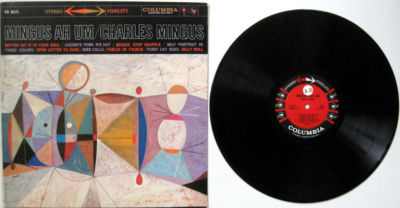
Mingus Ah UM/ Charles Mingus Columbia 6 Eye CS 8171
$
70


Favourite Auctions
To save auctions to your favourites, please login
If you don't have an account, please register
Description
Album Cover Very Good no Splits slight crease lower left hand corner about half inch in length Record Excellent +++++ to Near Mint. Side one label has half inch dot numbered A33 as record was in Rolodex for over 30 years
Charles Mingus Jr. (April 22, 1922 – January 5, 1979) was an American jazz musician, composer, bandleader, and civil rights activist.
Mingus's compositions retained the hot and soulful feel of hard bop and drew heavily from black gospel music while sometimes drawing on elements of Third stream, free jazz, and classical music. Yet Mingus avoided categorization, forging his own brand of music that fused tradition with unique and unexplored realms of jazz.
Mingus focused on collective improvisation, similar to the old New Orleans jazz parades, paying particular attention to how each band member interacted with the group as a whole. In creating his bands, Mingus looked not only at the skills of the available musicians, but also their personalities. Many musicians passed through his bands and later went on to impressive careers. He recruited talented and sometimes little-known artists whom he assembled into unconventional and revealing configurations. As a performer, Mingus was a pioneer in double bass technique, widely recognized as one of the instrument's most proficient players.
Nearly as well known as his ambitious music was Mingus' often fearsome temperament, which earned him the nickname "The Angry Man of Jazz." His refusal to compromise his musical integrity led to many on-stage eruptions, exhortations to musicians, and dismissals.[1]
Because of his brilliant writing for mid-size ensembles—and his catering to and emphasizing the strengths of the musicians in his groups—Mingus is often considered the heir of Duke Ellington, for whom he expressed great admiration. Indeed, Dizzy Gillespie had once claimed Mingus reminded him "of a young Duke", citing their shared "organizational genius."[2]
Mingus' music was once believed to be too difficult to play without Mingus' leadership, and Gunther Schuller has suggested that Mingus should be ranked among the most important American composers, jazz or otherwise.[3] However, many musicians play Mingus compositions today, from those who play with the repertory bands Mingus Big Band, Mingus Dynasty, and Mingus Orchestra, to the high school students who play the charts and compete in the Charles Mingus High School Competition.[4]
In 1988, a grant from the National Endowment for the Arts[5] made possible the cataloging of Mingus compositions, which were then donated to the Music Division of the New York Public Library[6] for public use. In 1993, The Library of Congress acquired Mingus's collected papers—including scores, sound recordings, correspondence and photos—in what they described as "the most important acquisition of a manuscript collection relating to jazz in the Library's history".[7]
price rating


![JAPAN ORIGINAL w) OBI SUPERB BLACK SABBATH [ Never Say Die ]](https://www.popsike.org/php/thumbnail.php?url=https://www.popsike.pics/pix/20141210/301433520959.jpg)


