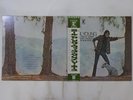
NEIL YOUNG WITH CRAZY HORSE Everybody Knows This Is Nowhere NM 1969 Reprise
$
53


Favourite Auctions
To save auctions to your favourites, please login
If you don't have an account, please register
Description
Vinyl: MINTY! TOP COPY! Appears to have never been played! Reprise Labels are Clean and Bright. This is the audiophile acclaimed Los Angeles Pressing of the 1969 Reprise Release! MSK 2282. This is the Beginning of Neil Young's Signature Sound...he has drifted from time to time, but if you want to know where Neil's head is at, start here...allmusic gives it 5 stars!
See Review Below!
In The Dead Wax: Matrices, etched. Also has the * glyph for Capitol's Los Angeles, CA Pressing Plant. Complete Dead Wax information cheerfully provided upon request.
Cover: NM- (see photos) Gatefold. Front, gatefold and back of cover artwork and text are rich, clear and bright, with just a trace of ring wear on the back cover. Seams, corners and spine are solid and clean, essentially flawless. No splits. No writing. Spine print is crystal clear.
Goldmine Standards.
U.S. Shipping: $4.99 Media Mail. Tracking included. 50 cents additional shipping per additional item, when the shipment is combined. If you wish to take advantage of my COMBINED SHIPPING deal, simply select your items by clicking on "ADD TO CART" on the main listing page. Do this for all of your selections and then go to your cart to checkout. Your combined shipping discount will be computed automatically. Free domestic shipping if you spend $100 or more!
All records are packaged securely with the vinyl outside the jacket (to avoid seam split in transit). The vinyl and jacket are sandwiched between two cardboard stiffeners and shipped in a custom cardboard record mailer box.
INTERNATIONAL BUYERS! EBAY'S PLATFORM DOESN'T ACCOMMODATE FOR COMBINED SHIPPING FOR INTERNATIONAL BUYERS---BUT DON'T LET THAT STOP YOU!!!---I CAN COMBINE SHIP FOR YOU AND MINIMIZE SHIPPING COSTS!!! TELL ME WHICH ITEMS YOU WANT TO BUY, AND I WILL WEIGH THEM AND THE SHIPPING BOX TOGETHER AND THEN I WILL CREATE A "LOT OF 2..." OR "LOT OF 3...", OR "LOT OF 4...", ETC WITH THE ITEMS YOU WANT, AND CREATE A LISTING WITH THE EXACT WEIGHT OF YOUR LOT. THIS WILL SAVE YOU A LOT OF MONEY!!! IF YOU'RE INTERESTED IN THIS, SEND ME A MESSAGE TELLING ME WHICH ITEMS YOU WOULD LIKE TO PURCHASE AND WE'LL GO FROM THERE. OR, FEEL FREE TO ASK QUESTIONS.
I ship internationally through EBay's Global Shipping Program. Check to be sure that they ship to your country. Feel free to ask any questions and happy shopping!
Once you're satisfied with your purchase, please leave positive feedback and I will do the same for you. If you're unsatisfied, please let me know so we can resolve it. I do not give partial refunds. Take a look at my previous feedback and buy with confidence. I've qualified for the "Top Rated Plus" seal from eBay, awarded to the most reputable sellers who consistently deliver outstanding customer service. Check my other items this week, check back often & CLICK ON "SAVE THIS SELLER" at the top of my listings page to be notified of New Listings as I will be adding more Rare items in the coming weeks! Thanks!!
Why buy a first or early pressing and not a re-issue or a ‘re-mastered’ vinyl album?
First and early pressings are pressed from the first generation lacquers and stampers. They usually sound vastly superior to later issues/re-issues (which, in recent times, are often pressed from whatever 'best' tapes or digital sources are currently available) - many so-called 'audiophile' new 180g pressings are cut from hi-res digital sources…essentially an expensive CD pressed on vinyl. Why experience the worse elements of both formats? These are just High Maintenance CDs, with mid-ranges so cloaked with a veil as to sound smeared. They are nearly always compressed with murky transients and a general lifelessness in the overall sound. There are exceptions where re-masters/re-presses outshine the original issues, but they are exceptions and not the norm. First or early pressings nearly always have more immediacy, presence and dynamics. The sound staging is wider. Subtle instrument nuances are better placed with more spacious textures. Balances are firmer in the bottom end with a far-tighter bass. Upper-mid ranges shine without harshness, and the overall depth is more immersive. Inner details are clearer. On first and early pressings, the music tends to sound more ‘alive’ and vibrant. The physics of sound energy is hard to clarify and write about from a listening perspective, but the best we can describe it is to say that you can 'hear' what the mixing and mastering engineers wanted you to hear when they first recorded the music.
AllMusic Review by William Ruhlmann [-]
Neil Young's second solo album, released only four months after his first, was nearly a total rejection of that polished effort. Though a couple of songs, "Round Round (It Won't Be Long)" and "The Losing End (When You're On)," shared that album's country-folk style, they were altogether livelier and more assured. The difference was that, while Neil Young was a solo effort, Everybody Knows This Is Nowhere marked the beginning of Young's recording association with Crazy Horse, the trio of Danny Whitten (guitar), Ralph Molina (drums), and Billy Talbot (bass) that Young had drawn from the struggling local Los Angeles group the Rockets. With them, Young quickly cut a set of loose, guitar-heavy rock songs -- "Cinnamon Girl," "Down by the River," and "Cowgirl in the Sand" -- that redefined him as a rock & roll artist. The songs were deliberately underwritten and sketchy as compositions, their lyrics more suggestive than complete, but that made them useful as frames on which to hang the extended improvisations ("River" and "Cowgirl" were each in the nine-to-ten-minute range) Youngplayed with Crazy Horse and to reflect the ominous tone of his singing. Young lowered his voice from the near-falsetto employed on his debut to a more expressive range, and he sang with greater confidence, accompanied by Whitten and, on "Round Round," by Robin Lane. Everybody Knows This Is Nowhere was breathtakingly different when it appeared in May 1969, both for Young and for rock in general, and it reversed his commercial fortunes, becoming a moderate hit. (Young's joining Crosby, Stills & Nash the month after its release didn't hurt his profile, of course.) A year and a half after its release, it became a gold album, and it has since gone platinum. And it set a musical pattern Young and his many musical descendants have followed ever since; almost 30 years later, he was still playing this sort of music with Crazy Horse, and a lot of contemporary bands were playing music clearly influenced by it.
price rating