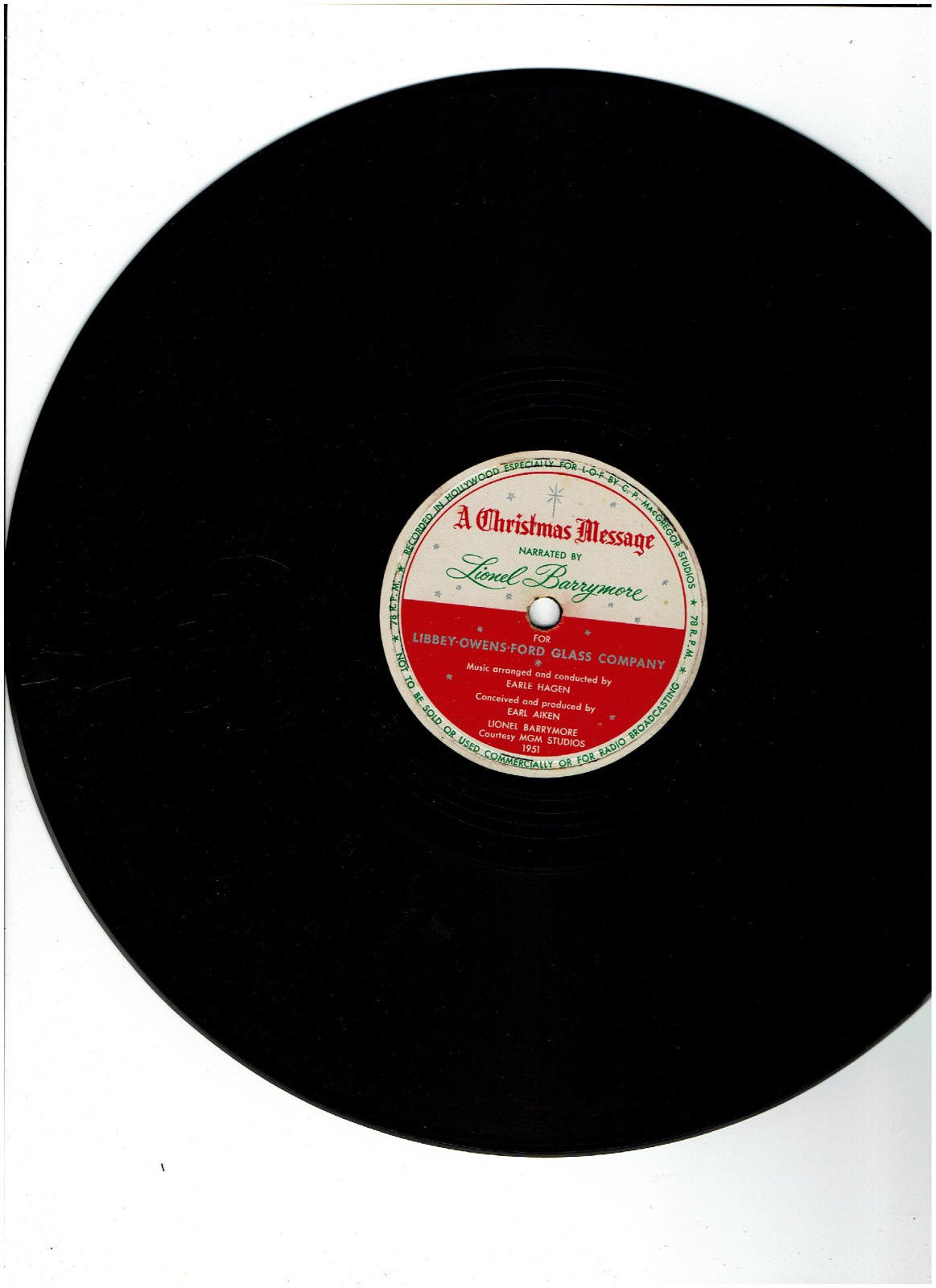
Odd/Rare LIBBY -OWENS -FORD GLASS COMPANY 78 RPM Record 1951 A Christmas Message
$
21


Favourite Auctions
To save auctions to your favourites, please login
If you don't have an account, please register
Description
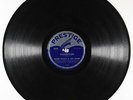
Odd/Rare LIBBY -OWENS -FORD GLASS COMPANY 78 RPM Record 1951 “A Christmas Message”/” A Christmas Message” narrated by Lionel Barrymore E-Visible Condition, a few scuffs and light scratches on both sides. Play is very good, the scuffs and light scratches do make a quite noticeable pop sound on one of the sides. I did not listen to the whole record but it appears that both sides are the same as narrated by Lionel Barrymore. I do not know the year that this was made but Mr. Barrymore talks about freedom a lot and also states that the year has been tragic for some and goes on to a rousing spoken version of the national anthem.
Lionel Barrymore (born Lionel Herbert Blythe; April 28, 1878 – November 15, 1954) was an American actor of stage, screen and radio as well as a film director. He won an Academy Award for Best Actor for his performance in A Free Soul (1931), and remains best known to modern audiences for the role of the villainous Mr. Potter character in Frank Capra's 1946 film It's a Wonderful Life. He is also particularly remembered as Ebenezer Scrooge in annual broadcasts of A Christmas Carol during his last two decades. He is also known for playing Dr. Leonard Gillespie in MGM's nine Dr. Kildare films, a role he reprised in a further six films focusing solely on Gillespie and in a radio series entitled The Story of Dr. Kildare. He was a member of the theatrical Barrymore family.
Lionel Barrymore was born Lionel Herbert Blythe in Philadelphia, the son of actors Georgiana Drew Barrymore and Maurice Barrymore (born Herbert Arthur Chamberlayne Blythe). He was the elder brother of Ethel and John Barrymore, the uncle of John Drew Barrymore and Diana Barrymore and the great-uncle of Drew Barrymore, among other members of the Barrymore family. He attended private schools as a child, including the Art Students League of New York. While raised a Roman Catholic, Barrymore attended the Episcopal Academy in Philadelphia. Barrymore graduated from Seton Hall Preparatory School, the Roman Catholic college prep school, in the class of 1891.
He was married twice, to actresses Doris Rankin and Irene Fenwick, a one-time lover of his brother, John. Doris's sister Gladys was married to Lionel's uncle Sidney Drew, which made Gladys both his aunt and sister-in-law. Doris Rankin bore Lionel two daughters, Ethel Barrymore II (1908 – 1910) and Mary Barrymore (1916 – 1917).Neither child survived infancy. Barrymore never truly recovered from the deaths of his girls, and their loss undoubtedly strained his marriage to Doris Rankin, which ended in 1923. Years later, Barrymore developed a fatherly affection for Jean Harlow, who was born about the same time as his daughters. When Harlow died in 1937, Barrymore and Clark Gable mourned her as though she had been family.
Reluctant to follow his parents' career, Barrymore appeared together with his formidable grandmother Louisa Lane Drew on tour and in a stage production of The Rivals at the age of 15. He later recounted that "I didn't want to act. I wanted to paint or draw. The theater was not in my blood, I was related to the theater by marriage only; it was merely a kind of in-law of mine I had to live with." Nevertheless, he soon found success on stage in character roles and continued to act, although he still wanted to become a painter and also to compose music. He appeared on Broadway in his early twenties with his uncle John Drew Jr. in such plays as The Second in Command (1901) and The Mummy and the Hummingbird (1902), the latter of which won him critical acclaim. Both were produced by Charles Frohman, who produced other plays for Barrymore and his siblings, John and Ethel.[citation needed] The Other Girl in 1903–04 was a long-running success for Barrymore. In 1905, he appeared with John and Ethel in a pantomime, starring as the title character in Pantaloon and playing another character in the other half of the bill, Alice Sit-by-the-Fire.
In 1906, after a series of disappointing appearances in plays, Barrymore and his first wife, the actress Doris Rankin, left their stage careers and travelled to Paris, where he trained as an artist. Lionel and Doris were in Paris in 1908 where their first baby, Ethel, was born. Lionel confirms in his autobiography, We Barrymore’s that he and Doris were in France when Bleriot flew the English Channel on July 25, 1909. He did not achieve success as a painter, and in 1909 he returned to the US. In December of that year, he returned to the stage in The Fires of Fate, in Chicago, but left the production later that month after suffering an attack of nerves about the forthcoming New York opening. The producers gave appendicitis as the reason for his sudden departure. Nevertheless, he was soon back on Broadway in The Jail Bird in 1910 and continued his stage career with several more plays. He also joined his family troupe, from 1910, in their vaudeville act, where he was happy not to worry as much about memorizing lines.
From 1912 to 1917, Barrymore was away from the stage again while he established his film career, but after the First World War, he had several successes on Broadway, where he established his reputation as a dramatic and character actor, often performing together with his wife. He returned to the stage in Peter Ibbetson (1917) with his brother John and achieved star billing in The Copperhead (1918) (with Doris). He retained star billing for the next 6 years in plays such as The Jest (1919) (again with John) and The Letter of the Law (1920). Lionel gave a short-lived performance as MacBeth in 1921 opposite veteran actress Julia Arthur as Lady MacBeth, but the production encountered strongly negative criticism. His last stage success was in Laugh, Clown, Laugh, in 1923, with his second wife, Irene Fenwick; they met while acting together in The Claw the previous year, and after they fell in love he divorced his first wife. He also received negative notices in three productions in a row in 1925. After appearing in Man or Devil in 1926, he signed a film contract with MGM and after the advent of sound films in 1927, he never again appeared on stage.
Barrymore joined Biograph Studios in 1909 and began to appear in leading roles by 1911 in films directed by D.W. Griffith. Barrymore made The Battle (1911), The New York Hat (1912), Friends and Three Friends (1913). In 1915 he co-starred with Lillian Russell in a movie called Wildfire, one of the legendary Russell's few film appearances. He also was involved in writing and directing at Biograph. The last silent film he directed, Life's Whirlpool (Metro Pictures 1917), starred his sister, Ethel. He acted in more than 60 silent films with Griffth.
In 1920, Barrymore reprised his stage role in the film adaptation of The Copperhead.[2] Before the formation of Metro-Goldwyn-Mayer in 1924, Barrymore forged a good relationship with Louis B. Mayer early on at Metro Pictures. He made several silent features for Metro, some surviving, some now lost. In 1923, Barrymore and Fenwick went to Italy to film The Eternal City for Metro Pictures in Rome, combining work with their honeymoon. He occasionally freelanced, returning to Griffith in 1924 to film America. In 1924, he also went to Germany to star in British producer-director Herbert Wilcox's Anglo-German co-production Decameron Nights, filmed at UFA's Babelsberg studios outside of Berlin. In 1925, he left New York for Hollywood. He starred as Frederick Harmon in director Henri Diamant-Berger's drama Fifty-Fifty (1925) opposite Hope Hampton and Louise Glaum, and made several more freelance motion pictures, including The Bells (Chadwick Pictures 1926) with a then-unknown Boris Karloff. His last film for Griffith was in 1928's Drums of Love.[citation needed]
With second wife Irene Fenwick, 1923
Prior to his marriage to Irene, Barrymore and his brother John engaged in a dispute over the issue of Irene's chastity in the wake of her having been one of John's lovers. The brothers didn't speak again for two years and weren't seen together until the premiere of John's film Don Juan in 1926, by which time they had patched up their differences. In 1926, Barrymore signed for Metro-Goldwyn-Mayer and his first picture there was The Barrier. His first talking picture was The Lion and the Mouse; his stage experience allowed him to excel in delivering the dialogue in sound films.
On the occasional loan-out, Barrymore had a big success with Gloria Swanson in 1928's Sadie Thompson and the aforementioned Griffith film, Drums of Love. In 1929, he returned to directing films. During this early and imperfect sound film period, he directed the controversial His Glorious Night with John Gilbert, Madame X starring Ruth Chatterton, and The Rogue Song, Laurel & Hardy's first color film. He was credited with being the first director to move a microphone on a sound stage. Barrymore returned to acting in front of the camera in 1931. In that year, he won an Academy Award for his role as an alcoholic lawyer in A Free Soul (1931), after being considered in 1930 for Best Director for Madame X. He could play many characters, like the evil Rasputin in the 1932 Rasputin and the Empress (in which he co-starred for the only time with siblings John and Ethel)[1] and the ailing Oliver Jordan in Dinner at Eight (1933 – also with John, although they had no scenes together). He played Professor Zelen, the Occultist expert, in the classic horror ??Mark of the Vampire? (1935).
During the 1930s and 1940s, he became stereotyped as a grouchy but sweet elderly man in such films as The Mysterious Island (1929), Grand Hotel (1932, with John Barrymore), Captains Courageous (1937), You Can't Take It with You (1938), On Borrowed Time (1939, with Cedric Hardwicke), Duel in the Sun (1946), Three Wise Fools (1946) and Key Largo (1948).
Barrymore in David Copperfield trailer, 1935
In a series of Doctor Kildare movies in the 1930s and 1940s, he played the irascible Doctor Gillespie, a role he repeated in an MGM radio series that debuted in New York in 1950 and was later syndicated. Barrymore had broken his hip in an accident, hence he played Gillespie in a wheelchair. Later, his worsening arthritis kept him in the chair. The injury also precluded his playing Ebenezer Scrooge in the 1938 MGM film version of A Christmas Carol, a role Barrymore played every year but two (replaced by brother John Barrymore in 1936 and replaced by Orson Welles in 1938) on the radio from 1934 through 1953. He also played the title role in the 1940s radio series, Mayor of the Town.
He is well known for his role as Mr. Potter, the miserly and mean-spirited banker in “It's a Wonderful Life” (1946) opposite James Stewart. The role suggested that of the "unreformed" stage of Barrymore's "Scrooge" characterization.
He had a role with Clark Gable in Lone Star in 1952. His final film appearance was a cameo in Main Street to Broadway, an MGM musical comedy released in 1953. His sister Ethel also appeared in the film. He died November 15, 1954. The scratches on the left of every photo are my broken glass on scanner ? not on item. Images of artists etc. are for information only and not included in auction, record & sleeve only.
If possible we gladly combine shipping items to lessen postage. PLEASE don?t use eBay auto pay. I will invoice you for general shipping costs which will be easier and cheaper for you: insurance added for all items $10+ or at your request. We will pack securely ? but are not responsible for shipping company damage if uninsured.
1 record - $4.70 ? Add $1 for each additional record (+ insurance if required). (USA ONLY) (Int?l use eBay calculator and I will adjust to get cheapest rate)
More of all the types of records listed: Odd tunes, Political, Blues, Hot Jazz, Hillbilly, Odd labels, Doo-Wop, etc. More of all the types of records listed: Odd tunes, Political, Blues, Hot Jazz, Hillbilly, Odd labels, Doo-Wop, etc.E++, Visibly nearly new with no visible signs of wear or damage.
E+, Looks and plays like new with only few signs of handling and play.
E Still very shiny, near new looking, with slight visible signs of wear and a few nearly inaudible scuffs and scratches
E- Still shiny but without the luster of a new record, few scuffs that have little or no effect on play, some light scratches.
E- - Mostly shiny but with even less of the luster of an E- record, more scuffs than E-that have little or no effect on play, light scratches with some light noise.
VG+, Slightly above average condition 78 in which scuffs and general use has dulled the finish somewhat. Wear is moderate but playing is generally free from distortion. Surface noise not overly pronounced.
VG, An average condition 78 - moderate wear throughout, but still very playable and enjoyable. Surface somewhat dull with noise and scratches audible but not intrusive.
VG-, Quite playable still, but with some distortion and may have some graying in loud passages. Music remains loud in most passages. Surface noise and scratches well below music level.
VG- - Quite playable still, but with distortion and most have some graying in loud passages. Music remains loud in most passages. Surface noise and scratches noticeable and may be loud at times.
G+ Quite worn and scratched, but music level is still higher than surface noise. Grey may be throughout but still serviceable. Music begins to sound muffled.
G Not so good. Wear and scratch damage extensive. Listening can become uncomfortable as music and surface noise probably blending. Lowest level music can be understood.
G-, Music barely audible over surface noise & listening is uncomfortable. Record is borderline unplayable.
P Used only for high dollar space fillers like Black Patti, Okeh blues, etc. Music covered by surface noise, scratches, and needle digs, label may be trashed, & listening is almost if not definitely impossible. Record is basically unplayable. What you keep because you can?t bear to toss ? while you look for that E+ copy of Robert Johnson on Vocalion at the local flea markets for $1 (Good Luck!)
See Description, A wildcard grade that can be used when standard grading does not apply or when a record (or item) has special attributes (or defects) that can affect how the item is assigned a grade.
price rating