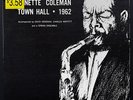
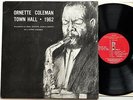
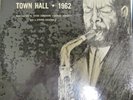
Ornette Coleman 'Town Hall · 1962' ESP-Disk' ESP-1006 A/B Stereo 1965
£
30
$
40


Favourite Auctions
To save auctions to your favourites, please login
If you don't have an account, please register
Description
Ornette Coleman 'Town Hall • 1962' ESP-Disk' ESP-1006 US reissue Stereo Vinyl, LP, with white labels, reissued in 1965.
The vinyl appears to have been lightly played and is in good shape. It played through beautifully on my stereo - no skip or stick. It is housed in its original sleeve, which is still largely wrapped in cellophane, so it too is in good shape no rips or writing. The spine is intact and legible. Matrix / Runout Side A : ESP 1006 A 152 DBH Matrix / Runout Side B : ESP 1006 B 152 DBH
'Town Hall, 1962' is a live album by Ornette Coleman, recorded on December 21, 1962 at New York City's Town Hall and released in 1965 by the ESP-Disk label. It was the first recording of Coleman's new trio, featuring rhythm section David Izenzon and Charles Moffett.
1962 was a difficult year for finding work for Coleman and his trio; that year, after an engagement at the Jazz Gallery, Coleman was dismayed to see Dave Brubeck follow him and earn a significantly higher fee. As a result, Coleman decided to charge more for appearances, leading to repeated rejections by club owners and concert presenters. In response, classically-trained bassist David Izenzon relied on freelance jobs with orchestras and chamber groups, and drummer Charles Moffett, whom Coleman had known since high school, took up a job as a teacher.
At the same time, Coleman—tired of being perceived as a "cornpone musician" (an "illiterate guy who just plays")—began composing classically-oriented works, and, with financial assistance from Irving Stone, rented Town Hall in order to present a full-length concert of his works. In addition to booking the hall and writing all the music, Stone also put up posters advertising the concert, rehearsed the musicians, and hired a recording engineer.
The concert was a success in that several hundred people attended and responded enthusiastically, and the proceeds allowed Coleman to break even. However, it did not receive much attention, leading Coleman to recall: "I'll never forget... that night there was a subway strike, a newspaper strike, a taxi strike, I mean everything was strike, even a match strike, know what I mean? Not only that, I hired a guy to record it for me, and [later] he committed suicide." Following the concert, Coleman did not record or appear publicly for two years. The trio would not record again until 1965, when they produced 'Chappaqua Suite' and 'At the Golden Circle Stockholm'.
The Penguin Guide to Jazz Recordings called "Sadness" one of Coleman's "most plangent and affecting themes... deeply marked by the blues," while "Doughnut" "catches Ornette in his most demonstrative form, punching out notes like a bar-walking R&B man." "The Ark" is described as "a seething troublous piece that refuses to cohere," and "Dedication" "points the way forward to what would be even more troubled projects in the future."
Lyn Horton, writing for All About Jazz, awarded the album 5 stars, commenting, "In the stream of its apparent freedom, this trio acts with constraints, imposed not by restriction, but by genius. To know what later transpired could only underscore the appreciation of what already exists." In a separate review for the same publication, Stuart Broomer also awarded it 5 stars, writing: "This concert is one of the essential Coleman documents, an extension of the raw, angular music he had developed in the early years of his public career... and an increasing sense of fluid group dialogue."
price rating