PAVLOV'S DOG PAMPERED MENIAL ACETATE TEST PROMO LP PROG
$
103


Favourite Auctions
To save auctions to your favourites, please login
If you don't have an account, please register
Description
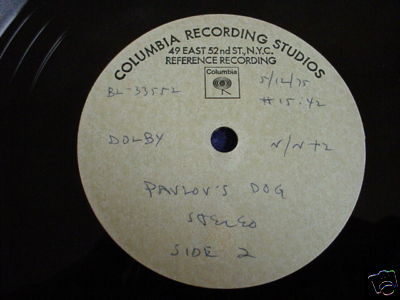
PAVLOV'S DOG - PAMPERED MENIAL AL/BL 33552
THIS IS A MEGA-RARE METAL ACETATE TEST LP FOR THE LP RELEASE FROM 1975.
COMES IN A PLAIN MANILLA SLEEVE. WHICH HAS "AL/BL 33552" "PAVLOV'S DOG" "FOLEY" "COL POP" HAND WRITTEN ON THE SLEEVE.
THIS ACETATE HAS 9 TRACKS ON IT, SO I AM PRETTY SURE IT IS THE COMPLETE ALBUM.
BEING IT IS AN ACETATE I HAVE NOT PLAYED IT, BECASE EVERYTIME YOU PLAY IT IT TAKES AWAY FROM THE QUALITY, DUE TO THE LAQUER BEING COATED OVER THE METAL DISC.
THE LABEL IS WHITE AND IS HANDWRITTEN IN PEN.
THE ACETATE DISC ITSELF IS VG TO VG +, THERE IS A SMALL CHIP AT THE EDGE OF THE DISC THAT WILL NOT AFFECT THE PLAY.
THIS SPECIFIC ACETATE LOOKS TO HAVE ALOT OF LIFE LEFT IN IT, MAYBE IT WAS PLAYED 1 OR 2 TIMES ?
I AM ADDING SOME INFO I HAVE FOUND ON THE INTERNET ABOUT THE BAND, THIS RELEASE, AND ABOUT ACETATE LP'S.
33552 - Pampered Menial (1975). 1. Julia 2. Late November 3. Song Dance 4. Fast Gun 5. Natchez Trace 6. Theme from Subway Sue 7. Episode 8. Preludin 9. Of once and future Kings.
FREE SHIPPING IN THE U.S.A. ONLY !!!
THE FOLLOWING EXCERT IS TAKEN FROM WIKIPEDIA :
Pavlov's Dog is a 1970s progressive rock/AOR band formed in St. Louis in 1972. Pavlov's Dog originally comprised David Surkamp (vocals and guitar), Steve Scorfina (lead guitar), Mike Safron (drums), Rick Stockton (bass guitar), David Hamilton (keyboard), Doug Rayburn (mellotron and flute), and Siegfried Carver (born Richard Nadler) (various string instruments including the rare vitar, a cross between a guitar and a violin). Carver left the band after the first album. On their second album At the Sound of the Bell (1976), Tom Nickeson was added to the line-up on guitar and he took over Hamilton's keyboard position after the album had been recorded as Hamilton left the band. Safron was still a member of the band but did not appear on the second album, former Yes drummer Bill Bruford played as a guest musician. Safron left in the aftermath of this, partially due to his failure to receive a promised credit on the album sleeve and the band's third album featured Kirk Sarkisian on drums.
The band's debut Pampered Menial was briefly released in 1974 on ABC Records but then quickly re-issued by Columbia Records. The result was that both versions appeared in stores at nearly the same time, which may have confused the public. Their second album At the Sound of the Bell followed on Columbia in 1975. The band recorded a third album in 1977, but due to poor sales of the first two albums, Columbia refused to release it, hastening the band's split. The third album finally appeared as a bootleg in the 1980s, a limited edition pressed from stolen master tapes. It was released under the name The St. Louis Hounds, without Pavlov's Dog's name on the sleeve. The third album finally was released legally in 2007 by German label Rockville Music, titled Has Anyone Here Seen Sigfried?, remastered and including additional 10 bonustracks of unreleased material from the 1970s. The German label TRC illegally bootlegged the album titled Third, but this does not include the bonustracks.
In 1990, a reformed version of the band, with only Surkamp and Rayburn from the original line-up along with some contribution from Scorfina, recorded Lost In America for US label Telectro Records, which was re-released worldwide by Rockville Music in 2007, after TRC also having illegally bootlegged it in the late 1990s.
Also in 2007 the solo album Dancing On the Edge of a Teacup by Pavlov`s Dog`s lead singer David Surkamp was released by Rockville Music.
On June 26, 2004, a reunion concert with the original line-up, except for Siegfried Carver, was scheduled to take place in St. Louis, Missouri. The band tours annually in Europe since 2005. Among others they played the Arrow Rock Festival in Holland 2006 in front of 54,000 people, as well as headlining both the Burg Herzberg Festival in 2007 (12,000 people) and the Woodstock Festival in 2008 (5,000 people).
David Surkamp's distinctive voice has been compared to that of Geddy Lee of Rush. When the band split up in the late 1970s, Surkamp was rumoured to be dead, although in fact he was working with former Fairport Convention member Ian Matthews on a band named Hi-Fi. While living in Seattle the group was successful on the club scene and recorded a 5-track live 12" EP in 1981 entitled Hi-Fi Demonstration Record and a studio album in 1983 entitled Moods for Mallards. The two Hi-Fi albums were released on First American Records and were intended for national distribution, but promotion outside the Pacific Northwest was virtually non-existent. The label self-destructed and was later revealed to be losing large amounts of investor money on purpose as part of a tax shelter scheme. So, in the end, Hi-Fi proved to be even more obscure than Pavlov's Dog.
WHAT IS AN "ACETATE"??
TAKEN FROM MADONNACATALOG.COM
An acetate disc is cut prior to the cutting of the master disc which is used for mass production of records. Even though referred to as an "acetate", it is essentially an aluminium disc coated with a fine film of nitro-celluolose lacquer with no acetate in it at all! I can tell you right off the bat that they're nothing special to look at. They do not come in a frame. There is NO picture sleeve, and no special artwork on the record labels. Most acetates are 10" round, but the actual music record grooves are usually 7" in diameter. A 7" single is usually cut on a 10" disc, a 12" single or LP is cut onto a 12" disc. They're almost always single-sided (the other side is totally blank and shiny, with no grooves and no label).
This is used as a reference disc allowing the producer, engineer, artist and other interested parties to see how well the recording transfers to disc. Trying to tranfser some recordings to disc is like trying to fit a square peg into a round hole, and so the cutting engineer must make some adjustments to the sound so that song on the tape fits within the confines of a record groove. This may include adjusting the overall level (volume), adjusting bass/treble, compressing the overall signal, etc so that the record sounds as good as possible when played on a variety of hi-fi systems. For example, if a song is excessively long, the cutting engineer will have to reduce the overall level of the disc. When such changes are necessary, the reference disc (or "acetate") allows the producer to check and approve these changes before the master disc is cut and sent off to the pressing plant where thousands of copies are pressed.
Once everyone is happy with the reference cut, the engineer will cut the MASTER LACQUER disc with the same changes and send it off to the pressing plant for mass production.
The lacquer coating on the disc is very soft and so the sound quality will deteriorate the more you play it. At first, the high frequencies will diminish and an increase of surface noise will be evident. If you thought records scratch and wear out easily, a lacquer disc is worse!
Reference cuts will usually appear as 10" discs with a 7"single cut onto them, or a 12" disc with either a 7" or a 12" cut. Reference discs will often have a second hole near the centre hole. This is to identify them as reference cuts and not master lacquers for production use.
So if you have an "acetate", you have a disc that was theoretically cut for the producer, engineer and artist to listen to. On the other hand, anyone with a disc cutting lathe can cut such a disc and pass it off as a real one".
To make sure that the disc-masterer will make a disc-transfer acceptable to you and you engineer and/or producer, you should request that reference lacquers, or "acetates", be cut before your master lacquers are cut, which would be used for pressing your records. Listen to your reference lacquers with your recording engineer or producer, who can best judge how they compare with your master tape. The lacquers should not be overplayed as they are very fragile and are only good for five or six listenings before noticeable sound deterioration. You will need to save a few plays for the pressing stage, in order to verify the quality of your test pressings. Lacquers should be checked for the following problems before you go to the trouble of making the final cut:
1. Low overall volume compared to other records 2. variations in volume levels within the songs or from cut to cut 3. variations of tempo within each song 4. breaking up or distortion in the treble or high registers at peak loudness levels or towards the end of a side 5. excessive boominess or airiness in the bass or low registers 6. dullness or lack of presence in the mid-range 7. skips, buzzes, crackling noises, or dull thuds at the beginnings of notes.Your engineer and/or producer will probably listen to the reference lacquers on both large and small speakers (like those used in car stereos) to be sure that there is adequate treble and bass response.
Once you've approved the reference lacquers (you don't send them back), the disc-masterer will then cut the master lacquers using settings identical to those used when cutting the reference lacquers. If the engineer has only minor changes to request, he or she probably won't ask for additional reference lacquers."
On many acetates, such as the one in this photo, You'll usually notice yellow (or red) "cue marks" on the record, which basically just look like a crayon line (or arrow) hand-drawn on the acetate, to indicate the beginning and end of the music. There are sometimes two holes in the center of the record (one is perfectly centered, and the other is off-center); the second hole is to let you know that these discs are not designed for use as master lacquers for record manufacturing.
When you physically handle an acetate, you'll notice that it's extremely stiff. Depending on whether the acetate is a "metal" plate or made from some other material, you'll notice that it is not nearly as "flexible" as a standard record. Acetates are not made from a variety of material. They are only made of: aluminum disc with a thin coating of nitro-cellulose lacquer. Most times, you'll even notice that the acetate smells kinda funny, almost like that "moldey, library kinda smell" - this is because they've usually been sitting around for years in storage, or in the record company's archives. The origial mustard-colored paper sleeves are usually what gives the acetates their funny smell.
I guess the best way to explain it would be like this: having an acetate for a song is almost like having the "negatives" for a photo. You can actually play an acetate if you really want to, but they weren't designed to be played on a standard record player, so sometimes they may not sound that great. The reason you cut an acetate refence disc is so that you CAN play it on a standard record player! That's why they were used for reference purposes. If it doesn't sound great it's because it has been played to death and the soft lacquer wears very fast. They sound GREAT when you are the first person to play it. Acetates are extremely rare, and in some cases, are one-of-a-kind.
- SEE PHOTOS FOR MORE DETAILS.
- ANY SHIPPING OUTSIDE THE USA , THAT ALSO INCLUDES CANADA IS ONLY THRU USPS PRIORITY INTERNATIONAL, AT THE COST OF $27.00. I DON'T MAKE THE PRICES OR THE RULES, I JUST FOLLOW AND POST THEM.
ALL SALES ARE FINAL SOLD AS IS, NO REFUNDS, NO RETURNS.