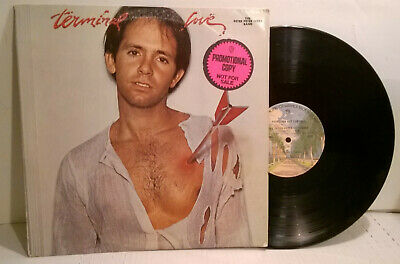
PETER IVERS BAND Terminal Love '74 Warners Eraserhead New Wave Theater READ--
$
50


Favourite Auctions
To save auctions to your favourites, please login
If you don't have an account, please register
Description
PETER IVERS BAND
Terminal Love
Warner Brothers BS 2804 RARE '74 promotional first press.
From an excerpted January 2020 story by Clark Collis for Entertainment Weekly.
Perhaps it is fitting that Ivers' name does not register to most in the mainstream, given how he enjoyed working and living on the fringes — introducing bands such as the Dead Kennedys and Fear on TV while spouting off head-scratching manifesto rhetoric like "Why glow in the dark when you can dance on Superman's grave?" "He was in a kind of world of his own," says Ivers' friend David Lynch. But without Ivers, diverse aspects of pop culture — from Lynch's full-length directorial debut, Eraserhead, to the punk scene to even MTV — might have wound up as different entities. He was the most adventurous and fearless of artists, and while the details of his death remain mysterious, those qualities may have in some way led to his early passing. Or, as Lucy Fisher, his longtime girlfriend and now Hollywood producer puts it, "Peter liked the edge."
For Ivers, sometimes "the edge" meant moving into a dangerous neighborhood, and sometimes it meant getting booed mercilessly by a crowd while opening for one of the biggest bands in the world. That's what happened to the singer in the late summer of 1976 when he supported Fleetwood Mac at Los Angeles' Universal Amphitheatre. "Oh God, the night from hell," says Fisher with a shudder. Fisher's recollection of that evening is that Ivers came out in a diaper and was then heckled. "The audience was not prepared for him," she says. "They just wanted Fleetwood Mac, and they really did not understand any of the conceptual-art stuff he was doing." While the Fleetwood Mac show was something of a professional nadir for Ivers, it was not out of character. "Peter was an inveterate iconoclast," says Parks. "His general demeanor was anti-authoritarian."
In his second year at college, Ivers took up the harmonica, a choice that hinted at his individualist streak. "One of the things that made him so singular was the harmonica," says Parks. "The herd was stampeding to either guitars or the piano. The harmonica put him in a singular place." That place led to a record deal with Epic, but Ivers' debut album, 1969's Knight of the Blue Communion, was a commercial failure and he was soon dropped by the label. A move to California with Fisher — who began dating the musician while in college — led to work scoring films for young directors like former college classmate Tim Hunter (who would later direct 1987's River's Edge), and Ivers nabbed another record deal, this time with Warner Bros. However, his two Warner albums (1974's Terminal Love and 1976's Peter Ivers) underperformed, the idiosyncratic tunes having more in common with the new-wave sound of the late '70s than anything popular at the time. "He was an intellectual pop artist," says Lynch. "You could say he was ahead of his time."
With Ivers' antics opening for Fleetwood Mac failing to galvanize sales, the singer-songwriter once again found himself without a label, so he moved back into soundtrack work, overseeing the music for Ron Howard's 1977 directorial debut, Grand Theft Auto. "[Film] executives liked him," says drummer Russell Buddy Helm. "He could talk the talk. He contacted me for Ron Howard's thing, and Peter recorded some of his own songs on Ron's money — which was really his alternative motive. [Laughs] Ron was cool. He came in, he didn't mind."
Lynch was feeling fraught when he first approached Ivers about writing the music for a song to appear in his 1977 debut feature, Eraserhead. "I was really embarrassed about my lyrics because they're so simple," says Lynch. "Pete said, 'No, I love them.' I came back to Pete's house two weeks later. He laid down on his bed, propped himself up on pillows, took a microphone, and sang right in front of me what is in the film." The haunting "In Heaven" (performed by the voluminously cheeked "Lady in the Radiator") stands as Ivers' most notable contribution to both music and film, and has been covered by acts such as the Pixies, Bauhaus, and Devo.
"It's almost childish, the song," says Devo bassist Jerry Casale. "But it was dark and foreboding at the same time. It was like a nursery rhyme turned on its head." Casale met Ivers when the band visited Los Angeles. "He knew everybody," says Casale. "He was everywhere on any given night. He was quite a larger-than-life character." Ivers had a wide and diverse circle of friends, from musicians to video artists to Hollywood notables and up-and-comers like Lynch, Animal House co-writer Doug Kenney, John Belushi, and actor-director Harold Ramis, who would help produce Ivers' early-'80s stage project Vitamin Pink Fantasy Revue. "He was such a touchstone for so many people in so many different walks of life," says Fisher. "That was one of his other major gifts." If only the artist could find the perfect outlet for his equally irreverent personality and music.
Ivers' exhibitionist side would be given free rein in the early '80s when he started to host the L.A. cable access show New Wave Theater. The program was conceived by producer David Jove (born David Sniderman), an enigmatic figure who, while calling himself Acid King, had reportedly supplied the drugs for which Rolling Stones members Mick Jagger and Keith Richards were infamously arrested in 1967 at Richards' country home, Redlands. (Both were acquitted.) "David Jove was a fledgling artist, director, gang leader of the freaks and misfits that made up his own cast of really odd people," says another Ivers friend, musician Peter Rafelson. "They would come and hang out in a small retail shop that he had converted into a cave without light covered in trinkets, knickknacks, pictures."
Jove conceived New Wave Theater as a showcase both for performances by bands from the flourishing punk scene and for his self-penned antiestablishment screeds, which Ivers recited on air while dressed in outlandish garb. The show also found Ivers interacting with guest cohosts — including both Kenney and Lynch — and asking members of the bands to explain the meaning of life. Over time a host of punk acts, including Bad Religion, Circle Jerks, and Black Flag, appeared on New Wave Theater. "It was a madhouse," says Lynch.
The series went national when USA network picked up New Wave Theater and broadcast it as part of its Night Flight programming block, turning Ivers into a cult figure. While the program may have been considered "edgy" at the time, much of its format and personality would soon become familiar thanks to a new cable network. "Again, Peter Ivers was ahead of his time," says Josh Frank, author of the Ivers biography In Heaven Everything Is Fine. "MTV came around, and music television, punk rock, all of that became [mainstream] entertainment. New Wave Theater was way more important than it has ever gotten credit for." And that extends to its host — described by one Night Flight producer as a "new-wave Dick Clark" — who never achieved the recognition of the TV VJs who followed".
Jacket Condition: Excellent Light wear to cover art. Promo sticker. No splits.
Vinyl Condition: M- No visible play wear. Looks unplayed.
CHECK OUT OUR OTHER AUCTIONS AND OUR "BUY IT NOW" STORE on eBay
SHIPPING & PAYMENT INFORMATION
Buyer Pays shipping.
(USA ONLY!)
PRIORITY Mail with insurance included.
Price is determined by your zip code.
OR MEDIA Mail with insurance included.
Media Mail-Takes 1-4 weeks! (8.00% tax in NYS)
ALL other COUNTRIES
Please email for shipping cost if you are unsure,
or use rate calculator at bottom of page.
Shipping can be combined. (you must ask about combined shipping)
We take PayPal, or Credit cards.
INTERNATIONAL- Must pay by PayPal or Credit Card.
ALL FUNDS MUST BE IN U.S. DOLLARS.
CHECK OUT OUR OTHER AUCTIONS AND OUR "BUY IT NOW" STORE on eBay
price rating




![Mastodon - Crack The Skye 45RPM 2x180G Vinyl [SEALED]](https://www.popsike.org/php/thumbnail.php?url=https://www.popsike.pics/pix/20090512/200341413480.jpg)