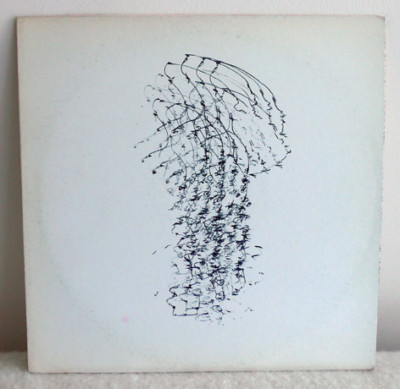
PHILIP GLASS music in similar motion LP 1973 avant oop
$
42


Favourite Auctions
To save auctions to your favourites, please login
If you don't have an account, please register
Description
Philip Glass "Music in Similar Mation / Music in Fifths" LP privately issued by the composer for his Chatam Square Productions (1003) in USA, 1973. ****** Rec:m- / Cov:ex ****** Glass's early music was aggressively reductive in its form, melodic content and harmonic language. The names of the works on this album, "Music in Fifths" and "Music in Similar Motion", are not only titles but apt summations of what actually happens in the compositions that they describe. "Music in Fifths" (1969), on the other hand, is in closed form, a predetermined structure that ends when the accumulation of repetitions fill it out completely. Glass has always considered "Music in Fifths" a sort of teasing homage to Boulanger; it is written entirely in parallel fifths, a cardinal sin in the traditional counterpoint his teacher so carefully instructed. The most appealing of these works, and the only one that the Philip Glass Ensemble still keeps in its active repertory, is "Music In Similar Motion" (1969). "The real innovation in Similar Motion is its sense of drama", Glass said in 1993. "The earlier pieces were meditative, steady-state pieces that established a mood and stayed there. But Similar Motion starts with one voice, then adds another playing a fourth above the original line, and then another playing a fourth below the original line, and finally a bass line kicks in to complete the sound. As each new voice enters, there is a dramatic change in the music". Still, Glass realized he was building a following and, with the business acumen he has demonstrated throughout his career, he privately produced his first recordings, which disseminated his work to home audiences and venturesome radio stations. Now, nearly a quarter century on, with the reissue of these rowdy, precious souvenirs, latter-day listeners can track the course of a tremendously important and influential aesthetic. To fully appreciate the sheer, unbridled audacity of these early works by Philip Glass, it is helpful, for a moment, to imagine that it's 1969 and you've never heard any of the composer's music before. Indeed, in 1969, it would have been unlikely that you'd heard anything like this before. The acknowledged, university-supported, musical avant-garde of the late 1960s was a combination of European-derived serialism (exemplified by Milton Babbitt and his acolytes) and the scrappy, anarchic, aleatory work of John Cage. Both of these musics, despite their very different origins and intentions, shared the same prohibitions and every composition student knew what they were. Consistency of any sort was to be shunned: budding composers were instructed to avoid suggesting a tonal center, to stay away from direct repetition, and to accept the fact that Stravinsky had had the last word on steady rhythmic pulsation. And along came Philip Glass, blasting out his stark, obsessive reiterative patterns at maximum volume, to stand all of the rules on their head. He was, in many ways, an unlikely radical. Glass went to Europe in 1964, where he eventually settled in Paris to study harmony and counterpoint with the legendary pedagogue Nadia Boulanger. During his second year with Boulanger, he was engaged to transcribe a film score by sitar player Ravi Shankar into Western notation for Parisian studio musicians. Following this new fascination, Glass spent the last part of 1966 and the first months of 1967 in India. Upon his return to the United States, he worked again with Shankar, who was then a visiting professor at the City College of New York, and with the tabla player Alla Rakha. He also grew close to several other young composers, particularly Terry Riley, Steve Reich and Jon Gibson, who were pursuing similar interests in lower Manhattan; the association with Gibson continues to this day. In 1968, Glass presented the first concert of his music at the Film-Makers Cinematheque in New York. The program included Strung Out, for solo violin, and Music in the Form of a Square, for two flutes. The same year, he put together the first Philip Glass Ensemble, an aggregate of amplified keyboards, voices, saxophones and flutes (also, on occasion, trumpet and violin) that would remain his principal means of musical expression for more than a decade and a key element of his creative life well into the 1990s. Chatham Square Productions recording "Music In Similar Motion" and "Music In Fifths". Produced by Philip Glass. Dedicated to Robert Prado (1938-1972). "Music In Similar Motion" was recorded June 1971 at Martinson Hall of The Public Theatre, NYC. Recording engineers: Robert Fries and Kurt Munkacsi. "Music In Fifths" was recorded June 1973 at Butterfly Productions, NYC. Recording engineer: Kurt Munkacsi. This is where it all began! ****** The record looks like it has never been played. Top conditions! ****** Please check my other auctions for Philip Glass "Music with Changing Parts" rare original double LP on Chatham Square. ****** Please wait to receive my invoice before sending the payment after the auction ends. Attention! Real postage costs are not USD 4 as all the items are located in Doha, Qatar (which has a very safe and professional post system). Postage costs registered up to 1 Kilo (generally 3 LPs): to Europe and Japan is USD 16,50 / to America and Oceania is USD 22,50. Postage costs registered up to 2 Kilos: to Europe and Japan is USD 28,00 / to America and Oceania is USD 34,00. Thank you for your kind attention and good luck with your bids.
price rating



![Enuff Z'Nuff - Enuff Z'Nuff [LP] Purple 180 Gram Audiophile Vinyl, Anniversary](https://www.popsike.org/php/thumbnail.php?url=https://www.popsike.pics/pix/20210302/383995125771.jpg)
![Enuff Z'Nuff - Enuff Z'Nuff [LP] Purple 180 Gram Audiophile Vinyl, Anniversary](https://www.popsike.org/php/thumbnail.php?url=https://www.popsike.pics/pix/20210306/384003103656.jpg)
![Enuff Z'Nuff - Enuff Z'Nuff [LP] Green 180 Gram Audiophile Vinyl, Anniversary](https://www.popsike.org/php/thumbnail.php?url=https://www.popsike.pics/pix/20210313/384020599157.jpg)