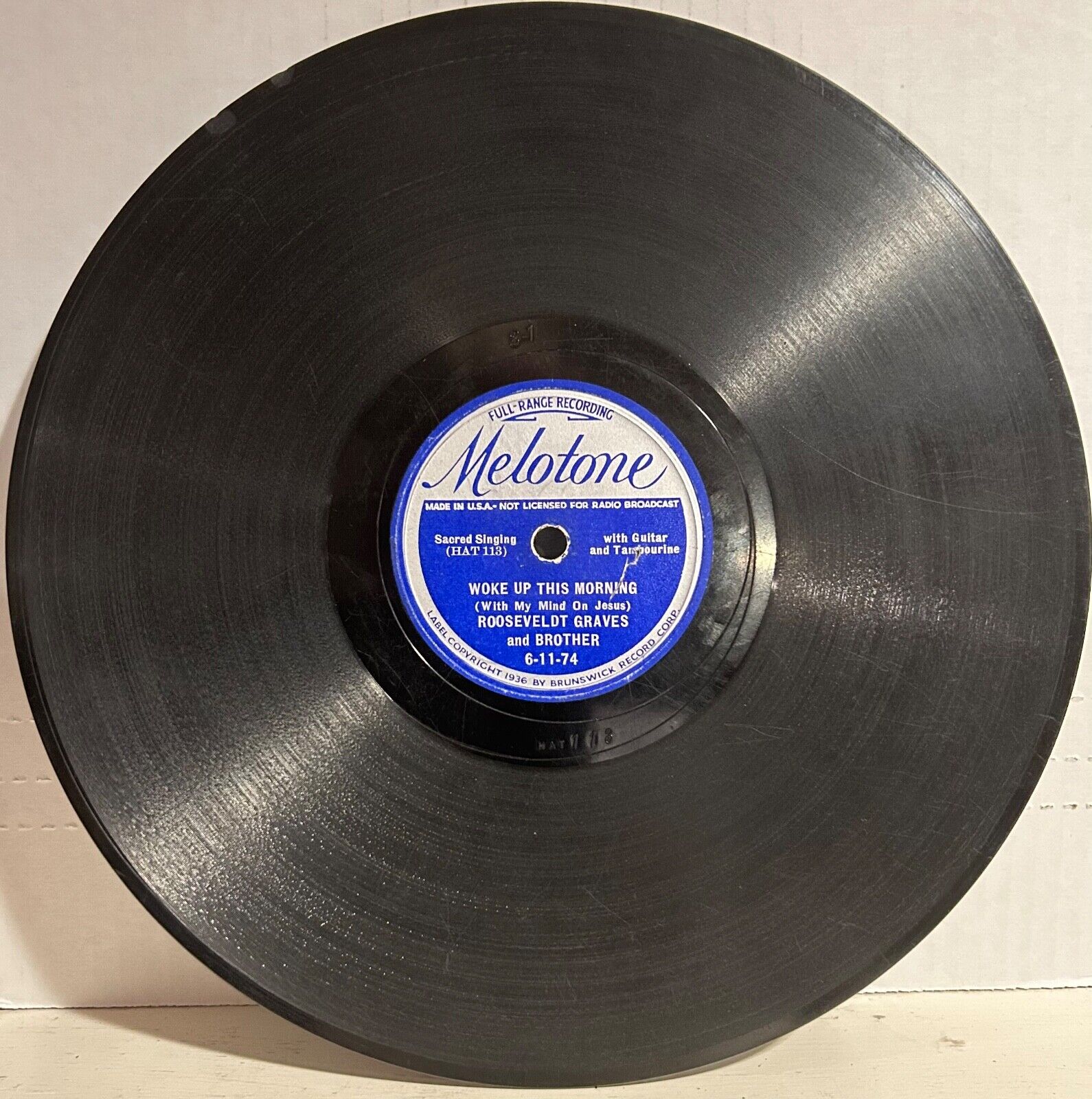
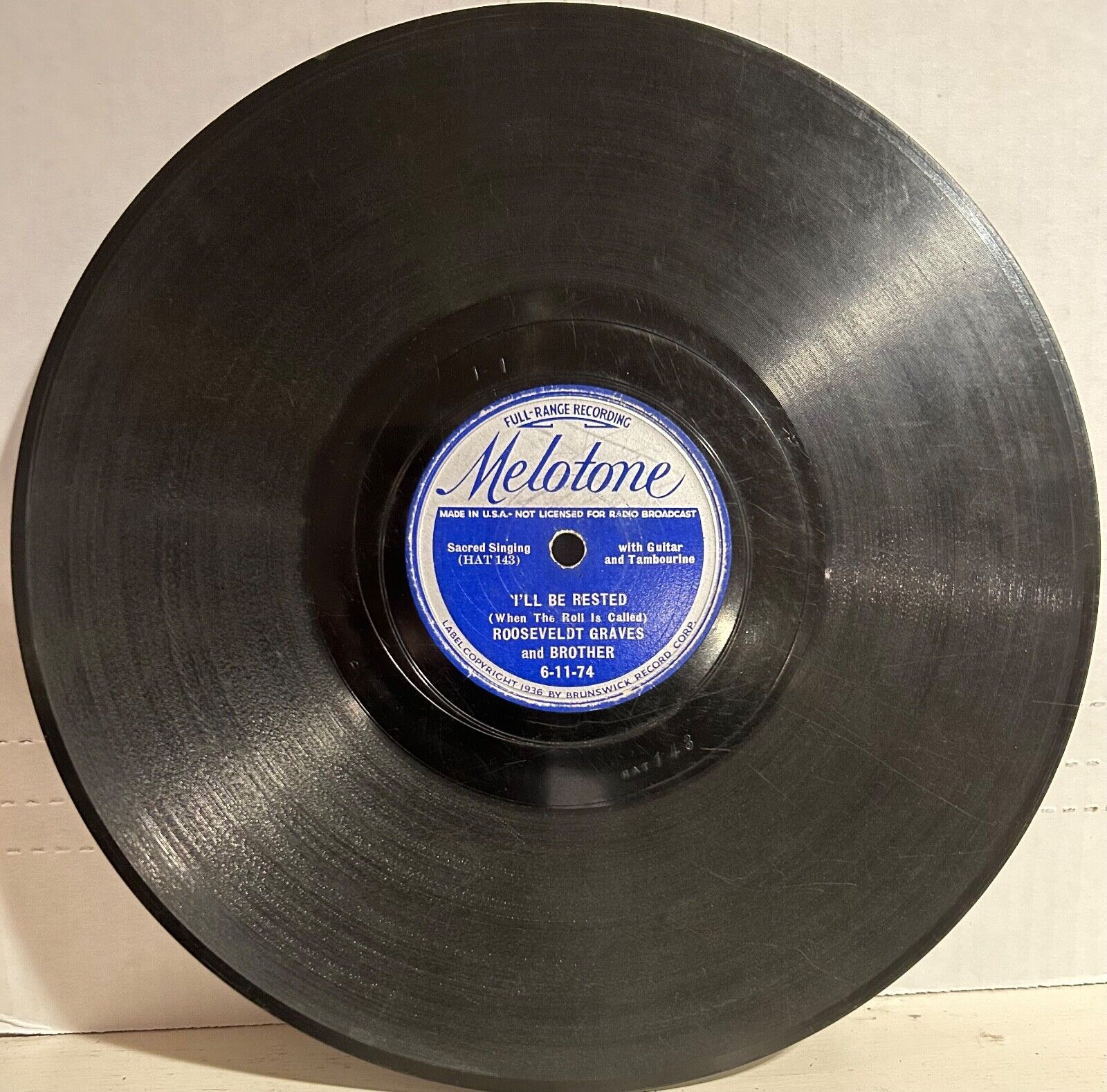
PREWAR GOSPEL BLUES ROOSEVELDT GRAVES + BROTHER MELOTONE 6-11-74 Woke Up This Mo
$
512


Favourite Auctions
To save auctions to your favourites, please login
If you don't have an account, please register
Description
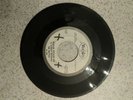
Released in 1936 on at least Perfect and Melotone, this record may have been issued on other ARC labels. Whether it was or not is a moot point, as it is a very rare record. And I know 'rare' is a much-overused word on eBay, but in this case, it is very accurate. A Perfect release of the same record sold for $1,000 in 2017, and it was graded in the same condition as this one. The seller said it was only one of five known copies. I have no idea how accurate that statement was. This particular copy plays very well, especially on more vintage equipment, and the guitar playing is strong and vibrant, very much in the country blues style. Below are the note from the Document CD booklet of Graves' recordings:
Abridged from this album’s original booklet notes. Ishman Bracey and informant Chester House asserted that Roosevelt Graves was from South Central Mississippi and played on the streets and in the local juke joints in various towns throughout that area. House, who had performed with Graves in the 1920s, specifically named Rose Hill (a small town about twenty-five miles from Meridian) as the home of the blind guitarist. Graves moved to Gulfport, Mississippi after World War II where he reputedly died in the 1960s. The elder Graves, who was totally blind, usually played a twelve-string guitar and took most of the lead vocals, while his younger brother, who was blind in one eye, harmonized and played tambourine. It was Paramount Records scout H. C. Speir who probably arranged for their trip to Richmond, Indiana, but at that first session it was pianist Will Ezell who called the shots musically. Ezell was working as a session musician and part-time talent scout for Paramount in September 1929, when he recorded with the Graves brothers. He brought with him a cornetist from St. Louis named Baby Jay (or James), who played in the riverboat style of Charlie Creath. Ezell took care of business at the outset, leading the group through seven blues and dance pieces. They did a slower, countrified version of “Pine Top’s Boogie Woogie” (Guitar Boogie), tackled the A. Tindley (as Leave It There) in 1916, and exemplified the type of gospel song popularized through the sale of sheet music and exposure at the well-attended gospel conventions. There are versions of this song recorded by Washington Phillips (DOCD-5054), Blind Willie Johnson, and Blind Joe Taggart, all attesting to its widespread popularity. I Shall Not Be Moved can be heard in a simple country version by Charley Patton (DOCD-5010), while When I Lay My Burdens Down which is sometimes called “Glory Glory, Hallelujah” can be compared to the versions by Mother McCollum(DOCD-5 101) and Mclntorsh and Edwards (DOCD- 5072). To this listener, the standout number is Telephone To Glory (first recorded by Rev. Sister Mary Nelson in 1927 as “The Royal Telephone”, see DOCD-5072), which Paul Oliver in Songsters & Saints points to as “representative of the new trend to find images that related to contemporary society and linked the familiar with the holy.” The cornet, piano, and guitar provide a lilting rhythm for the brothers’ remarkable vocals, resulting in a mesmerizing performance. For collectors, the real bonus on this disc will be the inclusion of the recently discovered Paramount 12913 (Happy Sunshine / I’m Pressing On). Not having had the opportunity to hear this at the time these notes were written, I can only hazard a guess that the latter title is the same as that by Rev. D. C. Rice (DOCD-507I). In 1936, it was again H. C. Speir, who found the Graves brothers performing in a church in McComb, Mississippi, and sent them over to Hattiesburg to be recorded by the ARC field unit there. They did eight sacred numbers as a duet, of which only two were released: Woke Up This Morning (With My Mind On Jesus) and I’ll Be Rested (When The Roll Is Called), both rhythmically complex in the interplay between the two instruments and the vocals. In fact, the 1929 and the 1936 sessions can be contrasted to illustrate the differences in the type of beat popular at the time. The secular and the sacred songs from the 1929 session have a beat that is closer to the stately syncopation of ragtime, while the 1936 session showcases the emergence of the newer boogie-woogie rhythm on the Mississippi Jook Band sides. The pianist at the 1936 session was Cooney Vaughn, who had a weekly performance slot on radio station WCOC in Meridian prior to World War Il and is remembered as more of a pop performer than a bluesman. Little Brother Montgomery crossed his path in 1935 and remarked that Vaughn was one of the best piano players he had ever heard. Vaughn is reported to have served time in the Alabama State Penitentiary for shooting and killing a man and may have been killed by a train that hit him after he fell asleep on a railroad track in Hattiesburg.
Ken Romanowski Copyright 1992 Document Records
We Use The VJM Record Grading System
NB 45s use the LP system as below.
N (78) M (LP). As new and unplayed (there are virtually no 78s that can categorically be claimed to be unplayed).
N- (78) M- (LP). Nearly Mint, but has been played. No visible signs of wear or damage.
E+ (78) VG+ (LP). Plays like new, with very, very few signs of handling, such as tiny scuffs from being slipped in and out of jackets.
E (78) VG (LP). Still very shiny, near new looking, with no visible signs of wear, but a few inaudible scuffs and scratches.
E- (78) VG- (LP). Still shiny but without the lustre of a new record, few light scratches. LP: Some wear, scratches and scuffs, but no skipped or repeat grooves.
V+ (78) G+ (LP) V+ is an average condition 78 in which scuffs and general use has dulled the finish somewhat. Wear is moderate but playing is generally free from distortion. Surface noise not overly pronounced. LP: Below average with scuffs and scratches on fewer than half the tracks. No skips or repeat grooves.
V (78) G (LP). Moderate, even wear throughout, but still very playable. Surface noise and scratches audible but not intrusive.
V- (78) G- (LP). Quite playable still, but distortion and heavy greying in loud passages. Music remains loud in most passages. Surface noise and scratches well below music level. LP: Lowest Grade. Audible scratches, etc. on more than half the tracks. Listening uncomfortable.
G+ (78). Grey throughout but still serviceable. Music begins to sound muffled. Heavy scratches.
G (78). Quite seriously worn and scratched, but music level is still higher than surface noise.
G- (78). Music still prominent, but wear and scratch damage extensive.
F (78). Most of music remains audible over surface noise, but listening now uncomfortable.
P (78). Unplayable.
NB: Damage to labels and jackets (LP) should be noted whenever present.
Abbreviations: sfc = surface; lbl = label; nap = not affecting play; scr/scrs = scratch/scratches; lc = lamination crack; cr = crack; hlc/hc = hairline crack; wol = writing on label; sol = sticker on label; fade = faded label; gr/grs = groove/grooves; eb = edge bite; ec = edge chip; ef = edge flake; rc = rim chip.
I have a lot of Rock and Roll, R & B, Jazz and Country LPs, 45s and 78s for sale, many at low prices. I do combine shipping so take a look! If you are bidding on more than one item, let me know you want to combine shipping, and DON'T pay the first invoice that eBay sends you. And then let me know WHEN YOU HAVE FINISHED, and I will send you an invoice for everything. It saves you money, and saves me time! 50 cents extra for each additional LP. I ship USPS Media Mail, but do charge an additional $1.50 for packaging for LPs and 45s. Because of the fragility of 78s, the packaging charge is increased to $5.00, and then an extra 50 cents per record. We've all been spoiled with free delivery from various retailers over the past few years, and I wish I could offer free shipping! But I can't. Even Media Mail is becoming expensive. The mailers and bubble wrap I use come out at close to a buck for each shipment for LPs and for 78s the cost is even higher. Two bucks for the box, and 50 cents for each corrugated pad. I use 4 pads per shipment, plus bio-degradable peanuts and bubblewrap. It all mounts up, and then there is the schlepping to the Post Office. I ain't getting rich!
I do pack carefully, but cannot be responsible for damage incurred during shipping. I understand that eBay will cover you in the case of a damaged or broken shipment.
I am starting to list a lot of 78s and prices are fairly low. Why not minimize your shipping costs by buying several at once?
A note about 78s and vinyl dating from 1948 through the early 60s. Tracking weights in the teens and twenties on old wind-up phonographs were around 150 - 200 grams. Yes, you read that right! The weight reduced as the years went by, and by the 40s and 50s was down to 8-12 grams. Playing an old record on modern equipment with a tracking weight of around 2-3 grams will often result in a lot of surface noise. The best rule of thumb is to play records on machines of similar vintage, although I do take the point that playing a 78 with a tracking weight of 8 grams IS better than 150 grams! Back in the early years of the twentieth century, 78s had an abrasive mixture added to the shellac. It was added with the express purpose of wearing the needle BEFORE the needle wore the record. That is why one should change the steel needle in a wind-up phono after each side of a record. Needles were MUCH cheaper than records! All of this is by way of saying, 'You gotta get in the groove'!
price rating