RARE 78 RPM STAR SPANGLED BANNER "AMERICA" VICTOR 9/11
$
150


Favourite Auctions
To save auctions to your favourites, please login
If you don't have an account, please register
Description
Hello Everyone! This is a ten-inch 78 rpm. Victor record featuring FRANCIS SCOTT KEY- SAMUEL ARNOLD on Victor ("scroll" label) 21428-A:1922
Side A - (21428-A) "STAR SPANGLED BANNER" (FRANCIS SCOTT KEY-SAMUEL ARNOLD!)
Side B - (21428-B) "AMERICA (MY COUNTRY 'TIS OF THEE!" (DR. S.F. SMITH- HENRY CAREY!")
I'M NOT A RECORD GRADER OR SELLER I ONLY HAVE NINE OF THESE 78'S BUT I CAN SAY THAT THEY ARE NICE AND GLOSSY AND FREE FROM SCRATCHES(EXCEPT FOR THE RECORD LABEL STICKERS HAVE SLIGHT "SCRATCHS" FROM PLACING IT ON THE RECORD PLAYER). I HAVE PLAYED THEM ALL AND THEY ALL SOUND BEAUTIFUL! GOOD LUCK ENJOY THIS RARE FIND. RECORD YEARS ARE BEST EDUCATED GUESSES FROM RESEARCH ONLINE.
STAR SPANGLED BANNER
An artist's rendering of the battle at Fort McHenry.On September 3, 1814, Key and John S. Skinner, an American prisoner-exchange agent, set sail from Baltimore aboard the sloop HMS Minden flying a flag of truce on a mission approved by U.S. President James Madison. Their objective was to secure the release of Dr. William Beanes, the elderly and popular town physician of Upper Marlboro, a friend of Key’s who had been captured in his home. Beanes was accused of aiding in the arrest of British soldiers. Key and Skinner boarded the British flagship, HMS Tonnant, on 7 September and spoke with Major General Robert Ross and Admiral Alexander Cochrane over dinner, while they discussed war plans. At first, Ross and Cochrane refused to release Beanes, but relented after Key and Skinner showed them letters written by wounded British prisoners praising Beanes and other Americans for their kind treatment.
Because Key and Skinner had heard details of the plans for the attack on Baltimore, they were held captive until after the battle, first aboard HMS Surprise, and later back on HMS Minden. After the bombardment, certain British gunboats attempted to slip past the fort and effect a landing in a cove to the west of it, but they were turned away by fire from nearby Fort Covington, the city's last line of defense. During the rainy night, Key had witnessed the bombardment and observed that the fort’s smaller "storm flag" continued to fly, but once the shelling had stopped, he would not know how the battle had turned out until dawn. By then, the storm flag had been lowered, and the larger flag had been raised.
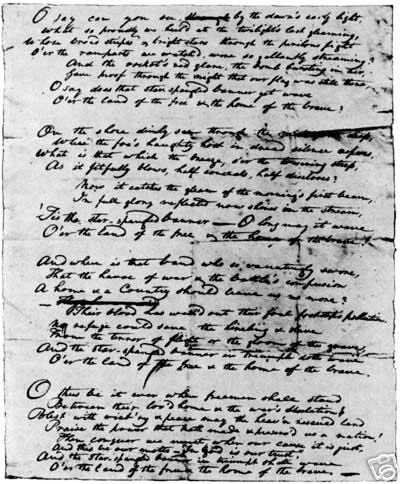
Francis Scott Key's original manuscript copy of his Star-Spangled Banner poem. It is now on display at the Maryland Historical Society.Key was inspired by the American victory and the sight of the large American flag flying triumphantly above the fort. This flag, with fifteen stars and fifteen stripes, came to be known as the Star Spangled Banner Flag and is today on display in the National Museum of American History, a treasure of the Smithsonian Institution. It was restored in 1914 by Amelia Fowler, and again in 1998 as part of an ongoing conservation program.
Aboard the ship the next day, Key wrote a poem on the back of a letter he had kept in his pocket. At twilight on 16 September, he and Skinner were released in Baltimore. He finished the poem at the Indian Queen Hotel, where he was staying, and he entitled it "Defence of Fort McHenry."
Key gave the poem to his brother-in-law, Judge Joseph H. Nicholson. Nicholson saw that the words fit the popular melody "To Anacreon in Heaven", an old British drinking song from the mid-1760s, composed in London by John Stafford Smith. Nicholson took the poem to a printer in Baltimore, who anonymously printed broadside copies of it—the song’s first known printing—on 17 September; of these, two known copies survive.
On 20 September, both the Baltimore Patriot and The American printed the song, with the note "Tune: Anacreon in Heaven". The song quickly became popular, with seventeen newspapers from Georgia to New Hampshire printing it. Soon after, Thomas Carr of the Carr Music Store in Baltimore published the words and music together under the title "The Star-Spangled Banner", although it was originally called "Defence of Fort McHenry." The song’s popularity increased, and its first public performance took place in October, when Baltimore actor Ferdinand Durang sang it at Captain McCauley’s tavern.
The song gained popularity throughout the nineteenth century and bands played it during public events, such as July 4 celebrations. On 27 July 1889, Secretary of the Navy Benjamin F. Tracy signed General Order #374, making "The Star-Spangled Banner" the official tune to be played at the raising of the flag.
In 1916, President Woodrow Wilson ordered that "The Star-Spangled Banner" be played at military and other appropriate occasions. Although the playing of the song two years later during the seventh-inning stretch of the 1918 World Series is often noted as the first instance that the Anthem was played at a baseball game, evidence shows that the "Star-Spangled Banner" was performed as early as 1897 at Opening Day ceremonies in Philadelphia and then more regularly at the Polo Grounds in New York City beginning in 1898. Today, the anthem is performed before the beginning of all NBA, NHL, MLB and NFL games, as well as in a pre-race ceremonies portion of every NASCAR race.
On 3 November 1929, Robert Ripley drew a panel in his syndicated cartoon, Ripley's Believe it or Not!, saying "Believe It or Not, America has no national anthem." [1] In 1931, John Philip Sousa published his opinion in favor, stating that "it is the spirit of the music that inspires" as much as it is Key’s "soul-stirring" words. By a law signed on 3 March 1931 by President Herbert Hoover, "The Star-Spangled Banner" was adopted as the national anthem of the United States.
Modern history
In 1944 a Boston audience was so stunned and bewildered by emigré Igor Stravinsky's modernist arrangement of the piece that the police were sent to his next concert with orders that he desist from further performances on pain of being arrested for "desecration of the national anthem."
The first "pop" performance of the anthem heard by mainstream America was by Puerto Rican singer and guitarist Jose Feliciano. He shocked the crowd at Tiger Stadium in Detroit and the rest of America when he strummed a slow, bluesy rendition of the national anthem before Game Five of the 1968 World Series between Detroit and St. Louis. This rendition started contemporary "Star-Spangled Banner" controversies. The response from many in Vietnam-era America was generally negative, given that 1968 was a tumultuous year for the United States. Despite the controversy, Feliciano's performance opened the door for the countless interpretations of the "Star-Spangled Banner" we hear today.[2]
In fact, many "interpretative" versions of the anthem are held in high regard by modern critics, such as Marvin Gaye's funk-influenced performance at the 1983 NBA All-Star Game, and Whitney Houston's stirring, high-note filled rendition before Super Bowl XXV in 1991, which when released as a single charted at number 20 in 1991 and number 6 in 2001—the only times the anthem has been on the Billboard Hot 100. Another famous instrumental interpretation is Jimi Hendrix's guitar solo at the first Woodstock Festival. Incorporating sonic effects to emphasize the "rockets' red glare" and "bombs bursting in air", it became a late-1960s emblem.
In March 2005, the government-sponsored The National Anthem Project was launched after a Harris Interactive poll showed many adults knew neither the lyrics nor the history of the anthem. [3]
Lyrics
15-star, 15-stripe "Star-Spangled Banner" flagO say, can you see, by the dawn’s early light,
What so proudly we hailed at the twilight's last gleaming,
Whose broad stripes and bright stars, through the perilous fight,
O’er the ramparts we watched, were so gallantly streaming?
And the rockets’ red glare, the bombs bursting in air,
Gave proof through the night that our flag was still there.
O say, does that star spangled banner yet wave
O’er the land of the free, and the home of the brave?
On the shore, dimly seen thro’ the mist of the deep,
Where the foe’s haughty host in dread silence reposes,
What is that which the breeze, o’er the towering steep,
As it fitfully blows, half conceals, half discloses?
Now it catches the gleam of the morning’s first beam,
In full glory reflected now shines in the stream:
’Tis the star-spangled banner! O long may it wave
O’er the land of the free and the home of the brave.
And where is that band who so vauntingly swore
That the havoc of war and the battle’s confusion
A home and a country should leave us no more?
Their blood has washed out their foul footsteps' pollution.
No refuge could save the hireling and slave
From the terror of flight, or the gloom of the grave:
And the star-spangled banner, in triumph doth wave
O’er the land of the free and the home of the brave.
O thus be it ever when freemen shall stand
Between their loved homes and the war’s desolation!
Blest with vict’ry and peace, may the Heav’n-rescued land
Praise the Power that hath made and preserved us a nation.
Then conquer we must, when our cause it is just,
And this be our motto: "In God is our Trust."
And the star-spangled banner in triumph shall wave
O’er the land of the free and the home of the brave.[4]
Protocol
When the song is performed in public, it is customary for American citizens to stand and face the American flag, if one is displayed, in an attitude of respectful attention.[5] If no flag is on display, it is customary to stand and face the source of the music in the same respectful attitude of attention as if the flag were on display. People are also encouraged to remove their hats during the performance. Boy Scouts, Girl Scouts, military personnel, fire service, and law enforcement officers in uniform normally salute during the national anthem from the first note and hold the salute until the last note is played. Civilians who are citizens of the United States should salute by placing their right hand over their heart.[6]
AMERICA MY COUNTRY 'TIS OF THEE
Samuel Francis Smith wrote the lyrics to "My Country, 'Tis of Thee" in 1831[1], while a student at the Andover Theological Seminary in Andover, Massachusetts. His friend, Lowell Mason had asked him to translate the lyrics in some German school songbooks or to write new lyrics. One melody in particular caught his attention. The German lyrics were a German patriotic hymn of some sort. Instead of translating it, Smith decided to write an American patriotic hymn, so he sat down and in thirty minutes had written My Country, 'Tis of Thee, to go along with the melody. He had never heard the tune before and had no idea of its derivation or associations with the British national anthem, "God Save the King."
Smith gave Mason the lyrics he had written and the song was first performed in public on July 4, 1831[2], at a children's Independence Day celebration at Park Street Church in Boston. First publication of 'America" was in 1832.[3]
[edit] Lyrics
1
My country, 'tis of thee,
Sweet land of liberty,
Of thee I sing;
Land where my fathers died,
Land of the pilgrims' pride,
From every mountainside
Let freedom ring!
2
My native country, thee,
Land of the noble free,
Thy name I love;
I love thy rocks and rills,
Thy woods and templed hills;
My heart with rapture thrills,
Like that above.
3
Let music swell the breeze,
And ring from all the trees
Sweet freedom's song;
Let mortal tongues awake;
Let all that breathe partake;
Let rocks their silence break,
The sound prolong.
4
Our father's God to Thee,
Author of liberty,
To Thee we sing.
Long may our land be bright,
With freedom's holy light,
Protect us by Thy might,
Great God our King.
5 (added to celebrate Washington's Centennial)[4]
Our joyful hearts today,
Their grateful tribute pay,
Happy and free,
After our toils and fears,
After our blood and tears,
Strong with our hundred years,
O God, to Thee.
Each record comes in manilla sleeve placed between to pieces of card board and a bubble padded envelope mailed in a priorty box and will be packaged quite securely and safely for shipping, however insurance is recommended most highly - we cannot assume responsibility for loss in transit. wWe will not ship Media Mail, so please don't ask us to! The USPS will no longer trace such parcels should they go missing or excessively-overdue. Obviously, posting overseas will cost a good bit more than domestic shipping. ALL OF OUR ITEMS COME FROM A SMOKE-FREE ENVIRONMENT!
If sending your payment by mail, please enclose either a copy of your invoice or a note telling us who you are and what you're paying for (the item's title should suffice).
Merchandise paid for by PayPal, money order, goods in trade, or by other special arrangement will be despatched on our next weekly posting day after receipt. Merchandise paid for by check will be held for several days to ensure bank clearance.
We ship only via the United States Postal Service. For multiple purchases, we will combine shipping whenever possible .
price rating







![NICK DRAKE - Bryter Later [Island pink rim] UK 1st press A1U w/label variant LP](https://www.popsike.org/php/thumbnail.php?url=https://www.popsike.pics/pix/20160313/381569032956.jpg)