RECORDANTO AL SEPTETO NACIONAL - 12" LP Esquivel 004 VG+ Ignacio Pineiro / Cuban
$
55


Favourite Auctions
To save auctions to your favourites, please login
If you don't have an account, please register
Description
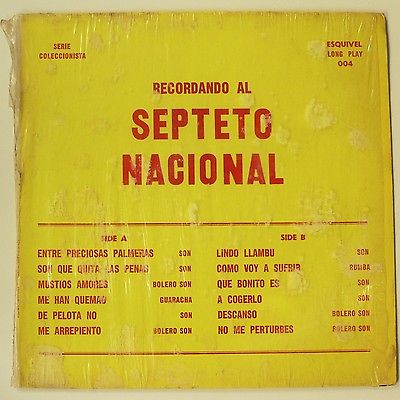
RECORDANTO AL SEPTETO NACIONAL
Vinyl grading - VG
Sleeve grading - VG
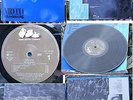
8 pictures uploaded, sleeve close ups, front and rear, disc - apologies for the tripod reflection - and a view of the label details.
Use the eBay 'Mouse Over to Zoom / Click to Enlarge' feature for meticulous scrutiny of the condition of the item.
Imported vinyl LP, undated and with the bare minimum of information about exactly who is involved and what exactly they are doing...a recent mp3 issue has supplied the information below, but this is the real thing, a vinyl LP, possibly early 1960's issue of the Septeto Nacional in full effect, possibly Cuban in origin...I have uploaded as many pictures of the item, showing as much of the information and detailing that I can, check 'em over and see if your research adds anything more...
What can we assume about it?...
'Developed in Oriente Province out of a mix of African, Spanish, Haitian, and French influences, the son became the bedrock of popular Cuban music for most of the 20th century: rumbas, boleros, mambos, and later salsa rhythms were all born out of the son song form. The son not only gave Cuba its own musical identity, but became the most influential musical export to emerge from the Western Hemisphere — in one of the finest examples of cultural cross pollination, pioneers of soukous and highlife music in central and western Africa were greatly influenced by various sones, which were initially inspired by African rhythms. The classic sextet configuration of early son outfits (including bongos, maracas, claves, tres guitar, and two lead vocalists or soneros) was first brought to Havana by the trailblazing Setexto Habanero (originally called Trio Oriental after the province they came from), which in turn inspired equally important groups headed by Miguel Matamoros and the bassist Ignacio Pineiro. Pineiro expanded the son sound, adding trumpet and a bit of swing to the mix with his Septeto Nacional. After a stint with Cuban singer Maria Teresa Vera, Pineiro began recording on his own in 1927, the early fruits of which are heard on this fine Tumbao collection. Including 17 mostly original son, bolero, rumba, and guaracha numbers, these 1928-1930 recordings offer a prime glimpse into the golden era of Cuban music. '
Released on - Esquivel, Serie Collectionista.
Catalogue number - Esquivel Long Play 004
May be 1964 issue, going by the matrix notations.
Import.
Produced by - Uncredited.
Duration - approx. 40 minutes.
Matrix numbers -
Side One - FI 004 A (0-7-64)
Side Two - FI 004 B (0-7-64)
Please read the record grading guide below and familiarize yourself with the grades used. Goldmine standards adhered to, plus full description in all aspects.
I strive to grade fairly, and have never sold a record without listening to it first.
Visual grading is not an option at all.
This 50 year old LP I have graded as being in Very Good condition. Both sides play through with no jumping, skipping or any other audio horrors. There are the usual minor hairline surface marks that any LP of this vintage would accumulate over the passage of time, but they are mainly visual and have no real impact on playback.
There is a bit of isolated, low-level and generally non-intrusive surface noise, mainly in the quiet passages between tracks, typically common to any used vinyl of this vintage, and which shouldn't spoil your authentic listening experience!
A perfectly acceptable vinyl-to-mp3 transfer, with a suitable turntable. Keep it real but in a digital way!
The sleeve, still in the original shrinkwrap, I have graded being in Very Good condition with light scuffing to the edges, minor bumps to the corners and some marking to the surface of the shrinkwrap - which may easily wipe off - plus other small signs of storage and age.
The label is in good condition, with a crease on the B side, obviously a pressing plant occurrence, see close-up picture uploaded.
The inner liner is plain.
Tracklisting -
Side One -
- Entre Preciosa Palmeras Son
- Son Que Quita Las Penas Son
- Mustios Amores Bolero Son
- Me Han Quemao Guaracha
- De Pelota No Son
- Me Arrepiento Bolero Son
Side Two -
- Lindo Llambu Son
- Como Voy A Sufrir Rumba
- Que Bonita Es Son
- A Cogerlo Son
- Descanso Bolero Son
- No Me Pertubes Bolero Son
Any questions, email and I'll help if I can.
Rare item, the authentic sound of old Cuba...one for the collectors and enthusiasts...
Thanks for looking!
:o)
Buy-it-Now, $54.99
Postage - USA - Free Shipping...nice!
Overseas orders welcome - $20, wherever.
* Records are posted in dedicated record mailing boxes with 2 corrugated cardboard stiffeners.
GRADING GUIDE. (Goldmine Standard)
* Gradings range between - for example - VG, VG+ and VG++. In some cases, for example again, VG- may be used.
MINT (M) Absolutely perfect in every way. Often rumored but rarely seen, and if it is not just out of the pressing plant it is unlikely that, personally, I would ever use this grading.
NEAR MINT (NM OR M-) A good description of a NM record is “it looks like it just came from a retail store and it was opened for the first time.” In other words, it’s nearly perfect. NM records are shiny, with no visible defects. Writing, stickers or other markings cannot appear on the label, nor can any “spindle marks” from someone trying to blindly put the record on the turntable. Major factory defects will be absent. If played, it will do so with no surface noise. NM covers are free of creases, ring wear and seam splits of any kind.
VERY GOOD PLUS (VG+) or EXCELLENT (E) A good description of a VG+ record is “except for a couple minor things, this would be Near Mint.” VG+ records may show some slight signs of wear, including light scuffs or very light scratches that do not affect the listening experience. Slight warps that do not affect the sound are OK. Minor signs of handling are OK, too, such as telltale marks around the center hole, but repeated playing has not misshapen the hole. There may be some very light ring wear or discoloration, but it should be barely noticeable.VG+ covers should have only minor wear. A VG+ cover might have some very minor seam wear or a split (less than one inch long) at the bottom, the most vulnerable location. Also, a VG+ cover may have some defacing, such as a cut-out marking. VG++ is a step up from VG+ generally.
VERY GOOD (VG) Many of the imperfections found on a VG+ record are more obvious on a VG record. VG records lack most of the original gloss found on factory-fresh records. Groove wear is evident on sight, as are light scratches deep enough to feel with a fingernail. When played, a VG record has surface noise, and some scratches may be audible. Minor writing, tape or a sticker can detract from the label. They remain a fine listening experience, just not the same as if it were in better shape.VG covers will have many signs of human handling. Ring wear in the middle or along the edges of the cover where the edge of a record would reside, is obvious, though not overwhelming. Some more creases might be visible. Seam splitting will be more obvious; it may appear on all three sides, though it won’t be obvious upon looking. A small pen or ink mark, or an original price sticker may be noticeable.
GOOD (G), GOOD PLUS (G+) or VERY GOOD MINUS (VG–) Good does not mean bad! The record still plays through without skipping, so it can serve as filler until something better comes along. But it has significant surface noise and groove wear, and the label is worn, with significant ring wear, heavy writing, or obvious surface damage to the label. A Good to VG– cover has ring wear, has seam splits obvious on sight and may have even heavier writing.
POOR (P) and FAIR (F) Records that have obvious damage, they are cracked, impossibly warped, or skip and/or repeat when an attempt is made to play them.