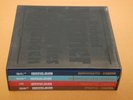
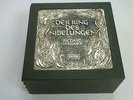
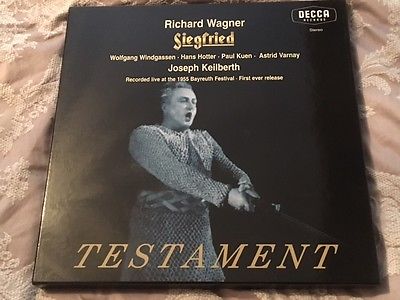
RICHARD WAGNER'S 'SIEGFRIED' NEAR MINT 5xLP BOX SET (DECCA / TESTAMENT 2006)
£
55
$
73


Favourite Auctions
To save auctions to your favourites, please login
If you don't have an account, please register
Description
RICHARD WAGNER'S 'SIEGFRIED'
SUPERB BOX SET OF 5 x VINYL LPs & 48-PAGE BOOKLET
RELEASED ON DECCA / TESTAMENT LABEL IN 2006 (SBTLP5 1392)
EVERYTHING IN NEAR MINT CONDITION
I ALSO HAVE A NEW / SEALED VERSION OF SAME ITEM AVAILABLE
IN STOCK FOR IMMEDIATE SHIPMENT FROM BANBURY, UK
WAGNER Siegfried
Wolfgang Windgassen, Astrid Varnay, Hans Hotter, Gustav Neidlinger, Paul Kuen, Maria von Ilosvay, Josef Greindl, Ilse Hollweg
Orchester der Bayreuther Festspiele / Joseph Keilberth
Testament issues the first-ever stereo recording of The Ring Cycle
with Hans Hotter, Astrid Varnay and Wolfgang Windgassen
In January 2006 Testament will release a new Siegfried, the first instalment of a 'lost' Ring recorded at the Bayreuth Festival in 1955. Thrillingly conducted by Joseph Keilberth (called by Astrid Varnay "a conductor with so much love, who was always there for you"), the cycle provides the opportunity to hear complete for the first time on commercial release the definitive performances of Hans Hotter (Wotan/Wanderer), Astrid Varnay (Brünnhilde), Ramon Vinay (Siegmund), Josef Greindl (Hagen) and Paul Kuen (Mime), in addition to the much-loved Siegfried of Wolfgang Windgassen, here heard in his prime.
These 'live' Bayreuth performances were taped by a Decca team led by Peter Andry and including the noted engineers Kenneth Wilkinson and Roy Wallace, with Gordon Parry as assistant. Using a new six-channel mixer designed by Wallace, the team made both stereo and mono recordings of each opera. Three microphones were placed in the sunken orchestra pit and three hung from a lighting bridge about 20 feet above the stage. "This was brilliant; it worked beautifully", remembers Wallace. The company prepared for an expected release, but John Culshaw, recently returned to Decca, vetoed the project. He disliked 'live' recordings and already had plans for a studio Ring with Solti which began four years later.
Decca's recording vividly captures in wonderful stereo sound the unique acoustic and stage/pit balance of the Bayreuth Festival theatre with its sunken orchestra, in addition to preserving the leading singers from a Wagnerian golden age in 'live' performance.
This Siegfried has been slumbering longer than Brünnhilde on her Valkyrie rock. Recorded live at the 1955 Bayreuth festival, it should have been the first commercial release of Wagner’s magnum opus, but record-company politics — detailed in Mike Ashman’s booklet essay — left it languishing on the shelves for more than 50 years. Now it is out of copyright and all the principal participants, except Astrid Varnay’s thrilling Brünnhilde, are dead, Testament can issue it legitimately. The revelations are the remarkable early stereo sound quality and Keilberth’s elemental conducting. This Siegfried has an inexorable sweep that will take your breath away. The singing, too, is of a kind you just don’t hear today. Windgassen and Hotter are both in fresher voice than when they recorded this opera in the studio, and the supporting cast — Paul Küen’s properly sung yet malevolent Mime, Gustav Neidlinger’s baleful Alberich, Maria von Ilosvay’s gravely beautiful Erda — are vintage Bayreuth. The classical-record event of the year.
Record Collector Magazine's Grading Guide:
"MINT: The record itself is in brand new condition with no surface marks or deterioISration in sound quality. The cover and any extra items such as the lyric sheet, booklet or poster are in perfect condition. Records advertised as Sealed or Unplayed should be Mint.
EXCELLENT: The record shows some signs of having been played, but there is very little lessening in sound quality. The cover and packaging might have slight wear and / or creasing.
VERY GOOD: The record has obviously been played many times, but displays no major deterioration in sound quality, despite noticeable surface marks and the occasional light scratch. Normal wear and tear on the cover or extra items, without any major defects, is acceptable.
GOOD: The record has been played so much that the sound quality has noticeably deteriorated, perhaps with some distortion and mild scratches. The cover and contents suffer from folding, scuffing of edges, spine splits, discolouration, etc.
FAIR: The record is still just playable but has not been cared for properly and displays considerable surface noise; it may even jump. The cover and contents will be torn, stained and / or defaced.
POOR: The record will not play properly due to scratches, bad surface noise, etc. The cover and contents will be badly damaged or partly missing.
BAD: The record is unplayable or might even be broken, and is only of use as a collection filler."
As well as the above grades, Near Mint is often used as well; this is really for a record that appears new but is known to have been played because the label has light spindle marks or because it has come from a previous owner and is assumed to have been played by them. For records which appear to fall between the accepted grades, + and - are also often added to the grading.
In addition to the basic grading, any individual faults should be noted separately such as if an otherwise Excellent cover has a name written on it, or a 7" single is missing its original centre etc.
price rating