ROBERT WILSON/BYRD HOFFMAN SCHOOL OF BYRDS ...Joseph Stalin LP PRIVATE Sound Art
$
41


Favourite Auctions
To save auctions to your favourites, please login
If you don't have an account, please register
Description
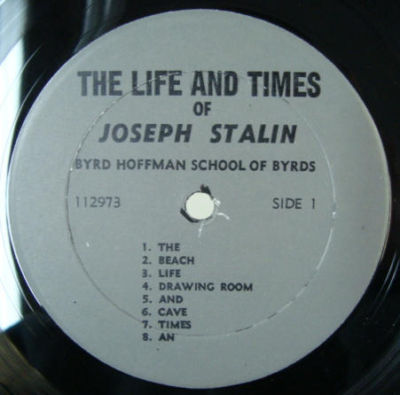
ROBERT WILSON / BYRD HOFFMAN SCHOOL OF BYRDS : The Life and Times of Joseph Stalin (no label [USA]) 1973.
Record is excellent with minimal light sleeve scuffs only. Plain white cover (still in shrink) is Near Mint.
Original copy of the only LP by American artist/designer/theatre director Robert Wilson. This is an abridged version of what was apparently originally a 12-hour "silent opera" from circa 1973, privately released in a plain white covor with no information at all, other than the title (Wilson is not credited).
Here are some quotes from a 1995 Paul Kaiser interview with Wilson, posted on the Hamburger Kunsthalle website:
"This all-night performance was a final grand statement of Wilson's work with his original ensemble, the Byrd Hoffman School of Byrds. Incorporating scenes from The King of Spain, The Life and Times of Sigmund Freud, Deafman Glance, and KA MOUNTAIN, Wilson devised a remarkable structure in which the play's first three acts subtly mirrored its last three acts, and its central act (the fourth) became a pivot around which the others revolved. The play interweaves surrealistic takes on Stalin's life with other dream-like renderings of life in the twentieth century, all presented within the elaborate stage artifice of the Victorian age."
"Many people said the work had nothing to do with Stalin, and in a sense you could see it that way. It wasn't the kind of work one would see about Stalin in a history book, but it was a work by an artist. It was a work in which we could see Stalin as a monster sitting in the middle of the Victorian bedroom; we could see him as the priest, as a murderess; we could see him as the mother, the child; we could see him as the Ice Man. We could see him as many characters, or as no one. Or Stalin could be seen as no one -- could only appear as a name in the title. It was thinking of contemporary gods the way Racine or the Greeks wrote about the gods of their time. They were commonly known by man. With Stalin already in the title, the audience came to the theater with some knowledge of who this man was, sharing the story. In a sense, I didn't have to tell a story; one could just associate these pictures with their own ideas of Stalin, and mine. Or one could look at it in a more literal way, the relationship of Stalin to the pictures. The story could simply be in the title"
See Broken Music, page 256.
price rating


![Neil Young & Crazy Horse ?– Rust Never Sleeps [12'' Vinyl Album]](https://www.popsike.org/php/thumbnail.php?url=https://www.popsike.pics/pix/20190117/123599274331.jpg)


