ROLLING STONES 'STICKY FINGERS' 1981 MFSL MOFI ORIGINAL MASTER RECORDING GREAT
$
78
Favourite Auctions
To save auctions to your favourites, please login
If you don't have an account, please register
Description
ROLLING STONES 'STICKY FINGERS' 1981 MFSL MOFI 'ORIGINAL MASTER RECORDING'
THE ROLLING STONES "STICKY FINGERS" MOBILE FIDELITY ~ ORIGINAL MASTER RECORDING LABEL: MOBILE FIDELITY SOUND LAB ~ MFSL 1-060 ROLLING STONES RECORDS ALBUM ORIGINALLY RELEASED: APRIL 30th 1971 THIS MFSL PRESSING RELEASED: JUNE 1981 MANUFACTURED BY MOBILE FIDELITY SOUND LABS (MFSL) MASTERED AT ORIGINAL MASTERING WORKS MASTERED & LACQUERING BY STAN RICKER LACQUERS: JVC CUTTING CENTER PRESSED AT VICTOR RECORDING COMPANY OF JAPAN, LTD. RECORDED AT: MUSCLE SHOALS SOUND STUDIOS ~ SHEFFIELD, ALABAMA RECORDED AT: MICK'S 'STARGROVES' MANSION w/ ROLLING STONES MOBILE UNIT RECORDED AT: OLYMPIC SOUND STUDIOS, LONDON RECORDING ENGINEERS: GLYN & ANDY JOHNS, CHRIS KIMSEY PRODUCER: JIMMY MILLER COVER CONCEPT & POLAROID PHOTOGRAPHY: ANDY WARHOL ALBUM GRAPHICS & DESIGN: CRAIG BRAUN MATRIX (SIDE A): (Etched) T/M MFSL-1-060 A10 SR/2 ORTOFON (Stamped) H1102 ⁜ D MATRIX (SIDE B): M/T ORTOFON SR/2 MFSL-1-060-B7 (Stamped) H171⁜⁜
CONDITION: VINYL: EX JACKET: EX- INSERTS: VG++ ~~~~~~~~~~~~~~~~~~~~~~~~~
I've been going thru my large vinyl record collection over the past few weeks and pulling out some LPs that I thought that someone else would want for their collection. I've been collecting records for over 45 years and it's time to pass some of them on to the next generation of collectors.
After all, we are just temporary 'caretakers' of these musical gems until the next owner and next collection takes them in.
This week on EBay I am offering up this rare 1981 original First MFSL Mofi Pressing of the fantastic Rolling Stones album 'Sticky Fingers'.
This is my personal, First Press MFSL copy that I purchased new back when it was first released, in the summer of 1981.
It's my favorite Rolling Stones record, so when these were first announced by Mofi, I had to have one. It's remained in my record collection ever since.
I've taken great care of this record for nearly 45 years now. It's been poly-line sleeved, inside and out, since I purchased it, stored properly in my collection, and it's still complete and in fantastic condition. Clean and bright. In all the years I've owned this, I'd estimate that it's been played less than 20 times.
Please read the full description of this album's content, the amazing story behind it's jacket, it's recording history, the 'controversy' over this pressing, and much more details on the record's condition below.
It's long, as I like to give a lot of description and details on the records I sell, but I think you'll find it informative and entertaining.... ~~~~~~~~~~~~~~~~~~~~~~~~~~~~~
'Sticky Fingers' was the 11th American studio album by the Rolling Stones. It was originally released on April 23, 1971 and was the first album on the Rolling Stones' new label, 'Rolling Stones Records'.
'Sticky Fingers' is many people's favorite Rolling Stones album and it's long been considered their masterpiece. When people talk about the classic, signature Stones 'sound', this is the album and the time period they are referring to. ~~~~~~~~~~~~~~~~~~~~~~~~~~~
This is a nice, clean, original First pressing of Mobile Fidelity Sound Lab's (MFSL) 'Original Master Recording' of Sticky Fingers from 1981.
This fantastic sounding album is an all-analog pressing, Half-speed mastered on an Ortofon system from the original master tapes of the album by Stan Ricker. It was pressed in Japan by Victor Ltd using 'High Definition Super Vinyl'. This album was an audiophile State-of-the-art masterpiece at the time, and the results sound amazing.
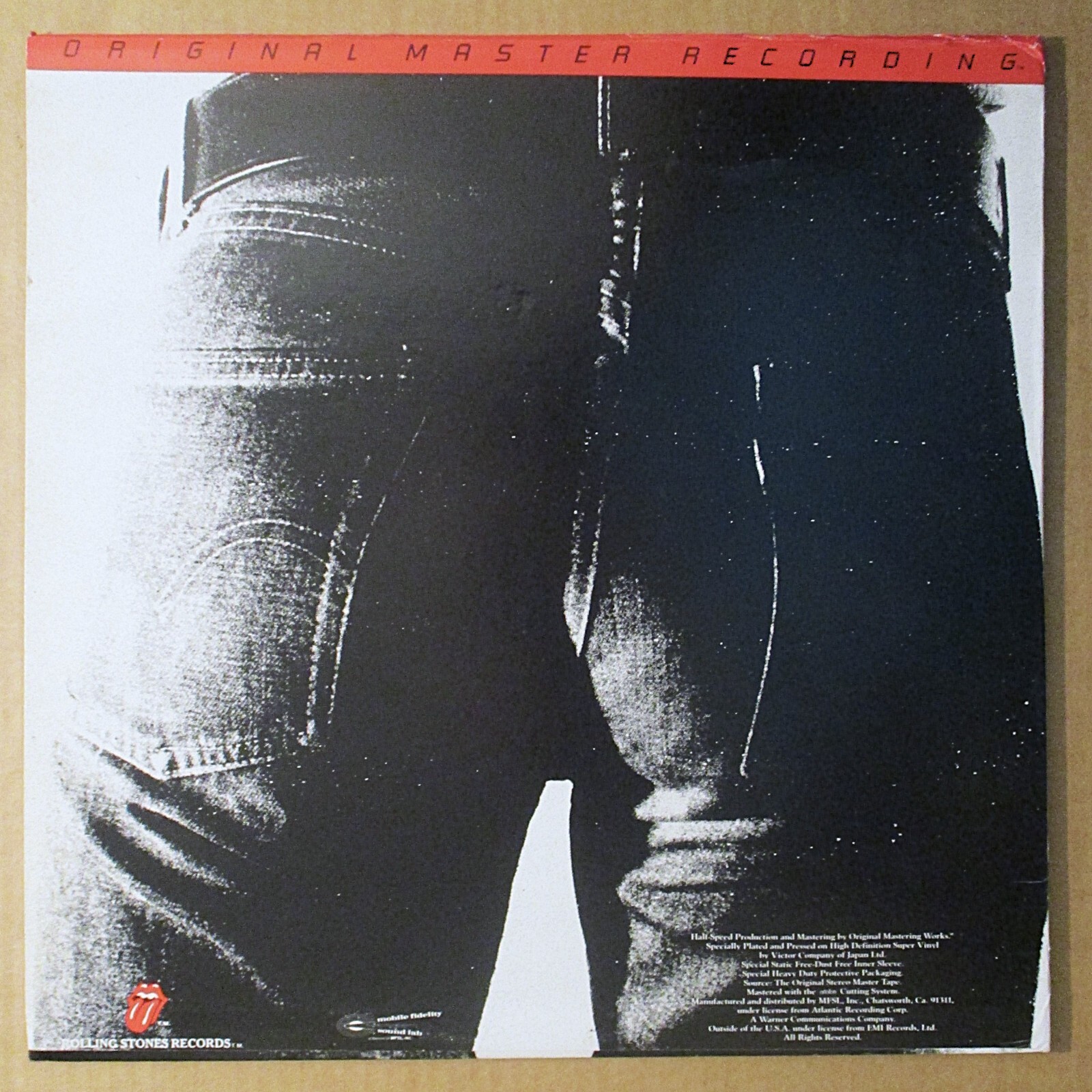
The back cover of this album lists some details of this pressing, which you can see in one of my photos.
This album comes with it's original insert, with a cool B&W photo of the band on one side, and the Stone's tongue logo artwork, song titles and credits on the other. This copy also still has all it's original MFSL paperwork with it.
This record originally came packaged in a Mofi inner sleeve, but for some reason I switched it out decades ago. This copy is in a thick, heavy, 80's style, 'Deutsche Gramophone' poly-lined sleeve. Not sure why I switched it out, I probably thought this heavier sleeve protected the record better.
Other than that, this pressing is 'complete' and as originally issued.
These original 1981 MFSL 'Original Master Recording' pressings of 'Sticky Fingers' are getting difficult to find, especially complete and in great condition. They don't turn up for sale often and it's a real gem. ~~~~~~~~~~~~~~~~~~~~~~~~~~~~~~~
This MFSL Mofi pressing reveals just how deeply layered, dynamic and intense the Rolling Stones music was. The overall sound is amazing; fresh and crisp, vibrant and dynamic, with lots of punch.
'Sticky Fingers' always sounded fantastic, but on this MFSL pressing it sounds even better.
Very dynamic, excellent separation between instruments, Jagger's vocals are crisp & clear, and it has a stellar soundstage. There's a good sense of space and depth with lots of noticeable details and clarity.
Although the Rolling Stones aren't known for their audiophile sound, and their music can sound heavy, muddy and murky at times, this pressing sounds stellar. Clear and punchy, with great separation, and plenty of depth and bite.
The drums & guitars sound great; loud, bold & punchy - perfect. But it's also warm, intimate, and sensitive where it should be - crisp acoustic guitars, Jagger's voice, tinkling piano, soft brass, even Paul Buckmaster's strings on a song or two.
This is an amazing sounding MFSL 'Original Master Recording', taken from the original master tapes, well mastered, sounds great, and all pure analog, not even a thought of anything digitally sourced back in those days. ~~~~~~~~~~~~~~~~~~~~~~
This album has been repressed, re-released, and remastered over the years, but as a Rolling Stones fan and Stones vinyl collector, this is one of the pressings you want in your vinyl collection. In terms of both performance and recording quality, the music here represents the full ferocious sound of the Stones in their prime.
'Sticky Fingers' is one of the very best, greatest, rock ’n’ roll albums ever made. Nothing else in their catalog comes close to touching 'Sticky Fingers' for its spirit, musicianship, and classic Rolling Stones sound.
The Stones have been called the World's Greatest Rock'n'Roll Band for years, but if that designation ever applied, it was here on 'Sticky Fingers'.
This MFSL pressing is a fantastic record to add to any Rolling Stones or classic Rock collection. ~~~~~~~~~~~~~~~~~~~~~~~~~~~~~~~~~~~~~~~~~~~
Here's some background on this classic album and some details on it's recording, and it's iconic album jacket art.
THE STONES DECIDING TO LEAVE DECCA AND ALLEN KLEIN BEHIND
The Rolling Stones had been contracted by Decca Records in the UK and London Records in the US since 1963, and they had little say in the release, design and content of their own records for nearly a decade.
By 1970, The Stones wanted to take their music in new directions, under their own control, and make their own decisions about what to release, and how to release it.
In the summer of 1970, the band finally extricated themselves from both the control of manager Allen Klein and their exploitive recording contract with Decca.
When they told Decca that they were parting ways, Decca informed the Rolling Stones that their contract stipulated that the company was owed one more single.
Now, being even more annoyed at Decca, the band submitted a track called "C*cksucker Blues", so raw and crude that the Stones knew Decca wouldn't or couldn't release it. They were right.
Instead, against the Stones' wishes, in August 1970, Decca released an older 'Beggars Banquet' track "Street Fighting Man" b/w 'No Expectations' instead, complete with a graphic, violent, bright orange picture sleeve showing police beating up a demonstrator at the 1968 Democratic National Convention in Chicago.
The American picture sleeve for ‘Street Fighting Man’ used two images depicting police brutality, and the single, seen as a Call to Arms, was quickly was banned in the US, with most all of the picture sleeves being destroyed.
It was Decca's bold attempt to sabotage the Rolling Stones and show how violent and evil they had become. The sleeve was recalled, wrecking Decca's plan, but the message was still received by the American public. The original sleeves have become a true Rolling Stones rarity, and I've only seen a few in nearly 50 years of collecting the Stones.
As soon as the Rolling Stones left Decca in 1970 to go with their own label, Decca started cranking out repackaged sub-par, compilation albums of earlier material from the Decca vaults. Some of these have become rare collectible records as well.
The Rolling Stones issued statements advising the public about the dubious nature of those albums, but they sold well anyhow.
Decca was now out of the Rolling Stones lives, but they still had to deal with Allen Klein, which wouldn't be as easy.
After some legal wrangling, the Stones were able to free themselves from Klein's grasp as well.
In their haste to free themselves from former manager Allen Klein, the Rolling Stones made one crucial error, and inadvertently signed over their entire pre-1970 American copyrights, master tapes, and publishing for the band's Decca/London material to Klein and his company ABKCO. A very costly mistake.
Klein ended up with his hand firmly in the Stones' wallets for decades to come, and quickly set about doing the same thing Decca did, releasing compilation albums of pre-1970 material that he now 'owned', without a penny going to the band. Abkco went on to release Rolling Stones re-issues for decades, again, without a cent going to the Stones. That's also why the Stones quit playing much of their earlier, pre-1970, material live in concert.
The Rolling Stones weren't happy with the actions of Decca and ABKCO, but at least they were now free to release their music and albums (including cover art) as they pleased, or so they thought. Klein still had one trick up his sleeve.
Although the Stones were now free to make their next album, 'Sticky Fingers' on their own terms, several of the tracks for the new album, 'Brown Sugar' and 'Wild Hoses' were recorded at Muscle Shoals studios in Alabama, in 1969, while they were still under contract with Klein and Abkco. Although yet to be released, Klein retained dual copyright ownership in conjunction with the Rolling Stones for those 2 classic songs.
When the Greatest Hits album 'Hot Rocks' was released just before Christmas in 1971, the famous early Shelley pressings out of New York included alternate versions of those 2 songs that Klein fully 'owned'.
Klein snuck his 'alternate' versions into the metal work and stampers for that album to try to skirt around the Stones co-ownership of the 'correct' versions, in an effort to earn more profits from 'Hot Rocks'. The band quickly recognized the switch and replaced them with the 'correct' versions on most all pressings, except the famous Shelley pressings that snuck thru, making those records rare Stones collectibles. I've always much preferred the 'Shelley' version of 'Wild Horses'.
Throughout the early 70's, the Stones were constantly being hounded, haunted, and sued by their previous manager Allen Klein. ~~~
By the spring of 1970, The Rolling Stones were now free to form their own record label.
After much negotiation, the Stones decided to team up with Ahmet Ertegun and Atlantic Records, who gave the group the artistic freedom to have their own imprint and record label under the Atlantic umbrella. ~~~~~~~~~~~~~~~~~~~~~~~~~~~~~~~~~~~~~
THE STORY OF THE 'STICKY FINGERS' ALBUM JACKET, COVER & ZIPPER
Steppng out on their own and forming their own record company meant coming up with a catchy name and an identity for the new label. Several names for their new label were tossed around, but they settled on simplicity; 'Rolling Stones Records'.
Coming up with a company logo and identity was a little more challenging. The Stones chose a local London graphic designer, John Pasche, to help create their new band Logo.
Mick Jagger suggested that Pasche come up with something based on the Hindu goddess Kālī and her out-stuck tongue, an image Mick saw in a local shop and was fond of.
Pasche and his team got to work. Pasche came up with a simple B&W tongue drawing and working with illustrator Walter Velez and illustrator Alan Aldridge, who had worked with the Beatles on 'Magical Mystery Tour' and recently did some images for a book called 'The Beatles Illustrated Lyrics', Pasche's team combined several ideas into the now iconic red Rolling Stones “tongue and lips” logo.
The logo represented the themes of Mick Jagger's mouth, the band's rebellious image, and the sexuality emanating from Mick and the group.
The Rolling Stones tongue logo was first used on the cover art for this album 'Sticky Fingers', appearing small in one corner of the back cover, and larger on one side of the now famous original inner sleeve.
The version of the logo used on the early American version of 'Sticky Fingers' was different then the one used in the UK and the rest of the world. It's slightly narrower and the black markings on the lips and tongue are thinner.
The iconic, instantly recognizable pop art image has since become one of the most striking and recognizable band logos in the history of popular music.
Pasche was initially paid a meager fee for his artwork, just £50, but has since earned millions in copyright fees for its use. He eventually sold the rights to the Logo to the Stones in 1984 for £26,000 British pounds and Pasche's original design has since been modified in all sorts of ways. Pasche's original artwork hangs in the V&A museum in London. ~~~~~~~~~~~~~
The Rolling Stones had little say in the design of their earlier album covers, during their years with Decca, and weren't happy with many of them, but now they had full creative control and were determined to have an album cover for 'Sticky Fingers' that looked exactly the way they wanted it to.
Mick was good friends with Andy Warhol in those days, so Mick and Charlie Watts, a gifted artist and illustrator himself, set about working with Andy Warhol, and record sleeve designer Craig Braun, to come up with the album jacket theme for their first record on their own label.
The concept and artwork for the innovative album cover was conceived and photographed by Andy Warhol, and the layout, graphics and design of the record jacket was done by Craig Braun's company 'Craigbrauninc'.
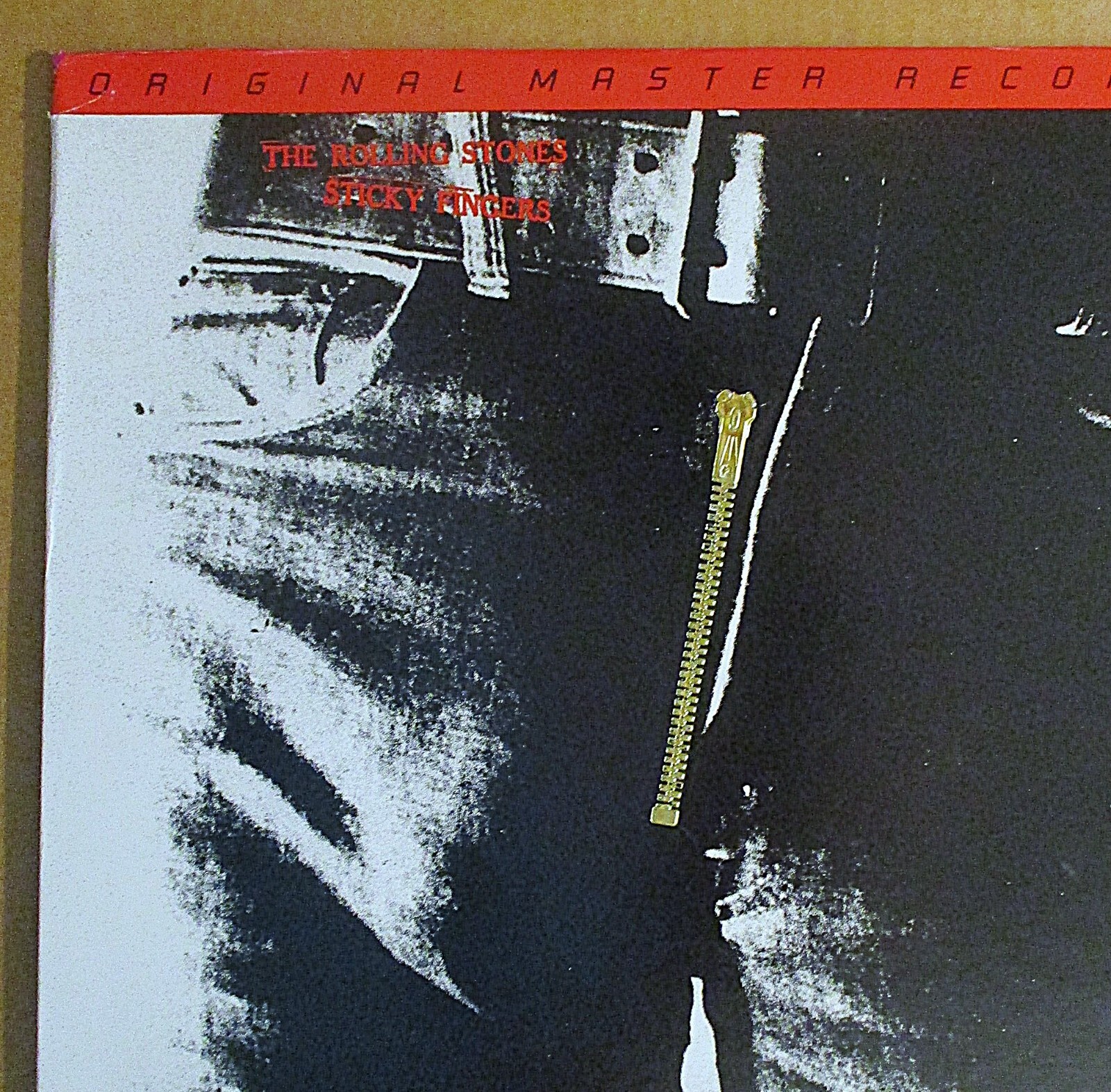
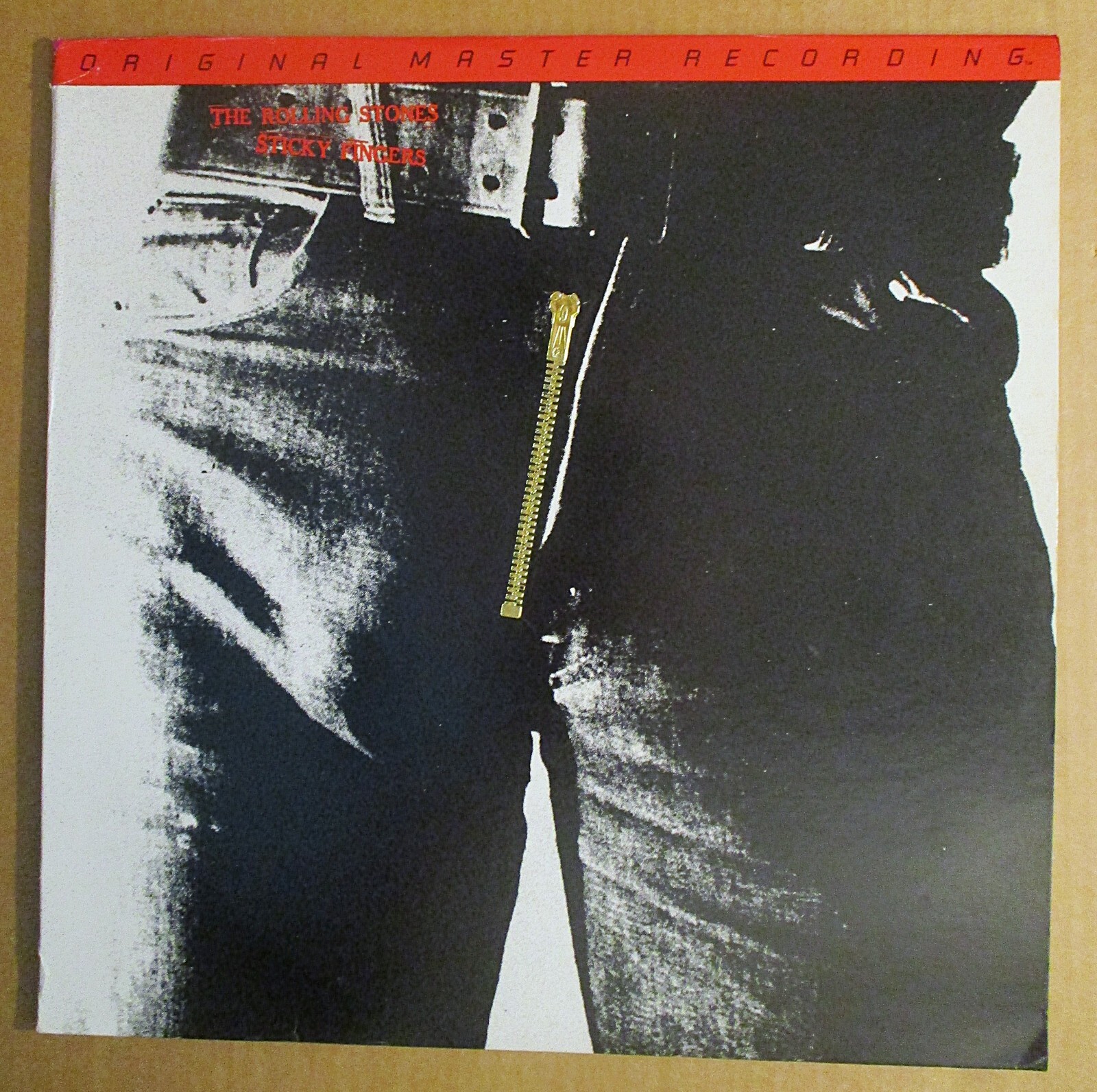
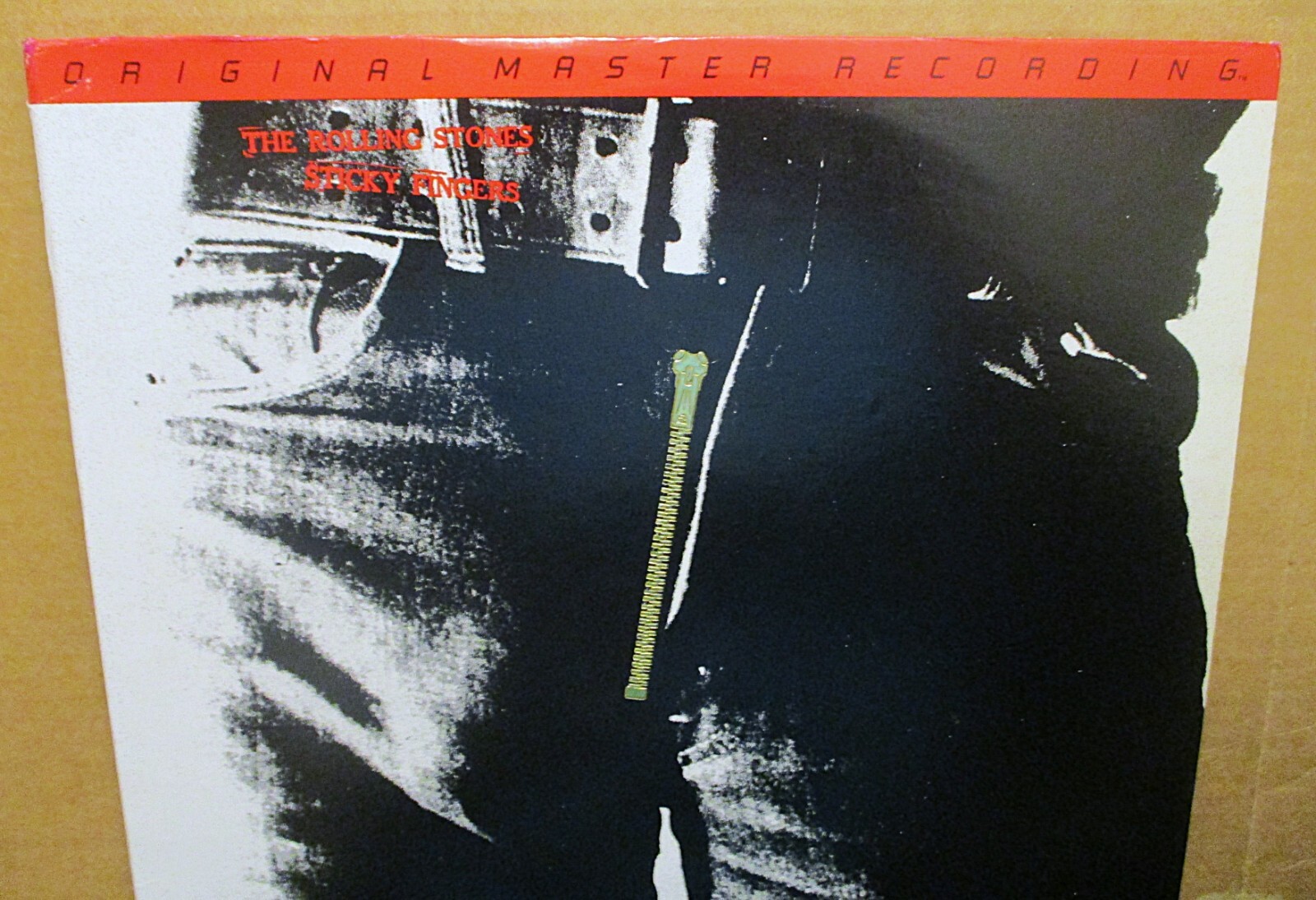
The original Grammy-nominated "zipper" album packaging for 'Sticky Fingers' featured a close-up of a man's crotch in tight jeans. It also had die-cut perforations around the belt buckle and a working zipper that you could open to reveal an image of the man's bulging briefs inside.
The multi-layered album cover was carefully put together in such a way that the top right corner was loose, but the rest of the right side was glued down, so that you could only open the jeans up partially to peek inside. Some UK and New Zealand pressings had a traditional gatefold cover, revealing the full bulging underwear image, but the rest of the world only got a teasing partial look inside.
The artwork was quite 'revealing' with it's controversial, clearly visible, outline of a penis, which many at the time assumed belonged to Mick. (or Keith).
The inner picture of bulging underwear was rubber stamped in gold with the stylized name of American pop artist Andy Warhol, below which read "This photograph may not be - Etc"
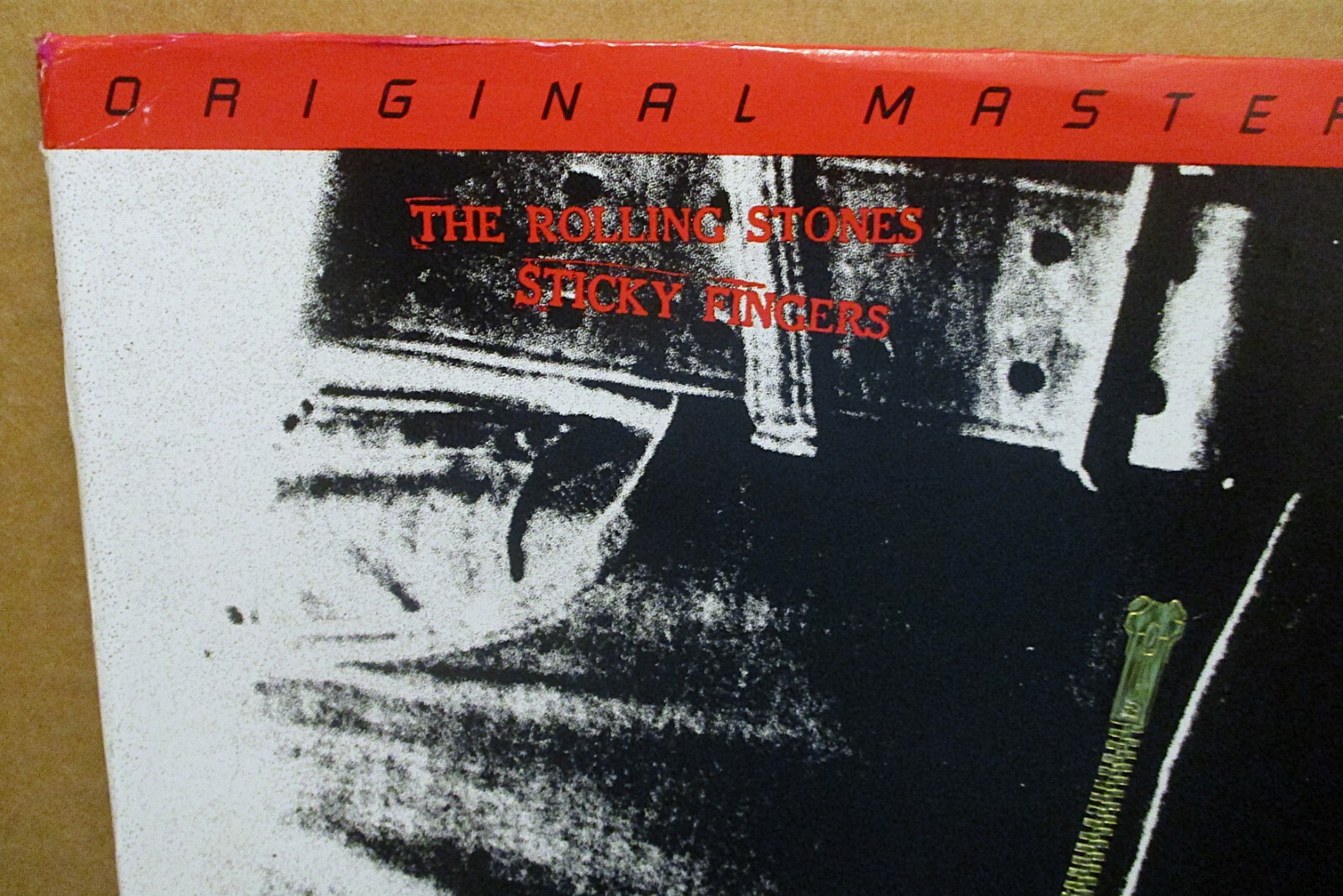
On the American release, the band's name and the album title were printed in bold red letters on the gentleman's belt. This Mofi pressing copied that American jacket style.
The back of the album jacket featured a similar close-up image of a man's jeans-clad butt.
British music magazine New Musical Express said at the time that “Fame has spread from Mick Jagger’s lips to his hips and zips.”
People at the time just assumed the model on the cover was Mick Jagger, which helped the album's sales and the band's notoriety, but the true identity of the male model is still unclear.
Andy Warhol took all the original photos with a Polaroid instant camera and he photographed several different Factory associates and 'protégés. Later on, Andy put all the Polaroids on a table and chose his favorite shots. It didn't really matter to Andy who the model was, it was which photos he thought were best.
The different models were all Andy's Factory associates, and the contenders were; Warhol film superstar Joe Dallesandro, Andy's film makeup artist Corey Tippin, Warhol's lover Jed Johnson, and Glenn O’Brien, an editor for Warhol's 'Interview' magazine.
To this day it remains uncertain who appears on the cover because Andy never publicly revealed exactly whose crotch he had immortalized. It's likely that at least 2 different models were used for the 3 shots.
Of course, many still insist the front cover photo of the crotch is actually Mick's. ~~~~~~~~~~~~~~~~~~~~~~~~~~~~~~~~~~~~~
Once the cover photos were chosen, it was album jacket designer Craig Braun who came up with the idea of adding a real working zipper to reveal the bulging underwear photo on the inside, instead of simply having it as a traditional gatefold image or printed on the inner sleeve.
Both Andy and the Stones thought it was a fabulous idea and that it added to the album's full effect.
Braun knew that adding a die-cut cover with a working zipper would add a significant cost to the album jacket, so he tried to get various zipper manufacturers to donate 'free' zippers in exchange for the advertising and fame of being on a Rolling Stones record that was predicted to sell at least a million copies.
Nobody was willing to donate 'free' zippers, so Braun asked Talon, one of the largest zipper companies at the time, for at least a nice discount. Talon offered him a deal for a zillion 4" zippers at 12 Cents each. Still too pricey.
Then Braun found a small New York City company, Cort Zipper, that gave him a better deal. "...We had to go everywhere in the world to find the zippers, but we eventually found Cort zippers, a nickel less than Talon" - Craig Braun.
One of the ways to identify First US pressings of this album is by their large tab 'Cort' zippers.
This 1981 Mofi 'Original Master Recording' pressing has a gold, non-working, textured, printed zipper. More on that later.
Although Cort zippers were first, eventually, lots of different 'brands' of zippers were used The 2015 vinyl reissue of 'Sticky Fingers' actually has a 'lips logo' shaped zipper pull.
The zippered cover of 'Sticky Fingers' was a great innovative idea and design, but when the first shipments of records arrived at retailers, the back of the jackets and the vinyl had some damage.
Because of the weight of the stacked albums during transport, the large Cort zipper tab from one record was denting the back of the jacket on top of it, and worse, the zipper pull was damaging the vinyl itself, right in the middle of the grooves on “Sister Morphine.”
Craig Braun, the jacket's designer, came up with a solution.
Before wrapping and shipping the records, he had workers at the pressing plant manually "unzip" the zipper slightly, so that the tab sat over the label of the record, not over the grooves. This helped minimize the damage, but the back covers were still getting 'dented' by the album under it when shipped.
The size and thickness of the zipper tab was quickly reduced, and the original Cort zippers were soon replaced with a 'flatter' style.
The 'lowered' zipper plan worked out well and actually looked even better on record store shelves. With the zipper pulled down, it’s even sexier. It shows that the zipper 'works' and that there's something behind it to be revealed. Mick Jagger called it “an amazing solution”.
The original record jacket for 'Sticky Fingers', with its fully working zipper, and revealing image, is still one of the most famous, best-known, and iconic album covers of all time. ~~~~~~~~~~~~~~~~~~~~~~~~~~~~~~~~~~~~~~
THE HISTORY, STORY & RECORDING OF 'STICKY FINGERS'
I suppose, in many ways, the beginnings of 'Sticky Fingers' is tied to the death of Brian Jones, the addition of new guitarist Mick Taylor, and the end of the 1969 American tour, so I'll start the story there....
On May 14th, 1969, Mick Taylor, who was fed up with, and about to quit John Mayall & the Bluesbreakers, auditioned for the Rolling Stones at Olympic Studios. He was instantly hired and joined the Rolling Stones' recording session for the song 'Live with Me' from the "Let it Bleed" album.
Mick was falling in with his new band, while Brian Jones was quickly falling out.
On June 8, 1969, Mick, Keith and Charlie met with Brian Jones at his home in Cotchford Farm and informed him he had to leave the group. They then issued a press statement that Brian Jones was leaving the Rolling Stones, and less than a month later, on July 2, 1969, Brian was found dead, floating in his swimming pool at Cotchford Farm.
Meanwhile, in the summer of 1969, Mick Jagger was in Australia filming 'Ned Kelly'. He had seriously hurt his hand during shooting and was trying to rehab it by fooling around with a new style of electric guitar.
Sitting in the middle of the outback, noodling around, Mick just came up with the words, melody and chords of 'Brown Sugar'.
'Brown Sugar', written in the summer of 1969, was the first new song the Stones had for 'Sticky Fingers'.
Near the end of the Rolling Stones 1969 Tour, on November 29, The Rolling Stones' 10th U.S. studio album, "Let It Bleed" was released.
The 1969 Tour officially ended a few days later, on November 30, at a show in West Palm Beach, Florida. Instead of returning home to England, the Stones immediately got to work on their new album, "Sticky Fingers" by driving up to Muscle Shoals Sound Studios in nearby Florence, Alabama.
Muscle Shoals was a smaller and much less glamorous studio than Olympic in London, but it had a special southern American 'sound & feel' that only those 'in the know', like the Stones, knew about and appreciated.
Over three days, December 2-4, 1969, the Rolling Stones managed to record Mick's 'Brown Sugar', 'Wild Horses' and a rough version of 'You Gotta Move', 3 terrific songs that would form the heart and core of their new album.
While at the studio, happy with their progress, the band decided to perform a final 'free concert' for American fans and decided on performing it in San Francisco. The band then flew from Muscle Shoals to San Francisco, on December 5th.
The Stones made a genuine attempt to perform a fun, free concert in San Francisco to celebrate the end of the tour and the spirit of Haight Ashbury, but it didn't work out that way.
Everybody wanted to exploit the fame of the Rolling Stones, so soon the shady promoters, marketers, and lawyers were in charge of the event, not the band.
After some last minute changes, on December 6, 1969, The Rolling Stones headlined the infamous free concert at the Altamont Speedway in Livermore, California, in front of 300,000 fans.
The concert was a disaster. The Hell's Angels, unwisely hired by someone as 'security', and paid with large amounts of alcohol, disrupted various group's performances, and a concertgoer ended up being stabbed and murdered right in front of the stage.
A lot of unhappy fans and the press unfairly blamed the Stones for how Altamont turned out, making them scapegoats. Altamont left a stain on the Stones that they had a hard time shaking off.
The day after Altamont, the Stones couldn't get out of America quick enough. On December 7th, the group flew back home to England and quickly hid from both the press and the public by retreating to the studio.
The band was in dire need of a reset and a new direction in order to shake off the bad press and bad reputation that had come in the wake of the 1969 U.S. tour and it's tragic ending at Altamont. ~~~
On December 9th, the Rolling Stones, already having the Muscle Shoals songs on tape, continued their recording sessions at Olympic Sound Studios in London.
They recorded a new version of 'Brown Sugar' with Eric Clapton joining in on guitar, and laid down rough versions of 'Dead Flowers' and a few other songs.
Missing being on the road and playing for live audiences, in December 1969, the band performed a few concerts, mostly for 'insiders' and the music press, at the Saville and Lyceum Theatres in London.
Around Christmas 1969, Mick Jagger and Marianne Faithfull went to Rome, to try to patch up their relationship, but it was clearly over between them. ~~~~~~~~~~~~~~~~~~~~~~~~~~~~~~
In early February 1970 The Stones gathered for a serious business meeting to figure out where they stood, financially, after cutting ties with Decca and Allen Klein. The reality of the situation wasn't good.
The band owed Millions in back taxes, which they just assumed that ex-manager Allen Klein was taking care of. He wasn't; he was only taking care of himself. The Stones earnings put them in a 93% tax bracket and there was no way they could earn enough money to dig them out of their hole, even with a new album.
The band and their financial planners realized that, due to financial mismanagement over a long period, in order to survive and earn a living, they would soon have to leave the UK to escape heavy taxes, and live abroad as 'Tax Exiles'.
A few weeks later, on February 19, 1970, the Stones were hit with another heavy financial blow when they were informed by their attorneys that they no longer owned the publishing rights and the master recordings of their earlier songs.
As I mentioned, in their haste to rid themselves of ex-manager Allen Klein, they accidently gave Klein ownership of all their pre-1970 publishing rights.
The Stones then realized that their entire financial future, and even their survival as a band, depended on their next album being a blockbuster.
Sessions for the new album, 'Sticky Fingers', continued in earnest. It was do or die.
Some recording sessions took place from March thru May 1970 at Olympic Sound Studios in London, but much of the recording for 'Sticky Fingers' took place during the summer and autumn of 1970, with the band secluded at Mick's large, luxurious, mansion 'Stargroves' out in the Newbury countryside. There, the band used the Rolling Stones Mobile Recording truck to capture new songs and creative moments.
At first, the Stones were in a slightly depressed mood over their situation, and the first songs laid down at Stargroves, after their intial sessions at Muscle Shoals and Olympic, were 'I Got the Blues', 'You Gotta Move', and 'C*cksucker Blues', among other somber bluesy tracks.
During early May, 1970, Charlie Watts, Bill Wyman and Ian Stewart participated in a recording session at Olympic Sound Studios in London with Howlin' Wolf, Eric Clapton, Steve Winwood, and other artists, which led to the fantastic, highly recommended, album "The London Howlin’ Wolf Sessions". These upbeat, rocking sessions rejuvenated the Stones rhythm section which directly led to the band recording more upbeat material for the new album. One of their American blues heroes, Howlin' Wolf, had inspired them.
In June, the Stones continued recording material at Stargroves and Olympic Sound Studios in London that included the fantastic 'Can't You Hear Me Knocking' as well as 'Shake Your Hips', 'All Down the Line', 'Sweet Virginia' and 'Shine a Light', songs that would eventually appear on "Exile on Main Street".
These sessions proved to the band that they could and would survive on their own record label, so on July 20, 1970 they officially ended their contract with Decca.
In the summer of 1970, The Stones did a brief European Tour, focusing on newer material from 'Let it Bleed' and songs that would be on the upcoming 'Sticky Fingers' album. That tour purposely downplayed their more 'violent' songs and image. For example, they only played "Gimme Shelter" once, on opening night in Malmo, Sweden and their sets contained more softer, countrified songs.
Despite trying to downplay their 'Bad Boy' image, the short 1970 European tour was not without its altercations and riots, further giving the band a bad public reputation.
In September 1970, "Get Yer Ya-Ya's Out!", The Rolling Stones' second live album after "Got Live If You Want It", featuring highlights from the 1969 tour with Mick Taylor, was released. Profits from that album's sales kept the band alive and funded further recording sessions for "Sticky Fingers".
In October and November, recording sessions continued at Mick Jagger's home, Stargroves, out in Newbury. Those sessions resulted in 'Bitch', 'Sway', and 'Moonlight Mile' for the new album, as well as 'Tumbling Dice', 'Sweet Black Angel', and 'Hide Your Love', that were saved for "Exile on Main Street".
By December 1970, the Stones had enough material for the new album laid down, so overdub/mixing sessions for 'Sticky Fingers' were held at Olympic Sound Studios in London. For Recording Engineers, the Stones chose Glyn Johns and his brother Andy.
During these mixing sessions, the Stones dusted off 'Sister Morphine', an earlier track recorded at Olympic in March 1969 for the "Let It Bleed" album but never used, and decided to include it on "Sticky Fingers". It fit the bluesy flow and the 'druggy' theme of the album perfectly.
'Sister Morphine' was Mick's final nod to his ex girlfriend, Marianne Faithfull, who wrote the 'sweet cousin Cocaine..' lines of the song.
'Sticky Fingers' was ready to go to press by January 1971. ~~~~~~~~~
THE RELEASE OF STICKY FINGERS
'Sticky Fingers' was a critically important album for the Stones at the time, since it was their first 'new' material in quite some time, and the first to be released in the aftermath of the Altamont disaster.
The Rolling Stones hadn't released a new studio album in almost two years. At the time this was the longest such hiatus the Stones had ever taken. The band’s first studio album of the 1970s was an almost unbearable 500 days in the making, an eternity in the pop music world at the time.
'Sticky Fingers' was a highly anticipated new album from one of the biggest bands in the world. Expectations for the album were enormous.
In early April 1971, the album's lead off single “Brown Sugar,” became the Stones’ first U.S. No. 1 hit since “Honky Tonk Women” two years prior. A week later, 'Sticky Fingers', the Stones 11th American studio album, on their new, and very own label, Rolling Stones Records, was unleashed upon the world. It was greeted with delight by fans and critics alike, and was a commercial smash.
It was the band's first album to reach number one on both the UK and US albums charts. The release of the album put the Stones back on track and they rose like a phoenix from their past troubles.
It was their third consecutive chart-topper and part of their amazing string of 4 great albums, from 1968's 'Beggars Banquet' and the following year's 'Let It Bleed', on through this album, and 1972's 'Exile on Main Street'. The Rolling Stones had created one of the greatest four-album runs in the history of rock music. ~~~~~~~~~~~~~~~~~~~~~~~~~~~~~~~~~~~~~~~~~~~~~
THE STONE'S 'NEW' SOUND ON 'STICKY FINGERS'
Much like the Beatles and Bob Dylan, the Stones’ had evolved in every aspect of their musical life - as songwriters, musicians, performers - during the late 60's.
With their freedom from Decca and Allen Klein, The Stones took a quantum leap forward into previously unimagined creative territory, and their musical style changed.
After the creative and commercial spiral caused by 1967's drug busts and their disastrous psychedelic “Satanic Majesties” album, the Stones became fascinated with, and moved towards, more simpler, rootsy, bluesy, American music. As the 60's came to a close, their connection to blues, R&B, and country music grew even more intense.
As Keith was diving deeper into his nasty habits: potions, pills, and powders, you name it, he took it, the band starting writing songs with a different fresh approach, utilizing their new guitarist Mick Taylor more, as well as following Mick's wishes to add horns to their sound.
This new album featured a musical return to basics for the Rolling Stones. It was the first studio album without Brian Jones, so, much of the unusual instrumentation used on previous albums, mostly Brian's influence, was gone.
The band's new music featured a return to the traditional classic rock lineup of twin guitars, drums, bass, and percussion, as expertly provided by Mick, Keith, Charlie, Bill, and new guitarist Mick Taylor.
Although he appeared on the fantastic Rolling Stones live album, '"Get Yer Ya-Ya's Out!", 'Sticky Fingers' was the first full-length studio album with new guitarist Mick Taylor.
Taylor is in top form on this album with his inventive guitar work. His playing and range of styles on this album are amazing. He faithfully captures the attitude, style, and sound of the Stones, but also adds his own distinctive sounds and flavors.
'Sticky Fingers' is filled with some heavy rock'n'roll and the clean, fluid, and highly melodic guitar work of Mick Taylor, flowing over the greatest rhythm section ever, but it's also full of southern-tinged Country rock, barrelhouse piano, pedal steel, Gospel, Soul, Stax-like horns, and gritty Chicago Blues.
The Stones were always fascinated with 'American' music and 'Sticky Fingers' contains the most authentically "American" sounding music the British-born Stones ever made. They aren't just copying the American blues and country that they love and respect, their are reinventing it, reformulating it, and making it their own. ~~
The overall musicianship on this album is outstanding and many excellent musical contributions are made by long-time Stones collaborators such as keyboardists Ian Stewart, and Nicky Hopkins.
The Rolling Stones horn section, made up of saxophonist Bobby Keys and trumpet player Jim Price, used so effectively on 'Let it Bleed', make a glorious return to the sound on 'Sticky Fingers'.
The Stones also used several 'guest' keyboard players on 'Sticky Fingers'; Billy Preston, Jack Nitzsche, and Jim Dickinson. Dickinson's honky-tonk piano really adds to the country-rock feel of 'Wild Horses'.
Billy Preston appears on several tracks and he adds a fantastic, soulful, churchy organ solo on 'I Got the Blues' that really nails the song's Gospel Rock feel.
Gifted musician and studio session player Ry Cooder adds his beautiful slide guitar to several tracks. His bluesy slide adds the perfect touch to 'Sister Morphine'.
~~~~~~~~~~~~~~~~~~~~~~~~~~~~~~~~~~~~~
The final 10 track listing on this classic album includes:
Brown Sugar / Sway Wild Horses / Can't You Hear Me Knocking You Gotta Move / Bitch I Got The Blues / Sister Morphine Dead Flowers / Moonlight Mile ~~~~~~~~~~~~~~~~~~~~~~~
Side one of 'Sticky Fingers' has always been one of my favorite "perfect" album sides. It packs such a raw, disheveled, bluesy punch.
When you drop the needle onto side one, the album hits you like a runaway locomotive, with the rollicking, boisterous opening track “Brown Sugar". After that classic opening song, 'Sticky Fingers' then opens up and reveals it's true, enigmatic power and charms.
Although 'Sticky Fingers' has a few radio-ready classic rock ‘n roll songs, the true beauty of the album is in its ability to conjure up so many different great moods, riffs, and atmospheres. ~~~~~~~~~~~~~~~~~~~~~~~~~~~
'Sticky Fingers' is Mick Jagger’s finest hour. Just like 'Exile on Main Street' is considered Keith's shining moment, this is, in many ways, Mick Jagger's album and his own shining moment.
By 1971 Jagger’s trademark mix of swagger and abandon had already made him rock's definitive frontman, but on this album, his songwriting, lyrics and vocal performances reach incredible new heights.
Jagger had long been a fantastic lyricist, as demonstrated by 'wordy' classics like '19th Nervous Breakdown' and 'Sympathy for the Devil', but it’s not just what he’s singing, but how he’s singing it.
'Sticky Fingers' showcased Jagger’s startling vocal range and power. Jagger's voice never sounded richer or fuller than it does here. Mick Jagger's voice is amazing; powerful, emotional, and all about melody, feeling, and style. Mick never sang better than what he does here.
His vocals on 'Brown Sugar', 'Bitch' and 'Can’t You Hear Me Knockin’ are perfect; sneering yet charismatic, hip, flowing, musical and spot-on.
Mick adds small vocal 'punctuations' throughout this album, like his perfectly timed, in-the-pocket, 'hiccup' that he slips in after the word 'drunk' on the line “I’m feeling drunk/ juiced-up and sloppy” on “Bitch.”
His final verse of “Sway” is a full-on gospel tinged shout and his tongue-in-cheek country twang on "Dead Flowers" is obviously played up for laughs.
It's hard to tell if Mick's bluesy voice on the band's cover of Mississippi Fred McDowell's 'You Gotta Move' is a sincere homage or a parody, but it's excellent. Bill Wyman actually plays piano on this take. ~~
"Brown Sugar" has a quintessential blues-rock riff, the greatest Keith Richards guitar riff that Keith never wrote. The song, riffs and lyrics are all Mick Jagger’s creation.
In the 50+ years since 'Brown Sugar' came out, many have grappled with this song. Mick's lyrics get more questionable the closer you listen.
Mick later said: "God knows what I'm on about on that song. It's such a mishmash. All the nasty subjects in one go... I never would write that song now"
'Can’t You Hear Me Knockin’ has a great funk soul feel. The 2nd half of the song breaks out into a Latin funk jam full of Mick Taylor's clean, fluid, melodic guitar lines, which were influenced by Santana's 1970 album 'Abraxas', which the Stones were well acquainted with.
'Sway' is a fantastic rocking song about “that demon life” that the Stones knew all too well. Although not credited, Pete Townshend and Ronnie Lane added backing vocals to the song at Olympic.
"I Got the Blues" is a powerful, sincere, slow-burn, blues song, sung and played in a swelling, Otis Redding R&B style.
'Bitch' kicks off side two of this fantastic album with its driving rhythm and crunchy boogie goodness.
'Wild Horses' is a beautiful, pure, heartfelt, country-folk ballad full of pristine bluesy guitar work and honky-tonk piano.
'Sister Morphine' is eerie and chilling! The song shows how well the Stones could convey the feeling of wasted, strung out, beauty and weariness.
'Sister Morphine' is one of the band's best 'drug' songs although Mick insisted the song was "about a man after an accident, really. It's not about being addicted to morphine"
The song features fantastic slide guitar work by Ry Cooder and Jack Nitzche's haunting piano. Charlie's drumming is amazing and powerful. At the end, the song just slowly fades out, as if to blackness or death. It's one of my personal favorite Stones songs.
'Dead Flowers', another personal favorite, is a clever, honky-tonk country song that leads into the last track on the album, the haunting, intoxicating, 'Moonlight Mile', one of the strangest and most unique recordings in the Rolling Stones’ entire catalog.
Jagger's intimate vocals on 'Moonlight Mile' are astonishing. They have a laid back, relaxed, 'just-woke-up' or 'never-went-to-bed' quality to them.
“When the wind blows and the rain feels cold/ with a head full of snow,” is a line too pretty to be about drugs, which means it’s almost certainly about drugs. Jim Price, the trumpeter, plays beautiful piano on this take. ~~~~~~~~~~~~~~~~~~~~~~~~~~~~~~~~~~
'Sticky Fingers' is where the Stones 'bad boy' myth matched up with the songwriting; Keith Richards' guitar riffs and melodies were in full force, Mick Jagger never sang better, their new guitarist, Mick Taylor, was upping the ante musically. Plus, the whole thing was wrapped up in a brilliant sexualized packaging concept by Andy Warhol. ~~
Los Angeles Times, music critic Robert Hilburn said that Sticky Fingers was “one of the best rock albums we’ll hear this year”.
Sticky Fingers was voted the second best album of the year by the Village Voice. Lester Bangs voted it number one.
NME wrote that it "captures the Stones bluesy swagger" in a "dark-land where few dare to tread."
The Guardian's Alexis Petridis ranked it the best album the band had ever produced, stating "their claim to be The Greatest Rock’n’Roll Band in the World has no more compelling evidence than the flawless 46 minutes of music here." ~~~~~~~~~~~~~~~~~~~~~~~~
THE PERIOD AROUND THE RELEASE OF STICKY FINGERS
Around the time of this release, April 1971 the Stones, once again, were heading off in new directions. The Stones played a brief 10 day run of college gigs on their March 1971 “Farewell To England” jaunt, just weeks before the album was released in the UK. These concerts were the band's first British shows in four and a half years and sold out instantly.
The Stones were at their absolute peak, as can be heard on many 'collector' records, and their 'Live at Leeds' limited official release.
The group's last UK gig was at London's Marquee Club, the place where the group had performed for the first time ever. The show was recorded for BBC TV.
Right after this brief UK tour, 'Rolling Stones Records' was launched on April 1st 1971, and the band prepared to leave England for France as 'Tax Exiles'.
By early 1971, much was changing behind the scenes, and the Rolling Stones were in flux and in transition in almost every sense of the phrase. So many things were happening in a short space of time.
Mick was clearly over his breakup with Marianne Faithful and had moved on. Fearful of not being able to return to England without consequences, Mick married Nicaraguan model and socialite Bianca Moreno de Macias in May 1971, in St. Tropez France
In the Spring of 1971, Keith Richards began renting a villa called Nellcôte, along the Côte d'Azur in the south of France. In May, The Rolling Stones started rehearsing and recording their next album, 'Exile on Main Street' in Keith's basement at Nellcôte.
What followed was a summer full of sex, drugs, decadence, and most certainly, rock and roll… as The Stones and their entourage started working on 'Exile' in the hot cramped basement of Nellcôte.
The stories behind the festivities at Nellcôte and the recording of 'Exile on Main Street' have become the stuff of Stones legend and Rock'n'Roll folklore. But that's a story for another day... ~~~~~~~~~~~~~~~~~~~~~~~~~~~~~~~~~~~~~~~~~~~
THE SOUND AND CONTROVERSY OVER THIS MOFI 'ORIGINAL MASTER RECORDING' PRESSING
This early Mofi pressing of 'Sticky Fingers' is one of the most polarizing MFSL titles in existence.
Some Stones fans think it sounds fantastic, and it was a great improvement over earlier pressings. Others think that this classic Rolling Stones album was just fine the way it was, and Mofi and mastering engineer Stan Ricker 'ruined' it by tinkering with it, remastering it, and over-polishing it.
The biggest complaint was that this album was mastered using Mofi's, then popular, 1980's era, 'Smiley Face' equalization curve which boosted the Bass and low end, as well as boosted the high end. This resulted in some of the midrange sounding slightly attenuated.
When this album was being considered for the 'Mofi Treatment', the biggest complaint against the original mix was that some of Bill Wyman's fantastic Bass playing was often 'burried' in the mix. In fact many people felt that several of the songs on 'Sticky Fingers' generally sounded thick, dense, muddy and 'burried'.
This MFSL pressing 'unburied' the songs, uncovered and released Wyman's Bass, and gave the album the kick it needed.
This album was originally recorded at several different locations so there was some degree of inconsistency in the bass from track-to-track.
Songs like 'Dead Flowers' and 'Wild Horses' really benefited from the new deep bass punch, and the improved bass sound really added to the enjoyment of these songs.
Some say that the added bass interferes with some of the other songs, like 'Brown Sugar' and 'Can't You Hear Me Knocking', effectively suppressing some of the mid-range of those tunes.
When listening, it's actually the quieter, bluesier tracks on 'Sticky Fingers' that seem to have benefited most from the heavier bass remastering.
Some fans felt that this MFSL album still had too much bass, and too heavy of a bass sound despite some clear improvements.
Stones purists quickly pointed out that this was The Rolling Stones, the greatest ROCK N' ROLL band in the world, and they always had a certain, shall we say, heavy, gritty, sludgy, grungey 'sound' to their music. Their music was supposed to sound this way; it was an intentional part of the original 'Sticky Fingers' sound and feel.
Others felt that the Rolling Stones were not some 'audiophile' band like Steely Dan. This was the Rolling Stones, and their recordings were never meant to be cleaned up, shined & polished, and turned into 'audiophile' records.
Many Stones fans liked the heavier bass, saying that this record was meant to sound loud and heavy. I have a MFSL cassette copy of 'Sticky Fingers' in my collection and the insert states "Brown Sugar's crunchy sound is intentional, not a defect".
Most, but not all, Rolling Stones fans eventually learned to accept this album's heavier bass sound. ~~~~~~~~~~~~~~~~~~
In addition to heavier Bass, Mofi's 'smiley face' equalization also boosted the original recording's high end.
Yes, this MFSL pressing has a slightly more pronounced high end, but there's a certain clarity to it. It's detailed, crystal clear, and never 'shrill' or harsh. It's not overpowering or 'bright' and the cleaner, louder, high end really opens up and improves many of the songs on 'Sticky Fingers'.
The high end really brings out details of the percussion and details of the acoustic guitars on this MFSL pressing. For example, on 'Wild Horses', you can really hear Keith's picking, his up and downward strumming, and sense his signature arm swing, all clear as day, as if he's sitting in the room next to you. ~~~~~~~~~~~~~~~~~~~
The 'SR/2' markings in the deadwax of this record indicate that this MFSL was mastered to vinyl at half-speed by Stan Ricker. In my opinion, it's the best sounding mastering I've ever heard of 'Sticky Fingers' and greatly improves the album.
Despite some 'tweaking' of the equalization curve, this MFSL pressing still retains the powerful and amazing punch and dynamics that this great album always had. The bold, punchy, dynamics of the music on this album is quite impressive. Much more powerful than earlier pressings.
Stan Ricker's mastering is crystal clear and reveals all the subtle detail of the original analog master tape. It sounds fantastic!
It has fantastic separation and full 3-dimensional imaging, revealing all the various instrument's individual details perfectly. The guitars have nice attack and decay making them sound more real and authentic.
There's fantastic stereo separation, a wide, well placed soundstage, and the individual instruments float transparently in three dimensional space. Fantastic 'imaging'. You can not only clearly hear everyone's individual contribution, you can 'see' them.
The result is an impressive pressing that sounds better than any other pressing of 'Sticky Fingers' I've ever heard. A fantastic sounding, well mixed, well mastered, very solid pressing and an amazing listening experience. ~~~
One of the other common 'complaints' about this pressing is that it was mastered and pressed at relatively low levels, and just doesn't sound that great when played at low volumes. That's somewhat true. You do need to really crank up the volume to fully appreciate and enjoy the experience of this record. Fortunately, the vinyl is dead quiet, so you can crank it up without adding any background noise or distortion.
It sounds great at normal listening levels, but when you crank this record up, things come alive and really shine. ~~~~~~~~~~~~~~~~~~~~~~~~~~~~~~~~~~~~~
People like to complain about the heavy bass and the low recording level of this recording, but one of the best improvements, one that no one talks about, is how this pressing restores and reveals the drum and percussion details.
Charlie's drums sound fantastic; crisp, clear, well placed, and well defined. The drums have a nice clean sound that isn’t present on earlier pressings. Charlie's technique, his light touches on the cymbals, and the snap of his rimshots all spring to life. His powerful, yet delicate drums on 'You Gotta Move', 'Sister Morphine', and 'Moonlight Mile' are perfect! But then again, Charlie's always been perfect.
'I Got The Blues' sounds like you are in the room, kicking back at Olympic Studios, just watching and listening to them play.
Ollie Brown, the percussionist on some of these tracks, also sounds excellent. His congas, bells and shakers come thru clearly and really add to the overall sound. The castanets in the intro to 'Brown Sugar' have a crisp, clear, click and snap.
Another thing not discussed is how great the Horns sound on this MSFL pressing of 'Sticky Fingers'.
On previous pressings and releases, the horns were often buried low in the mix and Bobby's sax often sounded like a kazoo, with more buzz than bite.
On this MFSL pressings, the Horns sound fantastic, ringing thru the the mix; bright, clear, and loud. You can hear bobby's reeds vibrate and really feel Bobby and Jim's horns punch and kick.
The horns really punch and sizzle on 'Brown Sugar' and 'Bitch'. They sound real, raw and in your face, not harsh and grating like on some of the regular pressings.
This MFSL pressing gives the listener a totally different perspective and a different, much better listening experience.
'Sister Morphine' has never sounded this good; crisp, stunning, emotional, and chilling. 'Moonlight Mile' has also never sounded so good.
Both 'Moonlight Mile' and 'Sister Morphine' have a haunting, spacious, darkness to them that really comes to the forefront on this quiet MFSL super vinyl pressing
This pressing opens up and reveals all the acoustic guitars buried on earlier pressings. They sound clear, well defined, and ring like bells. Keith's acoustic guitars on 'Wild Horses' sound fantastic. Mick Taylor's electric guitar on 'Horses' is crisp and has "presence".
Throughout this whole album, Mick Taylor's guitar work and solos have a new clarity, bite and 'presence' that wasn't as obvious on regular pressings. His fluid, flowing solo on CYHMK sounds amazing.
This MFSL pressing is just fantastic. It's not perfect, and I don't think anyone is wrong with their opinion of it, but I think it all comes down to people's individual stereo systems and personal preference. This Japanese MoFi pressing is my favorite version of 'Sticky Fingers', by far.
Noted record and equipment reviewer Michael Fremer summed up this album best in his article 'Round and Round: The Sound of The Rolling Stones':
"Mo-Fi's half-speed mastered edition (MFSL 1-060) was controversial when issued in 1980, with its jacked up lower bass, icy top end, sucked out midrange and low overall (recording) level. I'll tell you though, as my system has improved, the more I've come to appreciate it. It offers outstanding focus and clarity and its portrayal of inner detail and transient snap is unsurpassed. Admittedly the sound is not for everybody." ~~~~~~~~~~~~~~~~~~~~~~~~~~~~~~~~~~~~~~~~~~
'Sticky Fingers' is a perfect record. The Stones at their peak; great music, great musicianship, fantastic songs, and an iconic album cover. Plus, the strange story around its making has further added to its legend and lore.
While no singular Rolling Stones album can encapsulate their long, diverse and multifaceted career, 'Sticky Fingers' is a great place to start. It's one of their best, well balanced, and all-encompassing records and a remarkably pure distillation of their musical genius.
Although this Mofi pressing will never replace your need for an original 1971 First US, or first UK pressing in your collection, this is a fantastic Rolling Stones record and one that also belongs in your collection. ~~~~~~~~~~~~~~~~~~~~~~~~~~~~~~~~~~~~~
A nod of thanks to the many terrific Rolling Stones Collector's sites on the Interweb that I dug thru for inspiration for this write up. ~~~~~~~~~~~~~~~~~~~~~~~~~~~~~~~~~~~
CONDITION: I tried to show good hi-resolution photos of the jacket, labels, inserts, and vinyl in my pictures.
This is my original MFSL 'Original Master Recording' copy of 'Sticky Fingers' that I purchased new, nearly 45 years ago, when it was a recent release.
This record has been sleeved and stored properly for years, and is still in terrific condition.
VINYL: The vinyl is fantastic. Clean and bright, with a nice glossy sheen. No obvious flaws, hairlines, scratches, dings or damage. It looks terrific, sounds great, and I'm sure you'll be happy with it.
This record is beautifully pressed on thick, heavy, high quality 'Super Vinyl' with super sound to match.
You can see from my photos how terrific it looks. Just like the day I purchased it.
LABELS. This pressing uses the early white Mofi labels with the golden yellow lettering. The labels are clean and bright; no dings, scuffs, writing or damage. The spindle holes are clean and sharp, suggesting infrequent playing and my careful handling over the years.
JACKET: As you can see from my pictures, this still looks fantastic for a 45 year old copy. I tried to show details in my photos.
This jacket has some very mild, bottom right corner, 'bumping', from being stored and shifted around in my collection for 45+ years, but as you can see it otherwise still looks fantastic.
No names, marks, scuffs, ringwear or writing. The spine is straight, and there are no seam splits or other issues.
I should point out that the Tongue logo insert is clean and bright, no creases, and has sharp corners, but it does have single tiny clean 'pinholes' in the top corners. I don't remember, but I must have hung this up in one of my music rooms or offices decades ago. Not a big deal, but should be noted. (see picture).
Also, this Mofi pressing does not have the multi-layered, die-cut jacket or working zipper like early pressings. The Zipper is printed in gold, has nice details and stamped texture, but does not open. There are no 'bulging briefs' to be revealed inside. Another reason you need a clean early pressing in addition to this Mofi.
This copy is about as good a used copy of this classic early Mofi album as you're ever likely to find these days.
Very nice, all original, and a real gem. I'm sure you'll be very happy to add it to your collection. It would make a great addition to any Classic Rock or Stones vinyl record collection. ~~~~~~~~~~~~~~~~~~~
** NOTE: I'm selling this rare 'Collector' record "AS IS" and "NO RETURN". It's rare, and as described, and I'm sure you'll be very happy with it. A great, rare, original, excellent sounding copy. ~~~~~~~~~~~~~~~
I’m recently retired and downsizing and letting go some gems and rarities from nearly 50 years of vinyl record collecting.
Over the next few months I'll be offering an assortment of these rare and collectable LP’s. Many of these records have been in my personal collection for decades. Some of them are quite rare and seldom come up for sale. Limited pressings, European imports, promos, fan club releases, live recordings, first pressings and other general rarities.
Keep an eye on my Ebay page, 'jjrbyrne' for more of these great rare collectible albums, EPs and 45 singles.
All records have been carefully evaluated and graded by me. I visually inspect all records under bright light, personally gently clean them with a soft cloth and then, if unsure, play them on a modern high-end turntable and system to get a true picture of condition.
Please look at all the high-resolution pictures I added. They are all my own and are of the actual record being sold. The pictures are part of the description and can show small details, label variations, and condition better than I can put into words.
My grading is fair and honest. I have had over 3,600 happy and satisfied EBay customers over the years, with 100% positive feedback, and I have been buying/selling on EBay for nearly 30 years, so please bid with confidence!
I'm a One-man operation, this is a hobby, not my job. I do this for fun. I do this because I love music, love collecting vinyl and want others to share in that same experience. I take my time listening, researching, grading, listing and packaging. I will NOT sell any record that I personally would not want in my collection.
As you well know, packing and shipping rare records requires special care and attention, therefore, shipping cost within the lower 48 states is $5.00 on this item. If you would like insurance, or anything faster than Media/Economy Mail, please let me know and I can arrange it for you. I’ll work with you to make sure you’re happy!
I will gladly combine multiple records, or other items on my page, and make the shipping much less for you. I don’t inflate the shipping costs; they are what they are. I strive to keep them as low as possible. See my feedback for comments on my quality packing and shipping.
All items are packaged with sturdy cardboard mailers and appropriate padding. I take pride in my packaging and shipping and package all my records as if I were sending them to myself. I treat the records you win as if they were my own, and mail them the same way.
All orders are processed and shipped within 2 business days of receipt. We package and ship our vinyl records with the greatest care, using proper packaging to ensure that your rare and collectible vinyl records arrive in pristine condition.
Payments can be made by any of the multiple options that Ebay offers.
I will be happy to exchange feedback with anyone I complete a transaction with.
THANK YOU for looking and reading if you got this far. I know I rambled on a bit, but can't help it. I have a passion for records, especially the Rolling Stones.
I hope this listing was entertaining and informative. -- JOHN
price rating