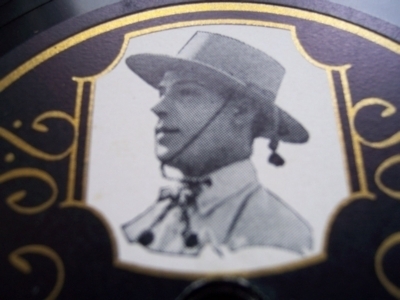
RUDOLPH VALENTINO extremly rare PHOTOLABEL 1923 Mint
€
86
$
100


Favourite Auctions
To save auctions to your favourites, please login
If you don't have an account, please register
Description
RUDOLPH VALENTINO extremly rare PHOTOLABEL 1923 Mint PRODUKTBESCHREIBUNG Verkaufe aus meiner sehr geliebten Schellack-Platten Sammlung, diese heiß begehrte Photolabel Platte mit Rudolph Valentino. Schönes und vor allem äusserst seltenes Label und Aufnahmen. Diese Platte hat ein beidseitig fast neuwertiges Label ! (im Gegensatz zu meiner ersten angebotenen Platte !) Es Singt/Artist: Rudolph Valentino Seite/Side A + B: Kashmiri Song (in English) / El Relicario (in Spanish) Label Druck / Label Print:Speciallabel BRUNSWICK / Distributet by the celebrities Recording Co. INC.Hollywwod California, sehr seltenes Sonderlabel !!! Very rare picturelabel. NEAR MINT LABEL / fast neuwertiges Label !!! Die beiden Label sehen Sie als Foto links von meiner Artikelbeschreibung! Left from the itemdiscription you can see both pictures from the label side A and B! Größe/Size: 10" ( 25 cm ) Geschwindigkeit/Speed: 78rpm Bestellnummer/Order Nr.: 33579 / 33580 Matrize/Matrix A / B : 33579 / 33580 Zustand/Condition: N- Near Mint / fast wie neu ! Location / Date of Recording: 14. May 1923 New York at the BRUNSWICK Recording Laboratories Comments: extremly rare PHOTOLABEL record Der berümte Schauspieler hat diese beiden Titel, für sich selbst ! , in New York aufgenommen. Nach seinem Tod brachte 1926 Bunswick diese Platte heraus. Der große Verkaufserfolg blieb jedoch aus. Rudolph Valentino sang einfach fürchterlich und er hätte es daher sicherlich nicht zum Tonfilm geschafft. Trotzdem, eine ausgesprochen extrem seltene Rarität. Es handelt sich auch ausdrücklich um das Original und nicht um die Kopie des korrigierten Intervievs ! This is an Original, not a copy with an edited interviev ! Rudolph Valentino Rodolfo Alfonso Raffaello Filiberto Guglielmi, in arte Rudolph Valentino, was born in the small town of Castellaneta, in Apulia, southern Italy, 6 May 1895. His father Giovanni Guglielmi (Martina Franca 1853 - Taranto 1906), an ex-cavalry captain, was a local vet. His mother (Castellaneta 1870 - France 1918), whose full name was Beatrice Barbin di Valentina d'Antoguolla, was of French origin. The family was originally from Martina Franca, a nearby town, where they owned land. They moved to Castellaneta after a massacre at the hands of brigands and went to live in via Commercio, 34 (today via Roma, 116). At birth, Rodolfo was an olive-skinned infant with slightly slanting eyes. He started his schooling in Castellaneta, until the family moved to Taranto, to live in a ground-floor apartment in a two-floor building on Via Massari. The idea of the move was to allow Rodolfo's father pursue his research in better equipped laboratories and ensure an adequate education for his sons. Rodolfo's performance at elementary school was far from outstanding, and a 1905 report from the state secondary school he attended reads pretty badly, too: failed, with 5 in Conduct, 5 in Italian, 2 in French, 4 in Mathematics, 2 in Art and only 6 for his handwriting. Rodolfo had one elder brother, Alberto and a little sister, Maria. Alberto was practically minded, easy-going and shy, whereas Rodolfo was a dreamer, with his mother's vivid imagination and a disobedient and restless streak in his character. He admired and respected his father, but had more in common with his mother. In Taranto, Rodolfo made his first friends and had his first adventures in love; at eleven apparently, he made his first victim, a little girl his own age called Teolinda. After his father's death in 1906, the family's financial situation deteriorated, and Rodolfo was sent to the Collegio Convitto per gli Orfani dei Sanitari Italiani, a boarding school for orphans of the medical profession in Perugia. He spent three years there and is remembered as a thin, 'ugly' little fellow, with a closed, cantankerous personality. His schoolmates baptized him 'the bat', on account of his pointed ears. By no means a model student, Rodolfo was eventually expelled for indiscipline. In 1909, he tried to get into the Naval Academy in Venice, but failed medical tests because of his weak chest and sight. He studied Agricultural Science instead, at the San Ilario College at Nervi, in the province of Genoa, where he obtained his diploma amidst general relief, and to his mother's delight. After just a few months back in Taranto, however, he went on a fatal holiday to Paris, where, overpowered by the 'Ville Lumière', he spent all his money having a good time and was obliged to write to his mother for the fare home. The trip to Paris was not an entire waste of time, however, for it was there that he began to work on his innate talent as a dancer, and became aware that Taranto could never provide sufficient scope for his ambitions. He told his brother, Alberto "Italy just isn't big enough for me", and promptly left for America. Rodolfo's interest in America was most probably fuelled by the success there of the Taranto musician, Domenico Savino (Taranto 1888 - New York 1973) , a conductor and composer who had emigrated in the retinue of the tenor, Tito Schipa. According to Leo Pantaleo, Rodolfo's family knew the Savinos well, and Domenico's sister used often to talk to Rodolfo about her brother's accelerated rise to fame. Rodolfo embarked on the cargo boat, "Cleveland" of the Hamburg America Line, and arrived in New York, 23 December 1913. There, as usual, he set about enjoying himself, ran out of money and was forced to take a series of jobs as a gardener, waiter and so forth. It was apparently due to an elegant tuxedo bought for him by Domenico Savino that, on applying to Maxim's, he was at once taken on as a taxi-dancer. In any case, his money troubles soon came to an end thanks to the generous tips left him by female clients. In that period, the famous dancer Bonnie Glass, finding herself without a partner after separating from her boy-friend Clifton Webb, was on the look-out for a promising male dancer. She saw Valentino dance - at this point his name was up on posters all over town - and, convinced that he had what it took, engaged him at fifty dollars a week. After Bonnie Glass, Valentino partnered another dancer, Joan Sawyer, for six months. According to Alexander Walker, Valentino was arrested in September 1916 after being denounced for false witness and instigation to prostitution, and was only let out after three days. Paramount could easily have made the file disappear to protect the image of their star. After his unhappy experiences in New York, Valentino joined up with an operetta company, which disbanded in San Francisco due to lack of funds. There, attracted by the climate and the fertility of the soil, he had the uncharacteristically down-to-earth idea of contacting the Italian Agricultural Society (set up to help Italian immigrants), in order to acquire a few acres of soil, build a farmhouse and, one day, when the war was over, bring over his mother. Unfortunately, a deposit of a thousand dollars was required and the idea came to nothing. In San Francisco, however, he met an old friend from New York, Norman Kerry, who had since become an actor and was in California to shoot a film with Mary Pickford. Kerry persuaded him to move to Hollywood, sure he had the phisique du rôle to work in cinema. In Hollywood Valentino made a dozen low-budget films before his overnight success with "The Four Horsemen of the Apocalypse". His mother, to whom he had kept writing, never knew anything about his success, since she died before the film came out, a cause of lifelong regret for Valentino. Soon after, he met his first wife, Jean Acker. A friend, Douglas Gerard, one of the directors of the Los Angeles Athletics Club, invited him to a party where Acker was presented to him as one of the rising stars of the screen. They passed the entire evening together and got married (5 November 1919). Kerry came to the wedding. This should have been the beginning of an idyllic period, but things turned out very differently. The couple separated after scarcely a month. On the set of "Camille" Valentino met his second wife Natacha Rambova Rambova was woman of some importance, not just for her love-life, but also on account of her artistic career. She was highly regarded in Hollywood both for her set and costume design. Valentino and Natacha spent all their time in animated discussion regarding the artistic choices to be made. Rambova was very ambitious, with a strong determined character, and became incensed with rage when her husband was given roles of scarce artistic quality. Valentino married Rambova, but found himself in jail for bigamy, having ignored a Californian law prohibiting re-marriage within a year of divorce. The gutter-press went wild, and Natacha returned infuriated to Hollywood, alone. June Mathis stood bail, and after three days Valentino was let out. The couple got married the following year. Valentino's disappointment with the artistic fruits of "The Young Rajah", led to the definitive break-up with Paramount. The company sued, obtaining an injunction which prohibited Valentino from making films with other producers. George Ullman helped the couple out of the ensuing financial straits. Waiting for his case against the company to come to court, the couple decided to travel to Europe, and Valentino made his first trip home to Italy to see his family. Back in Hollywood he shot "Monsieur Beaucaire", "A Sainted Devil" and "Cobra", before separating from his wife. His last two films were "The Eagle" and "The Son of the Sheik" produced by United Artists, who had a clause inserted in the contract forbidding Rambova to interfere in the artistic choices of her husband. Most probably, this was on of the motives for the couple's separation. In the last years of life, Valentino had a relationship with the popular actress Pola Negri, who lacked Natacha's coldness and insensitivity maybe, but failed to receive as much love. Before "The Son of the Sheik" had even come out, Valentino suffered a collapse, 15 August 1926, and was admitted to the Polyclinic Hospital in New York, where he was operated for a stomach ulcer and appendicitis. It was too late. He died on 23 August 1926. Two mourning procession, were organized, one in New York and another in Hollywood. His remains lie to the present day in the Memorial Park Cemetery of Los Angeles. Zustandsbewertung der Platten/condition 78rpm/grading chart: N / M = neu bzw. nicht gespielt / APPEARS UNPLAYED New or Mint. Ich biete diesen Zustand eigentlich nicht an, denn keiner kann einen ungespielten Zustand nachweisen. Ich beginne mit N- N- = fast neuwertig / near mint ALMOST LIKE NEW E = geringe Gebrauchsspuren / INSIGNIFICANT WEAR SHOULD PLAY CLEANLY, LITTLE MINIMAL SCUFFS. Meist kleine Kratzerchens. V = stärkere Gebrauchsspuren / SCRATCHES & SCUFFS, PLAYS ENJOYABLY WITH MINOR NOISE G / P = sehr schlechter Zustand / Poor. Oft wegen eines seltenen Labels sammelwürdig. Ein - oder + kennzeichnet ob die Platte besser oder schlechter als der allg. Zustand ist. - or + is badness or better Only optical condition. l = leicht / little kl. = klein oder winzig / little Nl. = Nadelloch / needledig Rs = Randschaden / Rimbrocken ( Bei mir nicht bis in die Rillen gehend. Weit von der Rille entfernt. Nur ein kosmetisches Problem also. Bei seltenen Labelplatten sind größere Randschäden mit Rillenzahl angegeben ) W = Wellig Hr. / Hc. = Haarriss / haircrack ( Haarrisse sind proffessionell fixiert und reissen dadurch nicht mehr weiter und spielen gut durch) Kr. = Kratzer / scuffs & scratches Die Platten wurden von mir nach besten Wissen und Gewissen rein optisch bewertet. Meist gehe ich dabei recht streng vor, damit es nicht zu Unstimmigkeiten kommt. Sie suchen eine bestimmte Platte? Fragen Sie per Mail ! Evtl. unterbreite ich ein Angebot. Als zusätzlichen Service biete ich zu allen Schellackplatten eine Schutzhülle kostenlos. So sind Ihre Platten optimal vor Schmutz und Staub geschützt. International Ebayer´s welcome. Bitte meine weiteren Angebote beachten !! In meinen weiteren Ebay-Angeboten finden Sie unter anderem : Schellack, phonograph, gramophone, gramaphone, graphophone, phonographe, phonographen, 78rpm, 78 r p m, 78upm, 78 u p m, 78 rpm, 78 upm, Rar, Konvolut, records, grammophon, grammofon, fonograf, Telefunken, Odeon, decca, Brunswick, Victor, beka, Brillant Special, capitol, polydor, Electrola, eterna, HMV, Imperial, kristall, MGM, Parlophon, Philips, polyphon, r e g a l, supraphon, tempo, ultraphon, victrola, vocalion, zonophone, polyphon, jazz, fox, foxtrot, mgm, decca, A M I G A, Kindergrammophon, Toyphonograph 226 ZAHLUNG Paypal kann die Abwicklung beschleunigen ! I prefer Paypal from international Ebayers ! Paypaladress: ronnybusse@freenet.de LIEFERUNG Bis zu 4 Schellacks versicherter Versand über HERMES für nur 4 Euro in Deutschland ! Bis 50 Schellacks versicherter Versand über DHL für 6 Euro in Deutschland ! Shippingcost for max. 3 records or 2 Kilo only 10 Euro Europe and 13 Euro international. For more records please ask the shipping cost ! I give the best price, only real shipping cost and the handling + packing is free for you. ÜBER MICH Schaut bitte auch bei meinen anderen Auktionen nach. Das spart Portokosten ;-) Please look by my other auctions and save your shipping costs. kindergrammophon.de / toyphonograph.eu HINWEIS HINWEIS Dieser Artikel wird privat verkauft; daher ohne Garantie, ohne Anwendung EU-Recht, Rücknahme und Umtauschrecht! Sollten Sie damit nicht einverstanden sein, bieten Sie bitte nicht!
databeckersuperseller.premium.3.3.60
price rating