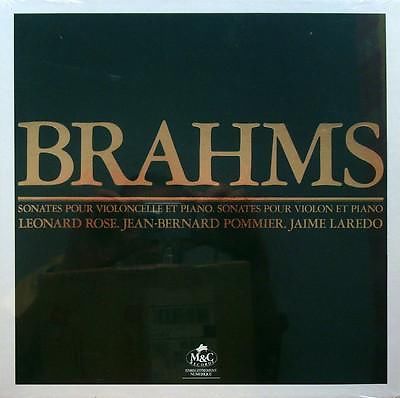
Rose/Pommier: Brahms Cello Sonatas - M&C Records 70001-10-11 (3LP box, sealed)
$
90


Favourite Auctions
To save auctions to your favourites, please login
If you don't have an account, please register
Description
redgarnett Store
ITEM DESCRIPTION:
This very rare and hamdsome 3LP box set, a still-sealed copy, from M&C Records (70001-10-11, French pressing, DDD stereo) sponsored by Vichy Laboratories features the very last recordings of cellist Leonard Rose, inspired readings of Brahms's Cello Sonatas No. 1 in E minor Op. 38 and No. 2 in F Major Op. 99, accompanied by that splendid French pianist Jean-Bernard Pommier, extraordinary performances later issued on CD by Virgin Classics.
Rose brings a lifetime's wisdom and experience to these works and Pommier proves the perfect accompanist, matching Rose's remarkable artistry from first to last, bar for bar. These recordings were made at the Château de Malesherbes, France, in August 1982.
Principal of the Cleveland Orchestra and then the New York Philharmonic, Leonard Rose was held in the highest regard by pianist Glenn Gould, and conductor Dmitri Mitropoulos once said of him, "I consider Leonard Rose the superlative cellist of today. He is the finest I have ever worked with, possessing all the qualities that make a great artist."
Of the Virgin Classics CD re-issue of these performances, the critic J.O.C. wrote in the April 1989 issue of The Gramophone:
"This was Leonard Rose's last recording, made at the Château de Malesherbes, France, in August 1982. The booklet includes a tribute from Isaac Stern, with whom (and Eugene Istomin) he so often played trios. It also prints interviews with both Rose and Jean-Bernard Pommier about their approach to Brahms and their partnership in general. Inevitably balance emerges as one of the major problems posed by these sonatas, and it's good to report that their own is in fact exemplary. If there was an audience at that French château, you are certainly not aware of it in what is an admirably full, clear and true reproduction of both instruments, particularly Rose's "voluminous, resonant and beautiful" (as he described it) 1662 Amati. There is just a trace of hardness in the louder keyboard sonority.
"Absolutely nothing in the sonatas is taken for granted. Both performances are deeply searching, with every small innuendo as it were re-thought so as to reveal new shades of meaning. For all three movements of the E minor work they favour slower tempos than their rivals listed above—very considerably slower than Harrell and Ashkenazy (Decca). I thought them rather too slow in the Allegretto quasi menuetto, where their pursuit of detail draws rather too much attention to itself— as does their rubato at the start of each section in the trio. I also questioned so pronounced a relaxation of tension in second-subject territory in the finale (notably between 4'22" and 4'45" of band 3).
"The F major Sonata is a more impassioned work than the first, and here they are much more carried along on the music's own tide. This is a richly eloquent reading, all the more admirable because not even a single pp pizzicato from the cello is ever submerged in the composer's almost orchestrally conceived keyboard part. All in all a disc exploratory enough to double your admiration for Brahms's unfailing invention, even though I'm bound to admit that Rostropovich (DG) and Harrell, with their respective partners, remain my top favourites for tone, style and some indefinable quality of interpretative intuition."
---------------------------------------------------------
Also included in this set, and very much on the same plane as Rose's contribution, is the veteran Jaime Laredo's traversal (also with Pommier) of Brahms's Three Violin Sonatas: No. 1 in G Major Op. 78, No. 2 in A Major Op. 100, and No. 3 in D minor Op. 108. These recordings were made at the Château de Malesherbes, France, in January 1983.
Of the Virgin Classics CD re-issue of these performances, the critic Guy Aron wrote for MusicWeb-International:
"Brahms' first essay in the violin sonata form was the Scherzo movement from the F.A.E. Sonata, a work jointly written by Brahms, Schumann, and Schumann's pupil Albert Dietrich. This is a vigorous movement with a repeated note motif and characteristic Brahmsian cross-rhythms. The Scherzo receives a bracing performance, with Laredo not afraid to put weight on the bow. Immediately one notices the rather dry recording, something that makes the piano sound a bit dead; the violin can also seem bleached on the upper strings above forte.
"The first complete violin sonata was published in 1879. It is often known as the "Regensonate" or "Rain Sonata" because it borrows several themes from Brahms' song "Regenlied", composed in 1873. It is a mostly gentle, lyrical work in Brahms' early manner, not unlike Beethoven's "Spring" violin sonata no. 5, op. 24. Laredo and Pommier play the first movement in a serene fashion. Here, as throughout, there is genuine chamber music interchange, with one player receding when the other has the spotlight. Their measured approach to the second movement generates tension, and Laredo's double-stopping at the return of the theme has warmth. The finale is one of Brahms' elegantly unsettled movements; the duo develops its short motifs into longer episodes with great skill.
"The second sonata in A major was written seven years later in 1886 and has a positive, open feeling. As before, Laredo and Pommier emphasise the lyrical character of the opening movement. Some of Laredo's playing lacks tonal allure, and his intonation is not always spot-on. The expansive set of variations which forms its second movement is similar to the Poco adagio from the earlier String Sextet no. 2 in G major, op. 36. Laredo and Pommier approach the theme seriously and the variations are well contrasted. The finale brings some soulful, viola-like sounds from Laredo's G string and the double-stopping is juicily played.
"The third Sonata is the only one to feature a Scherzo. Although written only a couple of years later than the A major work, it is much more turbulent in mood, as its key of D minor would suggest. The clouded beginning steals in, and Pommier's right hand doubles the violin line delicately. The second movement brings some lovely legato playing and tasteful expressive slides from Laredo. The scherzo is another of Brahms' elegantly wistful movements with more agitato episodes. The Presto is launched with fervour; Laredo sacrifices some tone in the loud chordal passages.
"As it happens, the Laredo/Pommier Brahms Violin Sonatas was one of the first CDs I bought, and I was glad to make its acquaintance again. My comparison recording is that of György Pauk and Roger Vignoles, released as part of the Brilliant Classics Complete Brahms Chamber Music. It is also available as a single CD (Brilliant Classics Catalog # 93989). The relaxed nature of their interplay tells of their long experience as a duo; they take about a minute and a half longer over the first sonata, but timings are otherwise pretty close. The recording is a bit more "dead" than the Virgin recording, but the piano sound is superior."
---------------------------------------------------------
This is exalted music-making by any measure and this first issue of these recordings – Leonard Rose's last – remains extremely elusive, particularly in a superb, still-sealed copy.
Note: I have sold this set once before and can confirm that a very nice booklet is included.
CONDITION:
The gradations of condition I use are as follows: MINT, Near-Mint, Excellent, Very Good, Good, Fair, Poor.
The condition of the still-sealed box is near-MINT. The shrinkwrap remains almost entirely intact, though there are a few small on the rear panel. However, there are no seamsplits, bends, or owners' markings, and the whole remains extremely solid, bright, glossy, and striking in appearance – very much a fine collector's copy.
The condition of the 3 LPs is MINT throughout – these are sealed, unplayed copies – the perfect collector's copies.
PLEASE NOTE:
The images I've provided are of the actual item you are potentially bidding on - these are not stock images or images I've taken from other sites. Bid with confidence!
PAYMENT:
Payment by PayPal is greatly preferred. Payment should be made within 5 days.
SHIPPING:
Shipping is free to anywhere in the world; this is true regardless of the number of LPs you buy, be it 1 or a 100. All LPs will be sent via standard airmail (7-10 days delivery). Note: There is no tracking number provided with standard airmail. Should you wish to have your item(s) sent via certified airmail (i.e., with a tracking number), please contact me. The fee for this $5.00 USD.
FEEDBACK:
I will promptly leave feedback for all buyers. Please do not leave negative, or even neutral, feedback without first giving me an opportunity to resolve any dissatisfaction you might have with an item or transaction. I do understand that, on occasion, a buyer might believe the item description to be inaccurate or that a buyer may be disappointed in some other way regarding the sale. I promise I will do my very best to resolve any unhappiness you've experienced in your buying experience with me to your complete satisfaction. Thank you.
REFUNDS:
Returns are honored, and any buyer you makes a return will be refunded in full. Please contact me before making a return.
Please see my other classical LP and CD auctions, and feel free to write with any questions, I'll be glad to help.
price rating






![Ronnie Milsap - There's No Gettin' Over Me (1981) [SEALED] Vinyl LP •](https://www.popsike.org/php/thumbnail.php?url=https://www.popsike.pics/pix/20210322/114736004067.jpg)