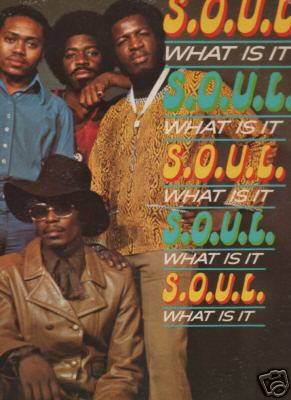
S.O.U.L. - What Is It LP Funk Soul Breaks
$
148


Favourite Auctions
To save auctions to your favourites, please login
If you don't have an account, please register
Description
Record Condition: VG + (Minor light surface marks. No skips. Shiny lacquer. Clean labels.) All auction LP's are professionally cleaned using a VPI Record Cleaning Machine.
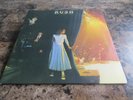
Cover Condition: VG + (Very slight surface and edge wear. No seam splits. Very slight ring wear on upper front cover - see photo. No stickers. Previous owner's name written in pen along left front cover.)
Notes: From 1971. Musicor Records (#MS 3195). Stereo. U.S. pressing.
Biography by Andrew Hamilton (www.allmusic.com)
Originating in Cleveland, OH, S.O.U.L. stood for "Sounds of Unity and Love." The members were Lee Lovett (bass), Gus Hawkins (sax/flute), Paul Stubblefield (drums), and Walter Winston (guitar). Larry Hancock (vocals/organ) was added in 1971 and Bernard (Beloyd) Taylor (guitar) replaced Winston in 1972. All had been involved in music before the formation of S.O.U.L. The fellows entered a battle-of-the-bands contest in 1970, sponsored by the May Company department store in Cleveland, WHK radio station, and Musicor Records. The group won the first prize of 1,000 dollars and a recording contract with Musicor. They traveled to New York City in 1971 and recorded a 45 entitled "Down in the Ghetto Parts I & II" which exceeded the expectations of Musicor by doing so well regionally. They cut a second single, then were invited back to New York to record an album. What It Is consisted of seven tracks and illuminated the versatility of the band. They did covers of jazz and funk tunes to augment their two singles. It did quite well, cracking the Top 40 album spot on Billboard's soul album chart and nesting there for two months. The album was released in the United Kingdom and other European countries in the early '90s on the BGP label where S.O.U.L. is a cult figure.
Bassist Lee Lovett was born in Detroit but moved to Cleveland in the late '50s. He led a popular band entitled Lee Lovett and the Dynamic Sounds in the '60s who played live gigs and backed some local acts in the studios.
Sax/flute player Gus Hawkins was born in Oakwood, where minorities were as scarce in the '50s and '60s as Dixie Peach hair dressing. It was an upper-middle-class village about 13 miles from Cleveland. He learned to play tenor sax in Oakwood's schools as a member of the band. Leaving school in the '60s, he moved to Cleveland and joined the Futuretones.
Around the time S.O.U.L. began work on their third LP, Winston quit the group and was replaced by Bernard "Beloyd" Taylor. Beloyd's birth place is a mystery, but he grew up in Cleveland. With Taylor, they enjoyed their most successful single, "This Time Around," which made the Top 50 R&B. The next release, "The Jones," written by Lee Lovett, entered the Top 100 and hung around for ten weeks.
After a few more releases the guys split up, going their separate ways. Gus Hawkins went to school and became a phlebotomist, then worked at the Cleveland Clinic before moving to Atlanta, GA, to work and raise his family. Paul Stubblefield joined a ten-member group called the Rasts, recording and touring before becoming a member of the Murphys (a lounge act). He also toured with various versions of the Ink Spots and the Platters before moving to Phoenix, AZ. Taylor moved to Los Angeles and wrote "Get Away" for Earth, Wind & Fire in 1976. He also recorded solo for 20th Century Records and later toured with Earth, Wind & Fire. Lee Lovett stayed in Cleveland and recorded tracks with other groups.
Hancock has been active since the breakup of S.O.U.L., recording with two versions of Truth. The first group featured Hancock, Al Boyd, Leo Green, and Russell Watts. Al Boyd later co-wrote "Shakey Ground" for the Temptations (it was redone by Phoebe Snow). Truth recordings failed to chart and two members left, leaving Hancock and Green as Truth's only members. The two recorded an album on Devaki Records as Truth, entitled Coming Home, that fail to grab the public when released. Interestingly, Dennis Edwards had been kicked out of the Temptations and was hanging around Cleveland and played a big part in the Coming Home album. Hancock ventured back out to California and recorded for Decca Records including a duet with Alfie Silas before returning to Cleveland. He also sang with one of the Platters groups. Lead singer Sonny Turner ("With This Ring") is a Clevelander and they knew each other well.
Click here for additional information about this album - including a track listing.
Buyer must include $3.00 for Media Mail OR $5.50 for Priority shipping and handling using a sturdy cardboard LP mailer. More overseas. If you have any questions, please feel free to e-mail us.
All records are graded using the following Goldmine Price Guide criteria:
Mint: Absolutely perfect in every way. Certainly never been played, possibly even still sealed. I do not use this grade.
Near Mint: (NM or M-) A nearly perfect record. Many dealers won't give a grade higher than this implying (perhaps correctly) that no record is ever truly perfect. The record should show no obvious signs of wear. A 45 RPM or EP sleeve should have no more than the most minor defects, such as almost invisible ring wear or other signs of slight handling. An LP cover should have no creases, folds, seam splits or other noticeable similar defects. No cut-out holes, either. And of course, the same should be true of any other inserts, such as posters, lyric sleeves and the like. Basically, an LP in near mint condition looks as if you just got it home from a new record store and removed the shrink wrap.
Very Good Plus: (VG+) A Very Good Plus record will show some signs that it was played and otherwise handled by a previous owner who took good care of it. Record surfaces may show some signs of wear and may have slight scuffs or very light scratches that don't affect one's listening experiences. Slight warps that do not affect the sound are "OK". The label may have some ring wear or discoloration, but it should be barely noticeable. The center hole will not have been misshapen by repeated play. Picture sleeves and LP inner sleeves will have some slight wear, lightly turned up corners, or a slight seam split. An LP cover may have slight signs of wear also and may be marred by a cut-out hole, indentation or corner indicating it was taken out of print and sold at a discount. In general, if not for a couple things wrong with it, this would be Near Mint. All but the most mint-crazy collectors will find a Very Good Plus record highly acceptable.
Very Good: (VG) Many of the defects found in a VG+ record will be more pronounced in a VG disc. Surface noise will be evident upon playing, especially in soft passages and during a song's intro and fade, but will not overpower the music otherwise. Groove wear will start to be noticeable, as with light scratches (deep enough to feel with a fingernail) that will affect the sound. Labels may be marred by writing, or have tape or stickers (or their residue) attached. The same will be true of picture sleeves or LP covers. However, it will not have all of these problems at the same time, only two or three of them.
This item must be paid for within 14 days of the end of the auction or it will be re-posted. We gladly accept PayPal as well as money orders and checks.
Click here to see our other auctions.
Check Out Our 'About Me' Page For More Info On Our Chicagoland Stores!
price rating
![Ozzy Osbourne Randy Rhodes Tribute [double lp] blue label *NICE CLEAN COPY*](https://www.popsike.org/php/thumbnail.php?url=https://www.popsike.pics/pix/20211129/304244200208.jpg)


![Rush- Clockwork Angels + Moving Pictures: Live 2011 [3LP Vinyl Bundle]- SEALED](https://www.popsike.org/php/thumbnail.php?url=https://www.popsike.pics/pix/20140822/380981127351.jpg)