SPRINGSTEEN "STILL ON THE EDGE" RARE 'DARKNESS' ERA OUTTAKES 2-LP GREAT CLASSIC
$
27
Favourite Auctions
To save auctions to your favourites, please login
If you don't have an account, please register
Description
SPRINGSTEEN "STILL ON THE EDGE" RARE 'DARKNESS' ERA OUTTAKES
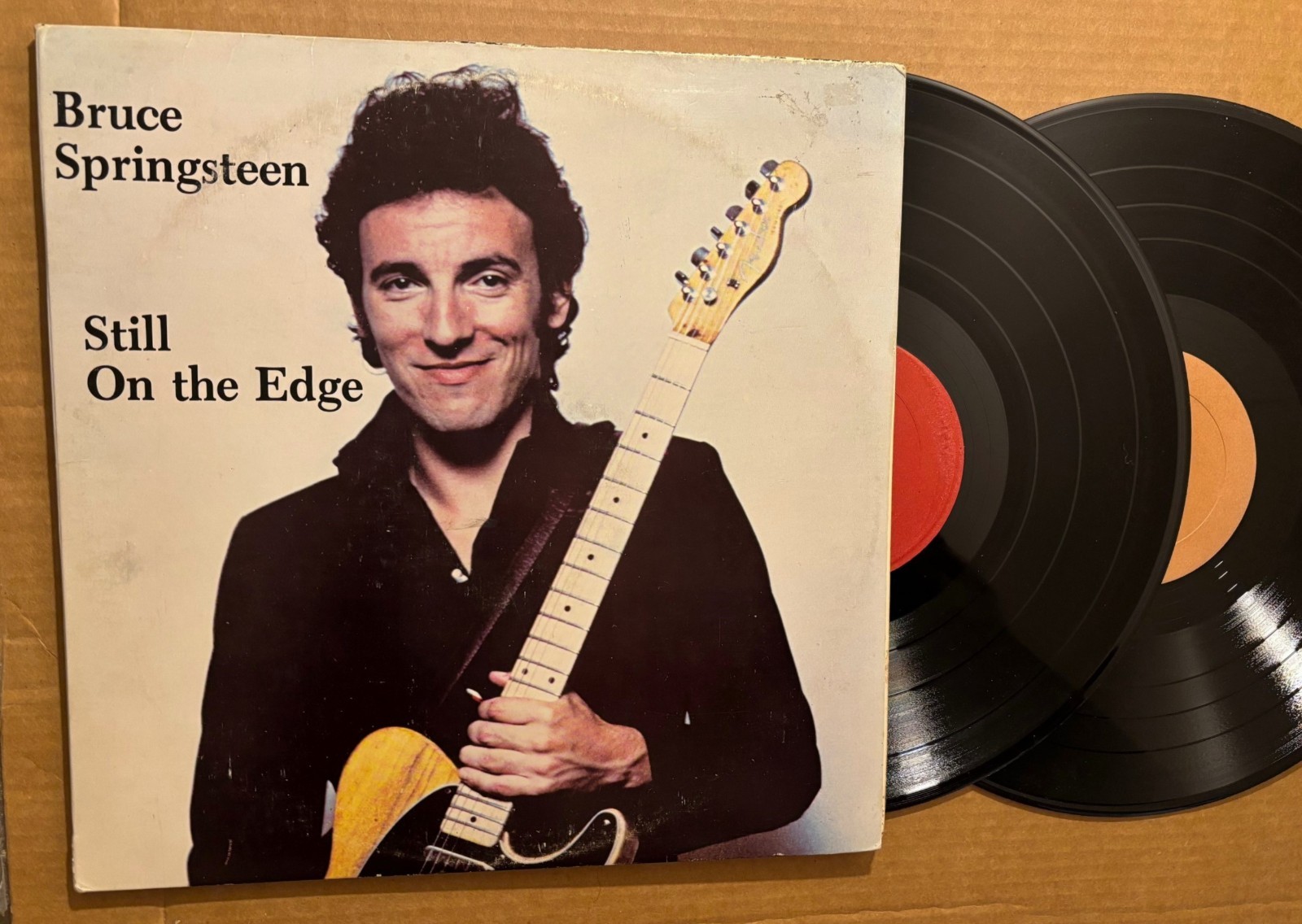
BRUCE SPRINGSTEEN BRUCE SPRINGSTEEN & THE E-STREET BAND "STILL ON THE EDGE" RARE & UNRELEASED 'DARKNESS' ERA OUTTAKES LABEL: JERSEY RECORDS ~ JER-1 2-LP COLLECTION OF STUDIO RARITIES DELUXE GATEFOLD JACKET w/ COLOR LABELS RELEASED: 1982 MATRIX (SIDE A): (Etched) JER - SIDE 1
CONDITION: VINYL: EX JACKET: VG+ ~~~~~~~~~~~~~~~~~~~~~~~~
This week on EBay I'm offering up this rare, vintage 1982 original First Pressing of the fantastic Bruce Springsteen 'collector' record 'Still on the Edge'
This is my personal, original copy that I purchased back in NYC in the early 80's and it has remained sleeved and stored properly in my vinyl record collection ever since.
The vinyl is in excellent condition, and the beautiful deluxe gatefold sleeve is still quite nice. Please read the full description of this 'collector' album's content and more details on the record's condition below. ~~~~~~~~~~~~~~~~~~~~~~~~~~~~
This fantastic 2-LP 'collector' record contains many amazing studio outtakes and early working versions of songs that were recorded in NYC in the summer of 1977. Some went on to be included on Bruce's 4th album, 'Darkness on the Edge of Town', some were saved and later dusted off and reworked for his next album, The River, and some were never released.
It was great to have these all compiled onto one double album and this record makes a fantastic album from Bruce’s classic golden years.
When this album was released in 1982, this was appreciated by us Springsteen collectors as an excellent looking and great sounding compilation of some rare performances of classic Springsteen songs. Many were brand new to us. ~~~~~~~~~~~~~~~~~~~~
The songs on this album, "Still on the Edge", are all original 1977 studio outtakes from the 'Darkness on the Edge of Town' sessions. Most all of these songs are from various dates, from June to October 1977, early in the recording sessions.
All but one track, 'Come On' ('Let’s go Tonight'), were recorded at Atlantic Recording Studios in New York City. 'Come On' ('Let’s go Tonight') was recorded in July 1977 at the Record Plant.
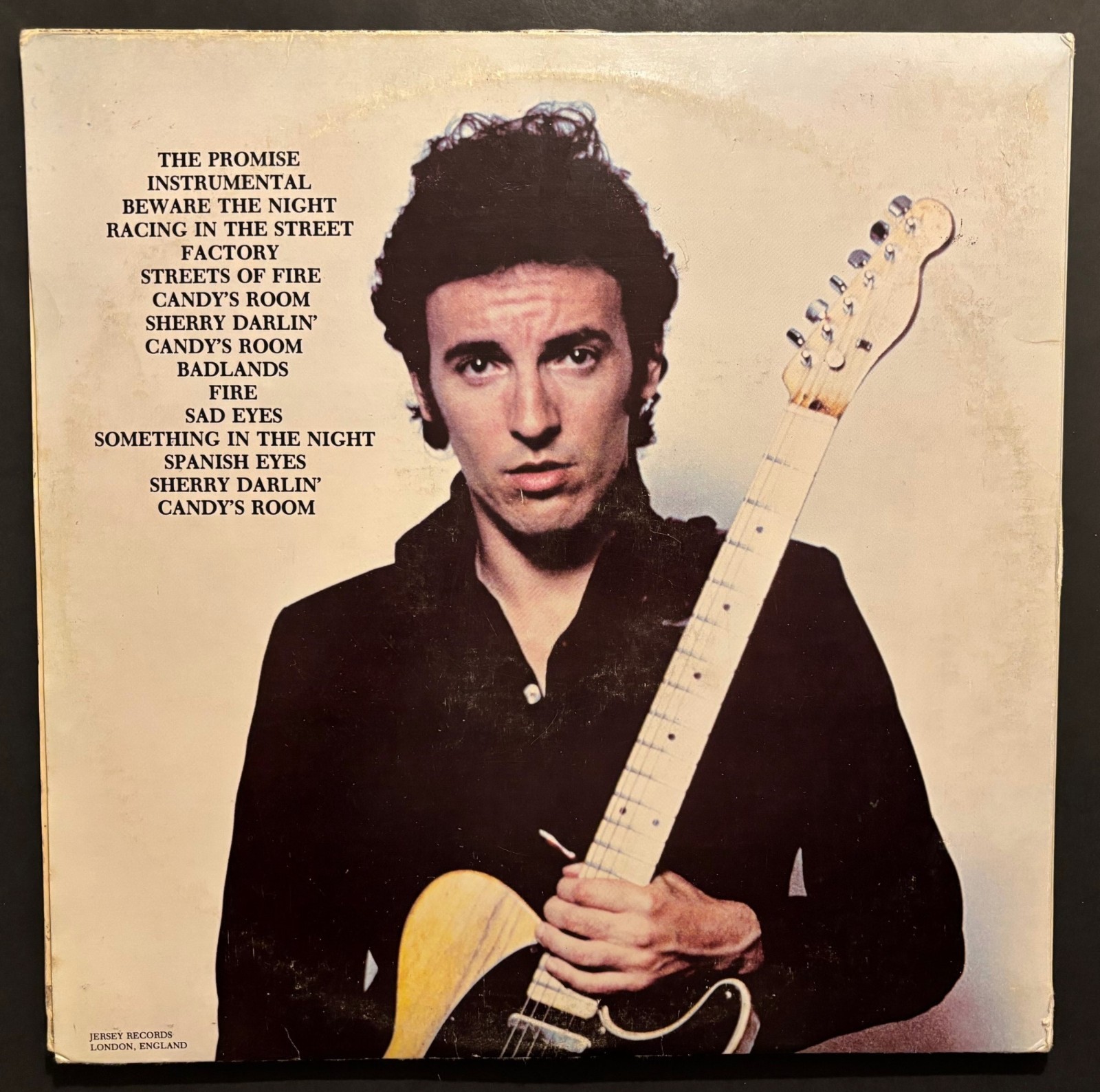
It's clear that the song titles, as listed on the album jacket, have some errors. When this album was pressed in 1982 the 'correct' names of some of the songs were not known.
The song titles, as they appear on the album jacket include:
The Promise Instrumental Beware The Night Racing In The Street Factory Streets Of Fire Candy's Room Sherry Darlin' Candy's Room Badlands Fire Sad Eyes Something In The Night Spanish Eyes Sherry Darlin' Candy's Room ~~~~
Also, the original album cover makes no mention of recording dates, but with hindsight, with more knowledge about the Darkness sessions being revealed over the years, the exact recording dates are now known.
The 'correct' song title and the recording dates are listed below:
THE PROMISE - Aug 30, 1977 DON'T LOOK BACK - June 6-8, 1977 BECAUSE THE NIGHT - June 1, 1977 RACING IN THE STREET - July 2, 1977 COME ON (LET'S GO TONIGHT) - July 2, 1977 STREETS OF FIRE - June 1977 THE FAST SONG (#1) - June 1977 SHERRY DARLING (#1) - June 24, 27 or July 1, 1977 CANDY'S BOY - June 6, 1977 BADLANDS - July 13, 1977 FIRE - June 17, 1977 DRIVE ALL NIGHT - June 16, 1977 SOMETHING IN THE NIGHT - June 16, 1977 SPANISH EYES - July 13, 1977 SHERRY DARLING (#2) - June 24, 27 or July 1, 1977 THE FAST SONG (#2) - June 1977 ~~~~~~~~~~~~~~~~~~~~~~~~~~~~~~~~
This album contains some of the best, most iconic, early Bruce Springsteen songs, from his best period. They reveal what a terrific, prolific songwriter Bruce was, and the absolute magic that his E-Street band could deliver in the studio.
An excellent selection of 'vintage' Bruce Springsteen and the E Street Band material and an essential record for any Springsteen fan. ~~~
This is an original first pressing from 1982 on the Jersey Record label.
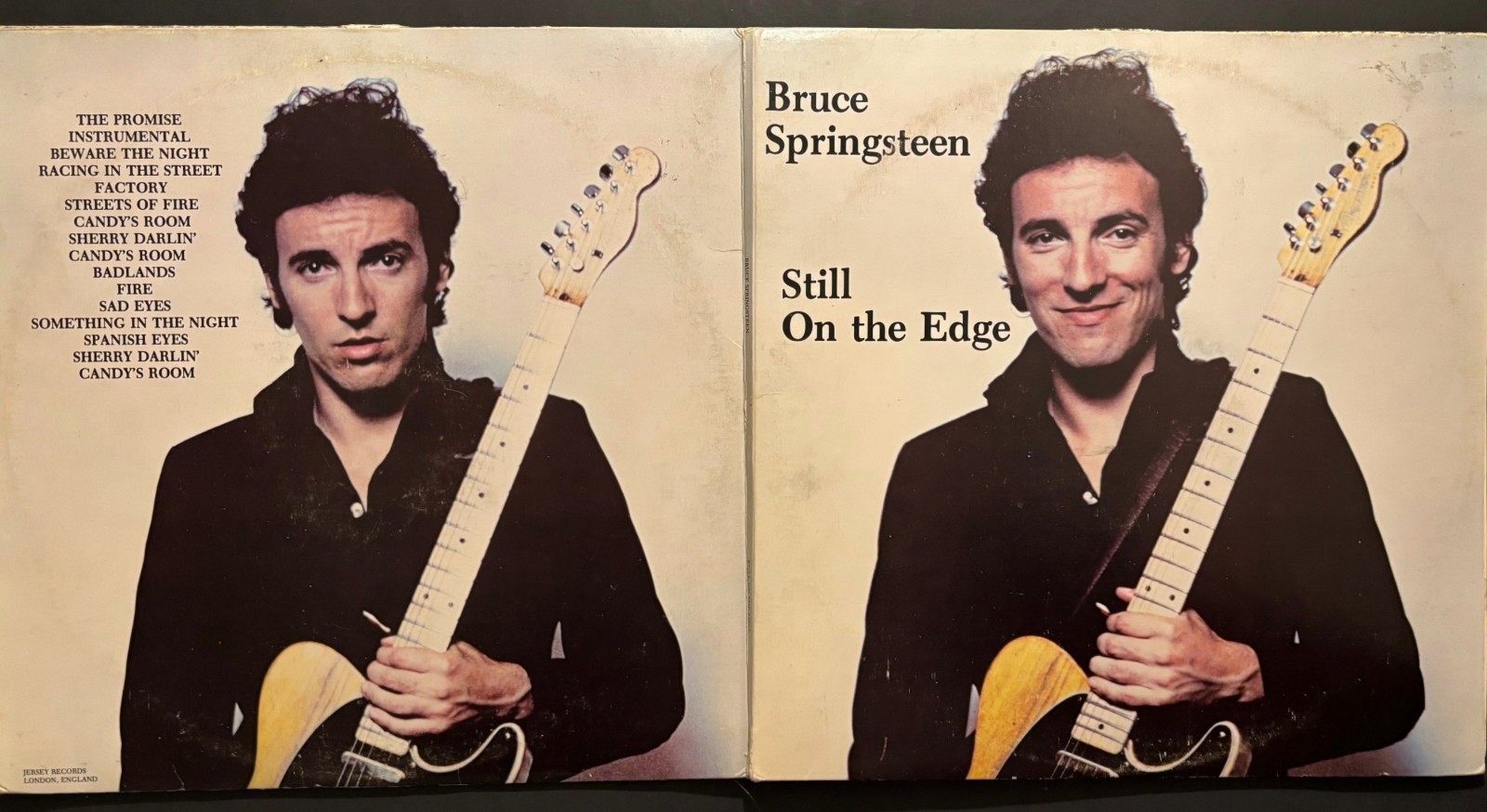
This pressing has a fantastic glossy, gatefold jacket with excellent pictures of Bruce on the front and back covers and a great Darkness era picture of Bruce live on stage inside the gatefold.
The labels on these first pressings were 'blank' but used colored paper, Tan and Red. Later pressings had plain white labels.
These first releases were pressed very well, using thick, heavy, high quality black vinyl and have the early 'JER - Side 1, 2, 3, 4' Matrix numbers.
Later pressings were on thinner vinyl, had simple matrix numbers, and sounded much inferior to these first pressings.
Original first pressings of this album also came with a 7" 45-rpm single of 'Spanish Eyes' b/w 'Ramrod' which had a green paper label.
I should have kept that single with this album, but I put it in with my other 7" singles, and it’s been traded away or sold long ago.
There's NO 7" single with this record. ~~~~~~~~~~~~~~~~~~~~~~~~~~~~~~~~~~
The sound quality on these original pressings is quite good, much better than the typical sound of these 'collector' records, but not perfect studio quality as you might expect for studio outtakes. Still quite good; loud, clear, fresh and full.
The songs are mostly in Stereo but 'narrow' stereo as these outtakes were 'raw' studio tracks and not yet mixed, mastered and polished. ~~~~~~~~~~~~~~~~~~~~~~~~~~~~~~~~~~~~~~
'Still on the Edge' is a fantastic 2-lp compilation of rare Darkness era studio outtakes from the summer of 1977.
A fantastic Springsteen record and one of the classic, best packaged, great sounding, most famous and important releases in the history of Springsteen 'collector' records.
It's an album that every Springsteen fan should have in their vinyl collection and also deserves to be in any 70s rock vinyl collection. ~~~~~~~~~~~~~~~~~~~~~~~~~~~~~~~~~~~~~~~
THE BACKSTORY AND CREATION OF 'DARKNESS ON THE EDGE OF TOWN'
Following the conclusion of Springsteen‘s 'Born to Run' tour in May 1976, Bruce was eager to get off the road and back into the studio to begin working on his next album.
By this point, Bruce and Jon Landau had joined forces and become a production team, with a shared vision, and in mid-June 1976, Bruce’s team informed CBS Records that he was planning to enter the studio to start recording his next, fourth album.
Bruce told his record company that he planned to use Jon Landau as his new manager and producer, not Mike Appel.
This obviously upset Mike Appel who had a contract with Bruce through Laurel Canyon. Bruce's contract stipulated that he had to work with Appel only and that any new music he wrote belonged to Laurel Canyon publishing, not Bruce or CBS.
Disagreements between Bruce and Mike Appel, about the direction of Springsteen‘s future, spiraled and got heated, resulting in Bruce and Appel suing each other for 'breach of contract'.
Bruce lost, and in September 1976 a judge ruled that Springsteen could not enter a recording studio, or record any new music, without Mike Appel involved.
Bruce wasn't going to go into the studio with his old manager Mike Appel, so, with these new restrictions in place, Springsteen decided to hit the road and tour. Bruce had a handful of new unrecorded songs, including 'Something in the Night', 'Frankie', 'Rendezvous', 'Candy's Boy' and fantastic 'The Promise', and if he couldn't record them, he would perform them on tour.
Being blocked from the studio for band rehearsals, Bruce got the E Street Band together for sessions at his farmhouse 'Telegraph Hill' in Homedale, NJ, in the summer of 1976, fleshed out the new material, and then hit the road.
Most Bruce fans and collectors agree that Springsteen‘s live shows from that late 1976 period, up through spring of 1977 were some of his best.
(My first Bruce show was in Philly in November 1976 and, although I've seen him many times since, that show was certainly one of the best.)
While Bruce was on the road, the lawsuit went back-and-forth and after a year of litigation, Springsteen finally reached an agreement with Mike Appel on May 28, 1977.
With his old manager out of the way, Bruce was finally free, for the first time in a year, to go into a studio and record. He wasted no time and jumped at the opportunity.
Recording sessions for Bruce’s fourth album, what would become 'Darkness on the Edge of Town', began several days later on June 1, 1977 at Atlantic Studios in New York City.
Bruce had been quite prolific since the 'Born to Run' album, had written many new songs. and on that first night of recording at Atlantic studios, Bruce and the E Street band laid down takes of about a dozen new songs.
One of the songs recorded that first night back in the studio was 'Something in the Night'. The band nailed an early take and that version actually made the final album. They were off to a good start.
Bruce spent the next few weeks in June recording at Atlantic Studios laying down new material. Soon he had over 20 songs on tape for possible inclusion on the next album.
Most of the songs were rough and raw and in various stages of completion, but Bruce wanted to get them down on tape, to have material to work with and expand on.
After several weeks of listening to the playback tapes, Bruce wasn’t happy with the sound he was getting from Atlantic Studios, so a decision was made to move to the nearby Record Plant Studios across town. Bruce was more familiar with that studio since most of 'Born to Run' had been recorded there.
Bruce had already purchased extensive studio time at Atlantic, and recording slots at the popular Record Plant were hard to get, so from late July into early September 1977, Springsteen and the E Street band recorded at both studios, but mostly at Atlantic.
By mid-September 1977, and up until the record's completion in March 1978, recording had switched over to the Record Plant.
The final version of all but one of the songs on 'Darkness' were recorded at the Record Plant. They already had a perfect take of 'Something in the Night' from that first night of recording at Atlantic back in June. ~~~~~~~~~~~~~~~~~~~~~~~~~~~~~
Duing the 'Darkness' sessions, Springsteen was quite prolific, and recorded many takes of many new songs in the studio.
By January 1978, some insiders estimate that Bruce had nearly 60 new songs either finished, down on tape, or floating around in his head at this time.
With all these new songs, Bruce, Jon Landau, and 'Miami' Steve Van Zandt then had the difficult task of deciding which of them to use for the new album.
Bruce chose to focus the album on the working man and darker themes. The songs on Darkness portray the lives of working people, struggling against a gathering storm, but living lives of decency, and hoping for a better future.
Bruce said “This was the record...where I figured out what I wanted to write about, the people that mattered to me, and who I wanted to be. I saw friends and family struggling to lead decent, productive lives and I felt an everyday kind of heroism in this.
"It was my way"..."I wasn't sure what I wanted but I smelled something in the air and knew when I didn't have it … I edited out anything that broke the album's mood or tension".
By deciding how he wanted to approach the new album and by selecting it's vibe and feel, there were many excellent new songs, upbeat rockers and beautiful love songs, already laid down on tape, that Bruce was forced to reject. Bruce recorded many fantastic, impressive songs during the Darkness sessions that were omitted from the album.
Some, like 'Sherry Darling' were shelved and saved.
"Sherry Darling" was recorded at Atlantic Studios on June 24 and 27 and July 1, 1977 during the Darkness sessions, but was held back as it didn't fit the theme of the album.
Springsteen returned to "Sherry Darling" in the spring of 1979, with takes at Power Station on May 25, 1979. It was then included on The River.
Other songs that didn't fit Bruce's 'theme' were given away.
'Fire' was written in May 1977, a few days after Bruce and Steve attended an Elvis Presley concert in Philadelphia. Allegedly a finished demo take was sent to Elvis Presley in July or August 1977, shortly before his death, with the hope that Elvis might cover it.
Bruce ended up giving the song to Robert Gordon. Gordon recorded his cover, with Bruce on piano, in early December 1977. The Pointer Sisters then quickly covered Gordon's version.
"Because The Night" was first recorded at Atlantic Studios on the first night of sessions on June 1, 1977 with some unfinished lyrics.
Around October 1977, Bruce's engineer Jimmy Iovine was also producing Patti Smith's 'Easter' at the Record Plant at the same time.
"One night whilst we were lounging around the Hotel Navarro in New York, I told Bruce I desperately wanted a hit with Patti, that she deserved one. He agreed..." As he had no immediate plans to put 'Because The Night' on Darkness, I said why not give it to Patti. Bruce replied, 'If she can do it, she can have it'."
Jimmy Iovine brought Smith the September 27th demo of the song, and Patti added her own lyrics, retelling it from a female perspective. she cut it and had a hit.
Patti's version came out just before the Darkness LP did.
Interestingly, when performed live, Bruce would often sing it with Patti's lyrics, not his own. Especilly the "Desire and hunger is the fire I breathe" in the first verse and "Love is a ring, the telephone" in the second. ~~~~~~~~~
Recording sessions for 'Darkness on the Edge of Town' were essentially completed by early January 1978.
Even by narrowing down the focus of the album, there were still a tremendous amount of different takes, mixes and versions of the few songs that made the short-list for the album.
Final selection, editing, revision and mixing was difficult and dragged on from January until late March 1977.
Two of the last songs recorded were 'The Promised Land' and 'Factory' in March 1977.
The title track 'Darkness on the Edge of Town' was one of the songs that Bruce had a working version of back in 1976. An early take of the song was one of the first few songs recorded on those first few days at Atlantic Studios in early June 1977, but the song was shelved right afterwards.
In March 1977, at the last minute, Bruce dusted off 'Darkness on the Edge of Town', decided it needed some tweaking and some guitar and sax added, but ended up re-recording it from scratch, which delayed submitting the final album to his record company. ~~~~
While Bruce, Jon Landau and Jimmy Iovine were busy putting final touches on the album in the Spring of 1978, Steve Van Zandt and Max Weinberg were busy working with Southside Johnny on their 'Hearts of Stone' album at the nearby Secret Sound studios.
Springsteen gave Steve Van Zandt tapes of two songs from the recent Darkness sessions, 'Hearts of Stone' and 'Talk to me' and gave Southside Johnny Lyon permission to use them on his new album. Southside Johnny’s 'Hearts of Stone' album, with 2 Bruce songs, was released in early October 1978. ~~~
Throughout the summer and fall of 1977. Bruce was quite prolific and continued to write a record new songs.
Album engineer Jimmy Iovine has said that approximately 60 different songs were worked up during the Darkness recording sessions. About 30 of those were considered for the album, and about half that many made the short list.
Today, of those 60 songs, 32 of them have been officially released; 10 on the original 'Darkness' album, four on the 1998 'Tracks' box set, and 18 on the 2010 release of 'The Promise: The Darkness on the Edge of Town Story' box set.
That leaves over 25 still unreleased. ~~
As the album was getting closer to completion, Bruce scheduled the long 'Darkness Tour' to start on May 23, 1978, shortly before the release of the album. Bruce was finally back performing live in front of his fans for the first time since March 1977. The shows on the Darkness tour were epic entertainment, with the concerts stretching towards three hours. His iconic concerts got rave reviews which led to packed houses, and made his 'Darkness on the Edge of Town' album a best seller. The Darkness tour would run from May 1978 until the first day of 1979. ~~~~~~~~~
Out of dozens of songs recorded across many months, and after much consideration, Bruce, Miami Steve, John Landau, and Jimmy Iovine finally narrowed song selection and sequencing down and presented a final set of 10 tracks for 'Darkness on the Edge of Town'.
Bruce then brought in Chuck Plotkin to assist Jimmy Iovine with final mixing and mastering. 'Darkness on the Edge of Town' was finally released on June 2, 1978. The album is fantastic, one of Bruce's best, and is greater than the sum of its individual parts.
The record opens with 'Badlands' and it’s classic line; "It ain’t no sin to be glad you’re alive..." Another interesting tidbit about 'Badlands'; Springsteen was working at Atlantic Studios on July 13, 1977, when the famous 24-hour-long New York City blackout began; soon after, the opening lyric "lights out tonight" came into being.
It wasn't until November 1977, that Badlands was re-written with new lines, including "I wanna go out tonight, I wanna find out what I got" borrowed from his song "Iceman" ~~~~~~~~~~~~~~~~~~~~~~~~
This 2-lp set 'Still on the Edge' contains some of the best, most iconic, 'lost' Darkness session tracks from those legendary recording sessions. ~~~~~~~~~~~~~~~~~~~~~~~~~~~~~~~~~~
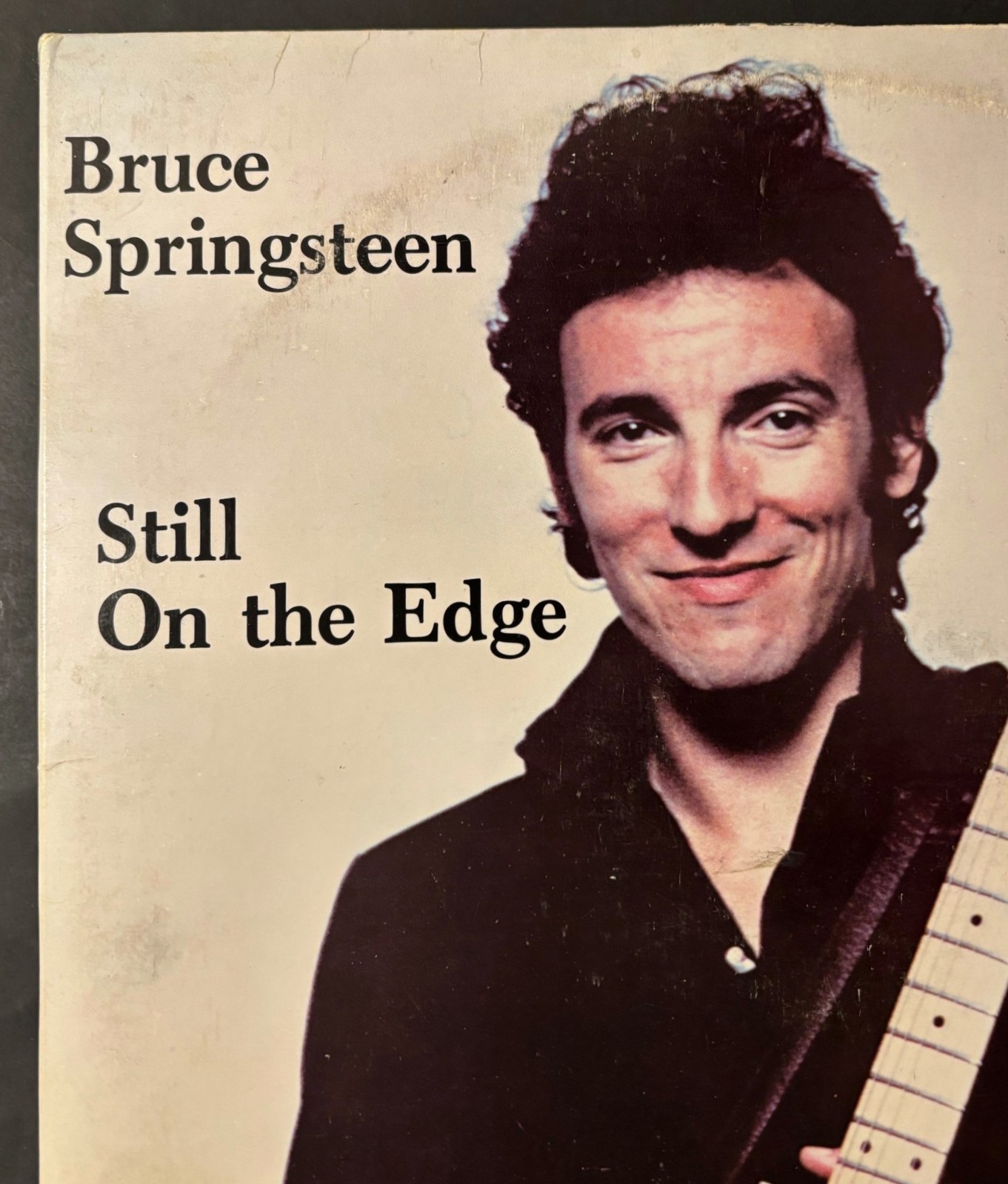
CONDITION: I tried to show good hi-resolution photos of the cover, labels and vinyl in my pictures. VINYL: This copy is beautifully pressed on thick, heavy, high quality black vinyl and this first pressing has a terrific sound to match.
The vinyl is still fantastic. Clean and bright. No scratches, scuffs or damage.
There's not enough room to show details of the vinyl, but I tried to get the lighting right, so you can get an idea of how clean the vinyl is. Hopefully you can see from my photos how terrific it looks.
LABELS: This album was pressed with 'blank' colored labels. There was no mention of the artist or song titles, typical of 'collector' records.
I purchased this record 'gently used' back in the day and the original owner wrote the song titles on each side, neatly, in pencil. That's how it was when I bought it.
The labels are otherwise terrific; clean and bright. No dings, scuffs or damage, and the spindle holes are clean and sharp, suggesting infrequent playing and my careful handling over the years.
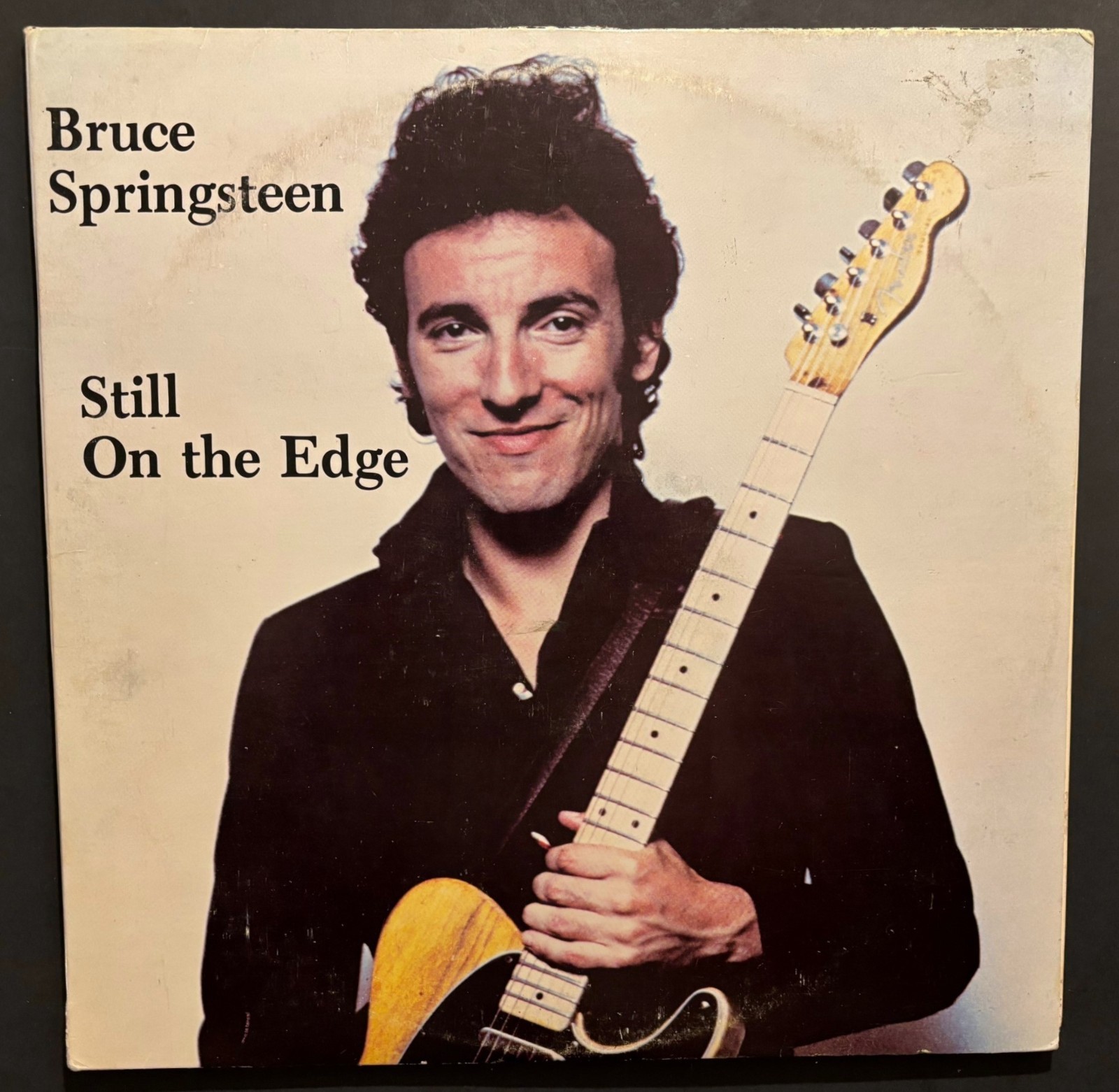
JACKET: As you can see from my pictures, this nearly 45 year old jacket is still in excellent condition and looks fantastic other than some very minor edge wear from being stored and shifted around in my collection for decades.
The sleeve is in excellent condition. Clean and bright. No names, writing or marks. The corners are relatively sharp. No seam splits, writing or issues. Some very mild, early rubbing and just a hint of ring wear. The mild ring wear looks slightly worse on the black inner gatefold, but not bad.
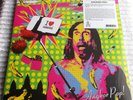
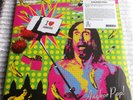
The album cover artwork features classic Lynn Goldsmith shots of Bruce on the front and back, and the overall design is similar to the 'Darkness' reord cover, his current album at the time.
The images of Bruce on the cover and the lettering is sharp and clear. Later pressings have a more washed-out, blue-ish tint to them and the printing isn't as crisp. This cover looks fantastic. I tried to show details in my photos.
I've owned this record since the early 80's and it has been sleeved and kept in great condition for around 45 years now. Despite the song titles wriitten on the labels and some minor rubbing to the inner gatefold, it's still about as good a copy of this classic release as you're likely to find these days.
Very nice, all original, and a real gem. I'm sure you'll be very happy to add it to your collection. It would make a great addition to any Classic Rock or Springsteen vinyl record collection. ~~~~~~~~~~~~~~~~~~~
** NOTE: I'm selling this rare Springsteen 'Collector' record "AS IS" and "NO RETURN". It's rare, and as described, and I'm sure you'll be very happy with it. A great, rare, original, excellent sounding copy. ~~~~~~~~~~~~~~~~~~~
I’m recently retired and downsizing and letting go some gems and rarities from nearly 50 years of vinyl record collecting.
Over the next few months I'll be offering an assortment of these rare and collectable LP’s. Many of these records have been in my personal collection for decades. Some of them are quite rare and seldom come up for sale. Limited pressings, European imports, promos, fan club releases, live recordings, first pressings and other general rarities.
Keep an eye on my Ebay page, 'jjrbyrne' for more of these great rare collectible albums, EPs and 45 singles.
All records have been carefully evaluated and graded by me. I visually inspect all records under bright light, personally gently clean them with a soft cloth and then, if unsure, play them on a modern high-end turntable and system to get a true picture of condition.
Please look at all the high-resolution pictures I added. They are all my own and are of the actual record being sold. The pictures are part of the description and can show small details, label variations, and condition better than I can put into words.
My grading is fair and honest. I have had over 3,700 happy and satisfied EBay customers over the years, with 100% positive feedback, and I have been buying/selling on EBay for nearly 30 years, so please bid with confidence!
I'm a One-man operation, this is a hobby, not my job. I do this for fun. I do this because I love music, love collecting vinyl and want others to share in that same experience. I take my time listening, researching, grading, listing and packaging. I will NOT sell any record that I personally would not want in my collection.
As you well know, packing and shipping rare records requires special care and attention, therefore, shipping cost within the lower 48 states is $5.00 on this item. If you would like insurance, or anything faster than Media/Economy Mail, please let me know and I can arrange it for you. I’ll work with you to make sure you’re happy!
I will gladly combine multiple records, or other items on my page, and make the shipping much less for you. I don’t inflate the shipping costs; they are what they are. I strive to keep them as low as possible. See my feedback for comments on my quality packing and shipping.
All items are packaged with sturdy cardboard mailers and appropriate padding. I take pride in my packaging and shipping and package all my records as if I were sending them to myself. I treat the records you win as if they were my own, and mail them the same way.
All orders are processed and shipped within 2 business days of receipt. We package and ship our vinyl records with the greatest care, using proper packaging to ensure that your rare and collectible vinyl records arrive in pristine condition.
Payments can be made by any of the multiple options that Ebay offers.
I will be happy to exchange feedback with anyone I complete a transaction with.
THANK YOU for looking and reading if you got this far. I know I rambled on a bit, but can't help it. I have a passion for records, especially 'Collector' records and Bruce Springsteen. I hope this listing was entertaining and informative. -- JOHN ~~~~~~~~~~~~~~~~~~~~~~~~~~~~~~~~~~~~
THE EARLY HISTORY OF BRUCE SPRINGSTEEN 'COLLECTOR' RECORDS FROM MY PERSONAL VIEWPOINT.
I've been a lifelong Springsteen fan. I grew up in New Jersey, just outside of New York City. As a teen, I spent many weekends and summers with my family down along the Jersey Shore and was introduced to Bruce's music at an early age, around the time of his first album.
My first Bruce show wasn't until November 1975, after 'Born to Run' was released, but I was an early fan from day one.
Back in those early days, it was hard keeping up with Bruce Springsteen's music and output. Bruce was quite prolific, started writing many new songs, and despite releasing two albums in 1973, Greetings from Asbury Park" and "The Wild, The Innocent & The E. Street Shuffle", Bruce still had many more songs completed, too many for his first albums. If you wanted to hear any of those songs, you had to 'know people'.
It seemed that everybody I knew had a 'Bruce Story' and every record collector I met knew 'somebody' that owned a copy of a rare Springsteen song or perormance on tape. I had heard reel to reel tapes and cassette tapes of Bruce's earlier 1973/74 live broadcsts, and early 1974 radio station appearances through friends and in the shops, but nobody owned any vinyl pressings of them.
Vinyl copies of these 'rarities' and radio shows were unheard of in the early 70's and such things didn't exist at the time.
As a young record collector, I would venture into the city with my older brother and his buddies, tagging along on their record shopping runs. By my late teens I was living in lower Manhattan and doing my own regular record shop circuit, digging for obscure rarities.
Rare 'collector' records were just starting to show up in the bins of certain record shops around this time, mixed in with the regular titles. They weren't at the 'normal' mall and chain record shops, but they were plentiful if you 'knew people' and knew where to look.
In those early years most companies that pressed these types of records were based in L.A. and out on the west coast, so Bruce Springsteen, some guy from Jersey, wasn't their priority. They tended to focus on acts like Bob Dylan, The Beatles, The Rolling Stones, and Led Zeppelin, the more universally popular stuff.
The very first Bruce Springsteen Collector records to appear were pressed by a Los Angeles based company called 'Hoffman Avenue Records', founded by Lou Cohan, a Cyprus California teacher and Springsteen collector. Lou was originally from Trenton, NJ, and published one of the early Springsteen fanzines, 'Thunder Road', which we all read.
Starting in the summer of 1975, Hoffman Avenue records pressed some of the very first Springsteen collector records: 'THE JERSEY DEVIL', 'THERE AIN'T NOBODY HERE FROM BILLBOARD TONIGHT' and 'HOT COALS FROM FIERY FURNACE'.
The first Springsteen collector record, 'THE JERSEY DEVIL', came out on Hoffman Avenue Records (HAR 147) around September 1975. It was the first Springsteen vinyl collector record I ever saw in the shops.
The cover had a drawing of Bruce, dressed as the furry Jersey Devil with horns and sneakers. He has a long tail, curled in an 'S' shape, and he's carrying his guitar.
It contained a very early version of 'Thunder Road', called 'Wings for Wheels' from the February 1975 Main Point broadcast, a very early version of 'New York City Serenade', live versions of 'Contessa/Santa Anna' and 'Tokyo/And the Band Played' from a 1973 show at the Main Point, and 'Up On The Roof' from the 1975 Main Point broadcast.
An amazing record packed with rarities that was a real 'find' for any Springsteen fan. I can still remember, despite it costing $8, twice the price of a 'normal' record back then, scooping up the first copy I ever saw at one of my regular NYC record shops.
Originals had a cheap, simple, B&W slip-sheet wrap-around cover, silver 'Hoffman Avenue' labels, and were pressed on cool, multicolored red 'splatter' wax.
They had hand typed song titles and liner notes and included a simple typed Hoffman Records 'catalog', giving information where you could buy other 'Hoffman Avenue' records. (for cheaper than what the store was charging!), so my vinyl obsession and addiction kicked in. ~~~~
'THERE AIN'T NOBODY HERE FROM BILLBOARD TONIGHT' (HAR 160) appeared in November 1975.
This was another Hofman Avenue release, and the 2nd Springsteen 'collector' record I was aware of. This record contained the KWEST-FM live broadcast of the October 17, 1975 show at the Roxy Theater in Hollywood.
This show featured the rarely performed 'Pretty Flamingo', the only live version of the Byrds' 'Goin Back', plus many rare and classic Bruce songs.
That particular Roxy concert was attended by many L.A. music industry people, radio personalities, and local musicians, who were curious to see what the Springsteen hype was all about. The title of the album, 'There Ain't Nobosy Here From Billboard Tonight', is taken from what Bruce said on stage the following night, when nobody was there except true Springsteen fans.
Like 'Jersey Devil', it was pressed on multi-color splatter vinyl, with a simple Black & White fold-over paper cover that showed the promo poster for those L.A. shows.
The classic poster featured Bruce, shown from behind, wearing a BTR tour jacket, with his guitar slung over his shoulder. A pair of sneakers dangled from the guitar's headstock. One of the classic early Springsteen 'collector' records and covers.
The dedwax of this release had the HAR-160 markings, chosen because it was label owner Lou Cohan's old address, 160 Hoffman Ave in Trenton, NJ. It was also one the first Springsteen collector records that I know of that had inscriptions in the deadwax; "BRUCE I WANT YOUR BILLBOARD!" on Side 1 and "CATCH ME IF YOU CAN — V. V." on Side 4. The other sides had dedications "THIS SIDE FOR MELINDA" and "THIS SIDE FOR JEAN & MARK" thanking their friends, helpers and collaborators.
The famous "Catch me if you can" phrase at the end of the record on side 4 was attributed to the legendary L.A. record producer Vicky Vinyl, who ran the local 'Idle Minds' label and helped fund and expedite this early Hoffman Avenue pressing. ~~~
A third release from Hoffman Avenue records, 'HOT COALS FROM FIERY FURNACE' (HAR 164) first appeared around February 1976.
This was an amazing and excellent 2-LP 'collector' record, packed with rarities, such as an early 'Saint in the City', 'Lost in the Flood', 'New York City Serenade', a rare slow version of '10th Ave Freeze-out', a 20-minute slow 'E Street Shuffle' with the iconic story about meeting Clarence on the boardwalk, a rare solo piano version of 'For You', and the first live performance of the Animal's 'It's My Life'. Still one of my favorite early Bruce 'collector' records. ~~~~~~~~~~
By the summer of 1975, there were a couple of rare Springsteen 'collector' records available on Hoffman Avenue records, but the one event that fueled the demand for more live Springsteen records, and opened up the market, was Bruce's Bottom Line radio brodcast in the summer of 1975.
In August 1975, just prior to the release of his third album "Born to Run", Bruce Springsteen and the E Street Band played a 5-night stand at The Bottom Line, a small club on West 4th Street in the Village. The band played 10 shows, 2 shows a night, during that 5 day run. The early show of the 3rd night, August 15th, was broadcast live on one of our local rock stations WNEW-FM.
Very sortly afterwards, vinyl copies of the show started showing up in the local Greenwich Village record shops.
The first I can remember was 'LIVE AT THE BOTTOM LINE 8/15/75' which had a simple B&W cover, featuring a smiling, close-up picture of Bruce, cropped and taken from the cover of 'Born to Run', with the song titles and running times printed at the bottom, to make it appear like a radio station timing strip.
The record was cleverly designed to look like a radio transcription disc or radio station promotional record, in order to avoid any attention or scrutiny in the bins.
Shortly after this plain looking record hit the stores, 'BRUCE SPINGSTEEN LIVE' on the Coral Records label started to show up in the Village shops.
This 2-LP collector record was the best and most famous version of Bruce's 1975 Bottom Line concert. It was packaged in a fully printed, deluxe gatefold sleeve, and had a fantastic full color illustration of 1975-era Bruce on the cover.
Before this album, most collector records had amateurish looking rubber-stamped covers, or crude, one color, mimeographed, paper slip-sheet covers, simply inserted over a blank jacket.
The Coral Records pressing of 'Bruce Springsteen Live' (Coral Records NR-909), was a beautiful, professional looking album and set a new standard for what a Springsteen 'collector' records should look like and sound like.
Before this record, most companies tried to maximize profits and put little to no effort into their album jacket designs, but Coral's 'Bruce Springsteen Live' kicked off a period of much nicer looking, better packaged, collector records.
Shortly after this classic record came out, we started seeing much more attention being paid to the cover art and packaging of Springsteen collector records.
The amazing 'YOU CAN TRUST YOUR CAR TO THE MAN WHO WEARS THE STAR' release. a 2-LP record featuring the WMMR Philadelphia broadcast of the February 5, 1975 Main Point gig from Bryn Mawr, PA then appeared on the market.
It was pressed on the 'Singer's Original Double Disk' label (SODD 001), and, although First pressings still had a simple tangerine colored slip-sheet cover, it's iconic cover featured a drawing of a late 1974-Era Bruce, dressed as a Texaco gas station attendent. This was one of the first Bruce Springsteen collector records to feature artistic, hand drawn, original cover artwork. Many more would follow.
This trend towards original hand-drawn artistic covers ushered in the classic William Stout artwork era. Stout would go on to design many classic covers for records released on the famous TMOQ, 'Trade Mark of Quality' west coast label. ~~~~~~~~~~~~~~~~~~~~~~~
Springsteen 'collector' records then became more and more popular in New York's record shops as the 70's progressed, but the problem was that it was a total guessing game and crap-shoot when purchasing these records; you never knew what you were getting.
This was in the pre-Internet, pre-Discogs era, and there weren't any reliable guides to tell you what was on these records, or how they sounded. Goldmine magazine, Jerry Osborne, and a few other people, published guide books for record collectors back then, but they covered commercially released records, not collector records.
Knowlege about these 'collector' records was largely learned by talking to record shop owners, other collectors, and at record conventions. Knowledge was mostly learned by taking chances and buying these collector records whenever you ran across them in the shops. An expensive 'hit or miss' approach.
By the late-70's, the 'best' collector records were often copied, re-pressed, and re-packaged by other companies, usually with lower pressing quality and crummy to atrocious sound. You never knew what you were getting.
Every once in a while, you would strike gold, and find a true rose among the thorns. 'Fire on the Fingertips' was one of those early Roses. It started showing up in the shops around the Fall of 1978.
Although it was difficult to tell what exactly was on it, due to the song titles all being strange and purposely mis-titled, it was all rare & unreleased material, and all in excellent sound quality. A true Diamond in the rough. 'Fire on the Fingertips' was one of the highlights of the late 70's run of Springsteen collector records.
Right after Bruce's September 1979 'No Nukes' concert at the Garden, the definitive triple-LP version of the complete 1975 Bottom Line show, 'THE GREAT WHITE BOSS' came out, which included all the DJ chatter and all the songs, including the long, jazzy, jamming 'Kitty's Back' from the broadcast.
After 'Great White Boss', zillions of different Bruce 'collector' records started to appear on the New York market and didn't let up until after the 'Born in the USA' tour ended. ~~~~
After the long, exhausting River tour wrapped up in September 1981, after nearly 140 3-hour shows, Bruce and the E Street band the band were one of the biggest rock acts in the world, but in need of a well desrved break.
At the end of the tour, Bruce retreated to his newly-rented house and ranch in rural Colts Neck, NJ, and spent time recuperating, relaxing and thinking about his career.
He didn't do many club or publicity appearances at the time, instead, unknown to his fans, went into a dark, contemplative period, quietly writing the songs that would later become 'Nebraska'.
Bruce basically disappeared from public and went silent, so we Bruce fans couldn't wait for the next new material, the next record, and then suddenly this album showed up on the scene.
Although it wasn't 'new' material, it was a beautifully packaged 2-lp set of rare 'Darkness' outtakes, many of which were 'brand new' and unheard by Bruce collectors at the time.
When I saw this 'gently used' copy during one of my regular vinyl digs in the Greenich Village record shops in the summer of 1982, I immediately grabbed it up. ~~~~~~~
By the mid-to-late 1980s, Italy and Sweden had relaxed their copyright laws, making 'collector' records fall into a semi-legal grey area, which opened the floodgates. Many many more Springsteen 'collector' records hit the market from Europe. By then, CDs had just started to take over the market and vinyl releases of Springsteen 'collector' records became less frequent. The golden age of vinyl 'collector' records dried up pretty quickly, although they continued to trickle out if you knew where to look. ~~~~~~~~~~~~~~~~~~~~~~~~~~~~~~~~~~~~~~~
price rating