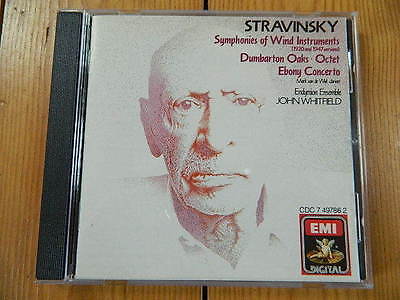
Stravinsky Symphonies of Wind Instruments John Whitfield Endymion Ensemble RAR
€
22
$
26


Favourite Auctions
To save auctions to your favourites, please login
If you don't have an account, please register
Description
Stravinsky
Symphonies of Wind Instruments
Dumbarton Oaks Concerto in E flat, Ebony Concerto op 44, Octet
John Whitfield
Endymion Ensemble
RAR!
This fine Stravinsky recital by the Endymion Ensemble under John Whitfield was recorded in January 1987 and published by EMI in 1988. The liner notes are silent about the interpreters. Whitfield, born in 1957 in England, was one of the founding members in 1979 of the Endymion Ensemble, from a group of students from the National Youth Orchestra, and specialized in 20th Century music theatre and small-scale opera. The ensemble is still in operation.
The compositions they've selected span a quarter-century in Stravinsky's compositional career. They do not belong to his most popular works, but they are genuine Stravinsky nonetheless and some of them (Symphonies for Wind Instruments, Ebony Concerto) genuine masterpieces even, in miniature form.
Dumbarton Oaks Concerto (1938) is a kind of Concerto Grosso, Stravinsky's homage to Bach's Brandeburgs. It is lightweight and boisterous in mood, dynamic and syncopated in rhythmic allure, and witty. Much of the mood and style of The Rake's Progress is announced, in fact. Endymion isn't as dynamic as Stravinsky in his own recording from 1964 (now on volume VI of Sony's 22-CD complete edition, Igor Stravinsky: The Recorded Legacy), but their rhythmic squareness and robustness, their instrumental clarity and character - interpretive features that will be reproduced in the next pieces - are well suited to the piece, imparting it a fine bonhomie and offering a welcome alternative to Stravinsky's view.
For a minute and forty-one seconds, I thought this was going to be an "Urtext" version of the Octet - I mean, one that followed precisely Stravinsky's metronome marks, which is something that the composer himself, in each of his three recordings does NOT do (he usually plays significantly faster; the 1933 recording I have on a 5-CD set published by the French Vogue that I find listed nowhere, but it is also on Stravinsky: Composer & Conductor, Vol. I; 1954 is on Stravinsky Conducts Stravinsky: The Mono Years 1952-1955; and 1961, on volume 7 of Sony's Stravinsky edition). 1:41 is indeed the time it takes Endymion to get through the Lento introduction, at a tempo of circa 76-80 eighth-notes per minute, close enough to the score's 76, and significantly slower than Stravinsky in both his American recordings (circa 88 to 92).
But no, deceptive lead. When comes the Allegro moderato, they play at quarter-note 120, following exactly here the Stravinsky performing model rather than the score's deliberate 108. Too bad: I'd love to hear it exactly as written some day; the impression will no doubt be jolting. Subsequently, Endymion are in fact very free in their tempos, sometimes slower, sometimes faster than both the metronome marks and Stravinsky the performer. Still, their playing is crisp, clear and spotless, each instrument can be heard vividly, so this version is interesting especially for its variances from the various Stravinsky versions - although I am not convinced that the ultimate variation (at 5:27 in the second movement) can really sustain such a slow tempo (eighth-note cira 69 to the score's 84 and Stavinsky-as-performer's xx).
A version that can be recommended then - but not as much as if it had followed Stravinsky's metronome throughout.
The Ebony Concerto (1945) is a little gem, Stravinsky's take on Jazz written for Woody Herman and his Herd, and one of the best Jazz-inspired compositions among so many, because, unlike so many, the Jazz is entirely metabolized into Stravinsky's language. Here, it benefits from fine sonics, affording great instrumental clarity and tonal character. Endymion is more laid back, less urgent and biting than Stravinsky (also on Vol. VII of the Stravinsky edition) in the first movement; paradoxically, with Stravinsky it sounds like Jazz (and what a great sense of swing!), with Endymion... like Stravinsky! I've never been so aware of the echoes of Petrushka, especially in the clarinet-trombone duet at 1:00. The two other movements are very similar to Stravinsky's recording, very marginally less urgent in the finale, and offer fine instrumental pungency.
Endymion plays two versions of the Symphony for Wind Instruments - the original, 1920 orchestration and the revision from 1947, which substitutes "normal" instruments to the more unusual alto flute, alto clarinet and trumpet in A, and adds a few transitional beats and bars. The differences are marginal and are likely to be heard only with score in hand - and even then. For the others the impression will be of having the same piece repeated. Again the reading by Endymion is remarkably crisp and clear, slightly more stately in its initial tempo than the composer's metronome mark, appropriately highlighting the piece's ritualistic aspect.
With a TT of 61 minutes the disc is generous enough, but I'd rather have had the instrumental suite from The Soldier's Tale than one of the two recordings of the Symphony for Winds. Given the ensemble's characteristics, I can surmise that it would have been an excellent reading
Zustand : Neu
----------- L-W-U-1234-----------------------
CD !
Kontodaten sind bei ebay hinterlegt!
Erstellt durch eBay Turbo Lister
Das kostenlose Einstell-Tool. Stellen Sie Ihre Artikel schnell und bequem ein und verwalten Sie Ihre aktiven Angebote.
price rating