TANGERINE DREAM ELECTRONIC MEDITATION LP OHR-CONRAD SCHNITZLER-PSYCH-KRAUTROCK
$
55


Favourite Auctions
To save auctions to your favourites, please login
If you don't have an account, please register
Description
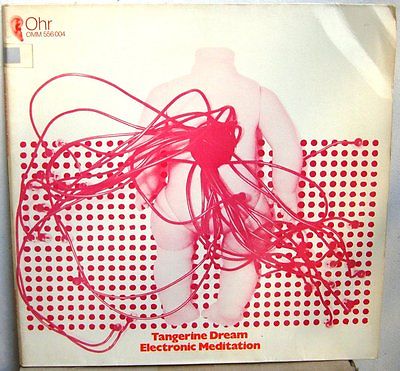
TANGERINE DREAM
ELECTRONIC MEDITATION LP
Ohr OMM 556 004
Excellent early electronics recorded in the late 60's in Berlin with various custom-made electronic devices implemented by Edgar Froese and found sounds such as broken glass, burning parchment, and dried peas.
Some info on the release: Rare second edition issue, released in Germany sometime in the early 70's on the great OHR label (Floh de Cologne, Annexus Quam, Anima, Guru Guru, Sergius Golowin, Limbus 4, Xhol, etc.). The album was recorded in a rented factory in Berlin in October 1969, using just a two-track Revox tape recorder. Its style is a unique form of free jazz, electronic art music, and instrumental rock; or as Sound on Sound magazine described it, "free electronic rock". Its instrumentation ranges from conventional instruments such as the guitar, organ, drums, and cello to various custom-made electronic devices implemented by Edgar Froese and found sounds such as broken glass, burning parchment, and dried peas being shaken in a sieve. The backwards vocals at the end of side two are of Edgar Froese reading from the back of a ferry ticket from Dover to Calais.
Tangerine Dream is a German electronic music group founded in 1967 by Edgar Froese. The band has undergone many personnel changes over the years, with Froese being the only continuous member. Drummer and composer Klaus Schulze was briefly a member of an early lineup, but the most stable version of the group, during their influential mid-1970s period, was as a trio with Froese, Christopher Franke, and Peter Baumann. Early in the 1980s, Johannes Schmoelling replaced Baumann, and this lineup, too, was stable and extremely productive. Tangerine Dream's early "Pink Years" albums had a pivotal role in the development of Krautrock. Their "Virgin Years" albums helped define what became known as the Berlin School of electronic music. These and later albums were influential in the development of electronic dance music, and also the genre known as New Age music, though the band themselves disliked the term. From the late 1990s into the 2000s, Tangerine Dream has also explored some styles of electronica.
Edgar Froese arrived in West Berlin in the mid-1960s to study art. His first band, the psychedelic rock-styled The Ones, was gradually dismantled after releasing only one single, and Froese turned to further experimentation, playing minor gigs with a variety of musicians. Most of these gigs were in the famous Zodiak Free Arts Lab, although Froese's band was also invited to play for Salvador Dalí. Music was mixed with literature, painting, early forms of multimedia, and more. Only the most outlandish ideas attracted any attention, and Froese summed up this attitude with the phrase: "In the absurd often lies what is artistically possible." As members of the group came and went, the direction of the music continued to be inspired by the Surrealists, and the group came to be called by the surreal-sounding name of Tangerine Dream, inspired by the line "tangerine trees and marmalade skies" from The Beatles' track "Lucy in the Sky with Diamonds." Froese was fascinated by technology and skilled in using it to create music. He built custom-made instruments and, wherever he went, collected sounds with tape recorders for use in constructing musical works later. His early work with tape loops and other repeating sounds was the obvious precursor to the emerging technology of the sequencer, which Tangerine Dream quickly adopted upon its arrival. The first Tangerine Dream album, Electronic Meditation, was a tape-collage Krautrock piece, using the technology of the time rather than the synthesized music they later became famous for. The line-up for the album was Froese, Klaus Schulze, and Conrad Schnitzler. Electronic Meditation was published by Ohr in 1970, and began the period known as the Pink Years (the Ohr logo was a pink ear). But starting with their second album, Alpha Centauri, the group has been a trio or occasionally duo of electronic instruments, commonly augmented by guitar from Froese (or, much later, other musicians as well), and occasionally also other instruments. Of these, drums from Christopher Franke and organ from Steve Schroyder (on Alpha Centauri) or Peter Baumann (on subsequent releases) feature prominently in the band's music during the early 70s. They also started their heavy usage of the Mellotron during this period.
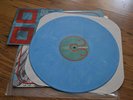
Condition: Vinyl lies in very good+ condition, looks to have some light marks and plays with surface noise, while cover lies in very good shape, with a bad looking top right corner bend, sticker, sticker removal trace and age wear-yellowing (see picture).
Tracklist
A1 Geburt (Genesis) 6:00 A2 Reise Durch Ein Brennendes Gehirn (Journey Through A Burning Brain) 13:25 B1 Kalter Rauch (Cold Smoke) 11:00 B2 Asche Zu Asche (Ashes To Ashes) 3:50 B3 Auferstehung (Resurrection) 3:40 Credits- Cello, Violin [Geige], Performer [Addiator], Guitar [2. Gitarre] – Conny Schnitzler
- Design [Grafik-Design Von] – Reinhard Hippen
- Guitar [6-saitige Gitarre, 12-saitige Gitarre], Organ [Orgel], Keyboards [Klavier], Performer [Glasscherben] – Edgar Froese
- Liner Notes – Hans-Ulrich Weigel
- Music By [Musik & Manuskript] – Conny Schnitzler, Edgar Froese, Claus Schultze
- Percussion [Schlagwerk], Performer [Peitsche, Metallstäbe, Brennendes Pergament] – Claus Schultze
- Producer [Produktion] – Hans Ulrich Weigel, Klaus Freudigmann
SHIPPING & PAYMENT
Shipping: Shipping for this LP is 12$ airmail in Europe / 14$ for the rest of the world
Registered mail: +5$
Insurance: optional
Combined shipping: BIG discounts
Payment: Paypal
Packaging: I am a collector too and i know
price rating

![Green Naugahyde (10th Anniversary Edition) [VINYL], Primus](https://www.popsike.org/php/thumbnail.php?url=https://www.popsike.pics/pix/20240813/305726741183.jpg)




![UPSETTER/THE GOOD THE BAD & THE UPSETTER [LP]](https://www.popsike.org/php/thumbnail.php?url=https://www.popsike.pics/pix/20061027/300042704592.jpg)