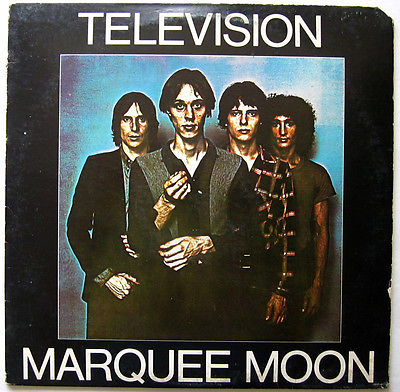
TELEVISION - Marquee Moon ELEKTRA Pressing Rare LP Record Album
$
31


Favourite Auctions
To save auctions to your favourites, please login
If you don't have an account, please register
Description
TELEVISION “Marquee Moon” LP Vinyl Record Album – Elektra 7E-1098 catalogue - Vinyl Ex / Sleeve G with Inner
From Wikipedia:
Marquee Moon is the debut album by American rock band Television. It was released in February 1977 by Elektra Records. By 1974, the band had become a prominent act on the New York music scene and generated interest from a number of record labels. They rehearsed extensively in preparation for the album and, upon signing to Elektra, recorded most of the songs in single takes. Television's frontman Tom Verlaine produced the album with recording engineer Andy Johns at A & R Recording in September 1976.
For Marquee Moon, Verlaine and fellow guitarist Richard Lloyd eschewed contemporary punk rock's power chords in favor of rock and jazz-inspired interplay, melodic lines, and counter-melodies. Verlaine's lyrics for the album combined urban and pastoral imagery, themes of adolescence, and influences from French poetry. He also used puns and double-entendres to give his songs an impressionistic quality.
Marquee Moon was critically acclaimed upon its release and achieved unexpected commercial success in the United Kingdom, but sold poorly in the United States. It has since been viewed by critics as one of the greatest albums of the American punk rock movement and a cornerstone of alternative rock. The band's innovative post-punk instrumentation on the album strongly influenced the indie rock and new wave movements of the 1980s, as well as rock guitarists such as John Frusciante, Will Sergeant, and The Edge.
Artwork
The album's cover was shot by photographer Robert Mapplethorpe, who had previously shot the cover for Patti Smith's 1975 album Horses. His photo for Marquee Moon situated Verlaine a step in front of the rest of the band, who are in a tensed, serious pose. Verlaine held his right hand across his body and held his slightly clenched left hand forward. When Mapplethorpe gave Television the contact prints, Lloyd took their favorite shot to a print shop in Times Square and asked for color photocopies for the band members to mull over. Although the first few copies were oddly colored, Lloyd asked the copy worker to make more "while turning the knobs with his eyes closed."[26] He likened the process to Andy Warhol's screen prints. After he showed it to the band, they chose the altered copy over Mapplethorpe's original photo, which Fred Smith had framed and kept for himself.[27]
Release and promotion
Marquee Moon was released in February 1977.[1] It was an unexpected success in the United Kingdom, where it reached number 28 on the UK Albums Chart.[7] The album's two singles—the title track and "Prove It"—both charted on the UK Top 30.[28] The album's sales were partly fueled by Nick Kent's rave two-page review of the album for NME magazine. While holidaying in London after the album's completion, Verlaine saw that the band had been put on the magazine's front cover and called Elektra's press department, who encouraged Television to capitalize on their success there with a tour of the UK. However, the label had already organized for the band to perform on Peter Gabriel's American tour as a supporting act. Television played small theatres and some larger club venues, and received more mainstream exposure, but were not well received by Gabriel's middle-American, progressive rock audiences and found the tour unnerving.[29]
In May, Television embarked on a highly successful theatre tour in the UK and were enthusiastically received by audiences. Verlaine said that it was refreshing to perform at large theatres after having played clubs for four years. However, he felt that supporting act Blondie did not suit their show because they were too different artistically, even though both bands had emerged from the music scene at CBGB.[29] Blondie's Chris Stein said that Television were "so competitive" and unaccommodating on the tour and that they did not treat it like a joint effort. He recalled one show where "all our equipment was shoved up at the [Glasgow] Apollo and we had like three feet of room so that [Verlaine] could stand still in this vast space."[30]
By the time of Television's return to the United States, Elektra had given up on promoting Marquee Moon, which they dismissed as a commercial failure.[5] Marquee Moon sold fewer than 80,000 copies in the US and failed to chart on the Billboard 200.[29] The band was dispirited by their inability to meet commercial expectations, which led to their disbandment in 1978.[29]
Critical reception
Marquee Moon was acclaimed by contemporary music critics.[31] Peter Gammond of Hi-Fi News & Record Review gave it an "A+" and called it one of the most exciting releases in music, partly because it is highlighted by Verlaine's steely, Gábor Szabó-like guitar and authentic rock music.[32] In his review for Audio magazine, Jon Tiven graded the album's performance an "A", its sound a "B", and wrote that although the vocals and production could be more amplified, Verlaine's lyrics and guitar "manage to viscerally and intellectually grab the listener".[33] Time magazine's Joan Downs felt that the band's sound is distinguished more by the bold playing of Richard Lloyd, who has the potential to become a major figure in rock guitar.[34] Nick Kent of NME said that Television have proven to be ambitious and skilled enough to achieve "new dimensions of sonic overdrive" and hailed the album as an "inspired work of pure genius, a record finely in tune and sublimely arranged with a whole new slant on dynamics".[35] He also claimed that the music is vigorous, sophisticated, and innovative at a time when rock is wholly conservative.[36] In his "A+" review of Marquee Moon for The Village Voice, Robert Christgau asserted that Verlaine's "demotic-philosophical" lyrics could sustain the album alone, as would the guitar playing, which he said is as penetrating and expressive as Eric Clapton or Jerry Garcia "but totally unlike either."[37]
In a negative review, Noel Coppage of Stereo Review panned the singing and songwriting, and wrote that the album sounds more like a stale version of Bruce Springsteen than avant-garde music.[38] Nigel Hunter, writing for Gramophone, found both Verlaine's lyrics and guitar playing vague, and felt that listeners need a "strong commitment to this type of music to get much out of it."[39] In his review for Rolling Stone, Ken Tucker stated that the lyrics generally amount to non sequiturs, meaningless phrases, and pretentious aphorisms, but are ultimately secondary to the music. Although he found his solos potentially formless and boring, Tucker credited Verlaine for structuring his songs around chilling riffs and "a new commercial impulse that gives his music its catchy, if slashing, hook."[2] High Fidelity magazine said that the music's "scaring amalgam of rich, brightly colored textures" compensates for Verlaine's nearly unintelligible lyrics.[40]
Marquee Moon was voted as the third best album of 1977 in the Pazz & Jop, an annual poll of critics run by The Village Voice.[41] Christgau, the poll's creator and supervisor, ranked it number one on his own year-end list.[42] NME named it the fifth best album of the year on its list.[43] Verlaine later said of the overwhelmingly positive response from critics, "There was a certain magic happening, an inexplicable certainty of something, like the momentum of a freight train. That's not egoism but, if you cast a spell, you don't get flummoxed by the results of your spell."[1]
keywords: vintage rock and roll british english classic vinyl record records album cover collectible memoribilia
price rating


![Barcelona [Vinyl LP], Henderson, Joe,](https://www.popsike.org/php/thumbnail.php?url=https://www.popsike.pics/pix/20240909/235737042260.jpg)