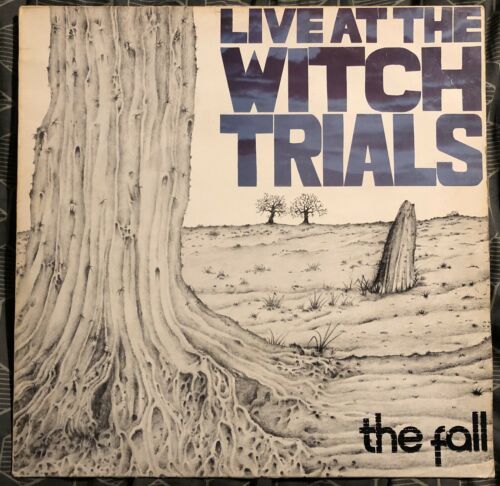
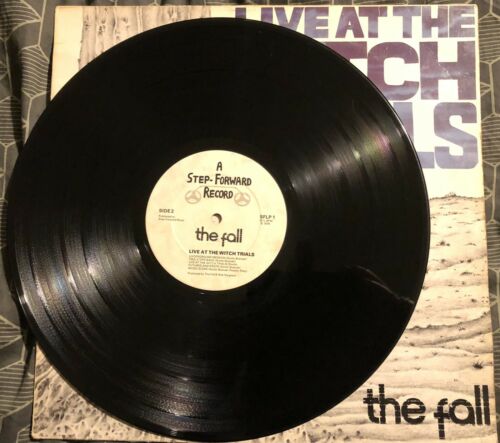
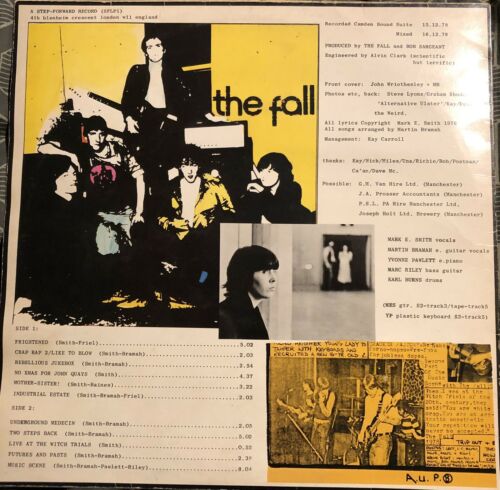
THE FALL Live At The Witch Trials STEP FORWARD LP 1979 UK 1ST PRESSING SFLP1 VGC
£
34
$
45


Favourite Auctions
To save auctions to your favourites, please login
If you don't have an account, please register
Description
THE FALL Live At The Witch Trials STEP FORWARD LP 1979 UK 1ST PRESSING SFLP1 VGC. Condition is "Used".
Sleeve: Very Good condition, Inner Sleeve ok, stuck up with cellotape for extra protection, but fine.
Vinyl: Very Good Plus. In remarkably good condition for its age and plays really well.
I'm selling a lot of my vinyl and CD collection, because the kids are getting bigger and the house is getting smaller! Basically, it was either the kids or the records, sadly the coin came down tails...
ONLINE REVIEW:
"....for a fleeting few seasons in 1979, in the hands of Smith and his gang of urban mutant malingerers, all that mattered was feeding the future to itself and seeing what got puked back up. This album represents the beginning of a brilliant, tumultuous and dazzling set of releases spanning five decades, and against the odds, The Fall became one of the greatest bands the UK has ever produced..."
When the Fall’s “Industrial Estate” plays during the closing credits of High-Rise–Ben Wheatley’s big-screen adaptation of J. G. Ballard’s classic novel–it’s more than a case of similar subject matter. True, the film is about urban malaise, and so is the song. But Ballard’s vision of a tower block turned hermetic, ingrown, incestuous, and cannibalistic unfolds with a clinical exactitude. On the other hand, “Industrial Estate” is a spew of dissonant chaos, fugue-state chants, and malfunctioning carnival organs that inhabits the liminal space between punk and post-punk–just like the rest of album it appears on, the Fall’s 1979 debut Live at the Witch Trials. At the time, the first wave of post-punks were taking Johnny Rotten’s “no future” rant and parsing it like surgeons, laying it bare and reducing it to its components like Ballard. The Fall were no exception but, where many of their contemporaries used anesthetic and scalpels, they packed switchblades.
Witch Trials came out in the spring of 1979, Dragnet in the autumn of 1979. Accordingly, these albums (newly reissued) are very much spring and autumn records, inasmuch as such acutely urban records can have ties to nature. The Fall came together in Manchester in 1976, the year punk conflagrated across England. Its working-class founder Mark E. Smith and his crew immediately hopscotched over punk, delivering an EP in 1978 (Bingo-Master’s Break-Out!) that tapped into everything from the Seeds’ keyboard-slathered garage rock to Can’s elemental clatter.
Witch Trials was both a step ahead and a step back with true punk bangers like “Futures and Pasts,” two-and-a-half minutes of eye-gouging and haranguing that unravels in hyperventilating gasps. That deconstruction quickly morphs from cheeky to sinister. “Rebellious Jukebox”—one of the first self-aware Fall anthems—churns and stutters, thrown into each successive moment by a serpentine bassline that coils like inside-out dub. Smith is all sneers and snarls, delirious as he struggles against and succumbs to rock’n’roll entropy. “We are The Fall/Northern white crap that talks back,” he taunts, chewing the microphone on “Crap Rap 2/Like to Blow.” Soon after, he takes a leap into the cosmic void: “We are frigid stars.” By the time the eight-minute closer “Music Scene” crawls its way into oblivion—en route, beating Public Image Ltd’s similarly distended “Theme” and “Fodderstompf” to the punch by months—the Fall had already established themselves as something far more wobbly and toxic than the emerging post-punk mass.
In a 2011 interview, Smith said that Ballard’s 1962 post-apocalyptic novel The Drowned World was the only book by the author that he liked. Even then, he referred to it only as “that one where the world’s underwater.” Erudition in the formal sense is never what Smith or the Fall were about, and that’s made plain on Witch Trials, where Smith’s loathing of cultured, mannered learning oozes from every fracture. Instead, the album is a celebration–if not exhortation–of working-class precocity and street-smart intellectualism cobbled together from thrift stores bookshelves and stolen snatches of philosophy. Hungry, angry, and ugly: that’s the post-punk proclamation of the Fall’s first two albums, a flag that would fully unfurl with the release of band’s masterpiece, Hex Enduction Hour, three years later. But for a fleeting few seasons in 1979, in the hands of Smith and his gang of urban mutant malingerers, all that mattered was feeding the future to itself and seeing what got puked back up.
This album represents the beginning of a brilliant, tumultuous and dazzling set of releases spanning five decades, and against the odds, The Fall became one of the greatest bands the UK has ever produced..."
price rating



![Live At The Witch Trials [VINYL]](https://www.popsike.org/php/thumbnail.php?url=https://www.popsike.pics/pix/20190917/283617490972.jpg)