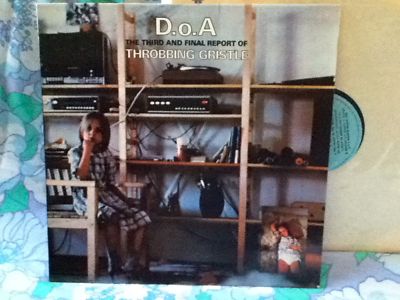
THROBBING GRISTLE D.O.A. The Third and Final Report LP
$
39


Favourite Auctions
To save auctions to your favourites, please login
If you don't have an account, please register
Description
THROBBING GRISTLE D.O.A. The Third and Final Report of…LP
1978 Celluloid/Industrial FRA (LTM 1036) Both Sleeve and Vinyl are in NM condition. sweet copy….Throbbing Gristle was an English avant-garde music and visual arts group that evolved from the performance art group COUM Transmissions. The band consisted of Genesis P-Orridge (aka Neil Megson - bass guitar, violin, vocals, vibraphone), Cosey Fanni Tutti (guitars, cornet, vocals), Peter "Sleazy" Christopherson (tapes, found sounds, horns, vibraphone, synthesizer), and Chris Carter (synthesizers, tapes, electronics).
Throbbing Gristle evolved from the performance art group COUM Transmissions, a group of performers centered around Genesis P-Orridge and Cosey Fanni Tutti. The final performance of COUM Transmissions in 1976 was the debut of Throbbing Gristle.
Throbbing Gristle's confrontational live performances and use of often disturbing imagery, including pornography and photographs of Nazi concentration camps, gave the group a notorious reputation. However the group always maintained that their mission was to challenge and explore the darker and obsessive sides of the human condition rather than to make attractive music. Throbbing Gristle pioneered the use of pre-recorded tape-based 'samples'[1] , and made extensive use of special effects to produce a distinctive, highly distorted background, usually accompanied by lyrics or spoken-word performances by Cosey Fanni Tutti or Genesis P-Orridge. Though they asserted they wanted to provoke their audience into thinking for themselves rather than pushing any specific agenda (as evidenced by the song "Don't Do As You're Told, Do As You Think" on Heathen Earth), Throbbing Gristle also frequently associated with the anarchist punk scene. They even appeared on the infamous Crass pamphlet Toxic Grafity, with a condensation of their own propaganda parody series, Industrial News.[2]
In 1977, they released their debut single United/Zyklon B Zombie, followed by an album, Second Annual Report. Although pressed in a limited initial run of 786 copies on the band's own Industrial Records label, it was later re-released due to high demand on Mute records, however this later release was reversed with all tracks playing backwards and in reverse order. This was followed by a series of albums, singles and live performances over a four year period.
On 29 May 1981, Throbbing Gristle performed at the Kezar Pavilion in San Francisco, California, USA. This concert marked the end of the group and its mission. As Cosey succinctly put it, "TG broke up because me and Gen broke up".[citation needed]
Genesis P-Orridge and Peter Christopherson went on to form Psychic TV, whilst Cosey Fanni Tutti and Chris Carter continued to record together under the names of Chris and Cosey, Carter Tutti and Creative Technology Institute. Christopherson later went on to become half of the band Coil with his partner and fellow Psychic TV member, the late John Balance. Meanwhile, Gen (now known as Genesis Breyer P-Orridge) subsequently formed Thee Majesty and PTV3 with the help of his late wife, Jacqueline "Jaye" Breyer.
D.o.A: The Third and Final Report of Throbbing Gristle is an album by industrial music pioneers Throbbing Gristle.
Contents
[hide]
• 1 Vinyl notes
• 2 Track listing
? 2.1 12" release
? 2.2 CD release
• 3 Personnel
• 4 Notes
[edit] Vinyl notes
First 1000 on Industrial enclosed a card calendar with color photo of little girl on bed. Another 1000 recut so that it looks like 8 tracks equally long (false track spirals). Their single "United," which had garnered some popularity due to its relatively accessible style, was included on the album sped up to 16 seconds (The original being about 5 minutes).
"A few words about this record: for various reasons we have decided to include a solo track by each of the four individual group members. We think you may find this illuminating [...] Explanatory details about individual tracks are as follows:
"Side One: "I.B.M. was inspired by a found cassette sent to us by Mark Eyles. "Hit by a Rock" was recorded at the Highbury Roundhouse, North London in September 1977. "Valley of the Shadow of Death" was recorded and arranged by Peter Christopherson. "Dead on Arrival" was recorded live at A.T.C., Goldsmiths College, London in May 1978. "Weeping" uses four types of acoustic violin through a space-echo played and arranged by Genesis P-Orridge, the lyrics are co-written by Genesis P-Orridge and Ewa Zajac (the mother of the girl used on the album cover)[1].
"Side Two: "Hamburger Lady" was inspired by a section of a letter from Dr. Al Ackerman of Portland, Oregon, U.S.A. reproduced elsewhere on this sleeve. "Hometime" was played, recorded and arranged by Cosey Fanni Tutti. "Death Threats" was taken unaltered off our telephone answering machine. "Walls of Sound" was recorded live at five locations during the last year. "Blood on the Floor" was recorded live at the Highbury Roundhouse in September 1977.
"The remaining material was gathered on location or recorded at the studios of Industrial Records, to whom, as ever, our thanks are due."
[edit] Track listing
All tracks by Throbbing Gristle except were noted
[edit] 12" release
Side A:
1. "I.B.M." - 2:35
2. "Hit by a Rock" - 2:32
3. "United" - 0:16
4. "Valley of the Shadow of Death" - 4:01 (Peter Christopherson solo)
5. "Dead on Arrival" - 6:08
6. "Weeping" - 5:31 (Genesis P-Orridge solo)
Side B:
1. "Hamburger Lady" - 4:15
2. "Hometime" - 3:46 (Cosey Fanni Tutti solo)
3. "AB7/A" - 4:31 (Chris Carter solo)
4. "E-Coli" - 4:16
5. "Death Threats" - 0:41
6. "Walls of Sound" - 2:48
7. "Blood on the Floor" - 1:07….
Payment:
Due within 10 days of auction end unless other arrangements have been made prior to bidding.
Shipping & packaging:
I package your records with the highest level of professionalism, using the best packing materials available. All shipping rates, including combined shipping is listed below. I will ship via priority or registered mail on request.
United States:
7" records and CD’s: $3.50 - .50 each additional.
10” records, LPs, 2xLPs, 3xLPs: $4.00 (media mail) — $1.00 each additional
Priority mail is $8.00-$1.00 each additional
Canada:
7" records/CD’s: $5.00 — $1 each additional.
LPs & 10": $9.00 — $2 each additional.
Double LPs, 180 & 220 gram records: $10 — $2.00 each additional.
Triple LPs, 2x 180 & 2x 220 gram records: $11.00 — $2.50 each additional.
International:
7" records/CD’s: $7.00-$1.50 each additional.
LPs & 10": $14 — $2.50 each additional
Double LPs, 180 & 220 gram records: $17.50 — $3.00 each additional
Triple LPs, 2x 180 & 2x 220 gram records: $18.50 — $3.50 each additional.
PACKAGING: I pack and mail items with care, I ship all LP’s in a new rigid custom LP mailer and filler pads with the disc, in the inner sleeve, placed behind cover to prevent seam splitting. I DO NOT use flimsy "freebie" post office priority mailers!
GRADING
(M) Mint : Absolutely perfect in every way — certainly never played, possibly even still sealed. (More on still sealed below). Should be used sparingly as a grade, if at all.
(NM or M-) Near Mint : A nearly perfect record. Many dealers won't give a grade higher than this implying (perhaps correctly) that no record is ever truly perfect. The record shows no obvious sign of wear. A 45-rpm sleeve has no more than the most minor defects, such as almost invisible ring wear or other signs of slight handling. An LP jacket has no creases, folds, seam splits or any other noticeable similar defect. No cutout holes, either. And of course, the same is true of any other inserts, such as posters, lyric sleeves, and the like. Basically, Near Mint looks as if you just got it home from a new record store and removed the shrink-wrap.
(VG+) Very Good Plus: Shows some signs that it was played and otherwise handled by a previous owner who took good care of it. Record surfaces may show some slight signs of wear and may have slight scuffs or very light scratches that don't affect one's listening experience. Slight warps that do not affect the sound are OK. The label may have some ring wear or discoloration, but is should be barely noticeable. The center hole is not misshapen by repeated play. Picture sleeves and LP inner sleeves will have some slight wear, lightly turn-up corners, or a slight seam-split. An LP jacket my have slight signs of wear also and may be marred by a cut-out hole, indentation or corner indicating it was taken out of print and sold at a discount. In general, if not for a couple of minor things wrong with it, this would be Near Mint. All but the most mint-crazy collectors will find a Very Good Plus record highly acceptable.
(VG) Very Good : Many of the defects found in a VG+ record are more pronounced in a VG disc. Surface noise is evident upon playing, especially in soft passages and during the song's intro and fade, but will not overpower the music otherwise. Groove wear will start to be noticeable, as will light scratches (deep enough to feel with a fingernail) that will affect the sound. Writing may mar labels, or have tape or stickers (or their residue) attached. The same will be true of picture sleeves or LP covers. However, it will not have all of these problems at the same time, only two or three of them.
(G) Good, (G+) Good Plus: Good does not mean bad! A record in Good or Good Plus condition can be put onto a turntable and will play through without skipping. But it will have significant surface noise and scratches and visible groove wear. A jacket or sleeve has seem splits, especially at the bottom or on the spine. Tape, writing, ring wear or other defects will start to overwhelm the object. If it's a common item, you'll probably find another copy in better shape eventually. Pass it up. But if it's something you have been seeking for years, and the price is right, get it.
(P) Poor , (F) Fair: The record is cracked, badly warped, and won't play through without skipping or repeating. The picture sleeve is water damaged, split on all three seams and heavily marred by wear and/or writing. The LP jacket barely keeps the LP inside it. Inner sleeves are fully seam split, and written upon. Except for impossibly rare records otherwise unattainable, records in this condition should be bought or sold for no more than a few cents each.
ABBREVIATIONS: WOC-writing on cover, WOL-writing on label, DH-drillhole/punchhole, PRST-promo stamp or sticker, RSST-radio station stamp, TSM-taped seam, SPSM-split seam, TOC-tear on cover, SMW-seamwear/scuffed seams (not split), STKRES-sticker residue/glue, s, CC-cut corner….
price rating
![Chris Stapleton - Traveller [VINYL]](https://www.popsike.org/php/thumbnail.php?url=https://www.popsike.pics/pix/20190409/293042141947.jpg)