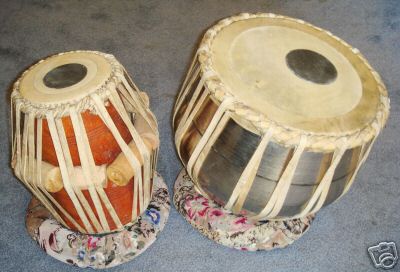
Tabla drums set of two Indian Srilankan percussion
A$
239
$
158


Favourite Auctions
To save auctions to your favourites, please login
If you don't have an account, please register
Description
A set of Tabla Drums in very good brand new condition. Bought to play but never played.
Full size professional drums both "Dayan" (small treble/ tenner) drum and the "Bayan" (the bigger bass) drums comes with the circular donut like cushions to position's them when playing. Excellent hide. The approximate diameters are 18cm and 27cm's and about 26cm tall. The small one has a carved out of wood and the big one is out of plated brass.
Due to the size of these, it may not be possible to use Australia post. I would prefer for the buyer to pick up.
For those who do not know what Tabla drums are, they are like Congo's and Djembes played with fingers and palm but more involved and in the experianced hands these drums can make wide variety of sounds.
I also have two smaller Tablas more for ornamental purpose which are also listed on ebay.
Please contact me if you need any further clarification.
For more information about TABLA instruments please read the following. Courtasy from Buckingham music site.
About tablas
The Indian tabla, a two-piece percussion instrument, is the principal rhythmic accompaniment to most North Indian classical (namely khyal) and light music. It is said to have its origin in the two-faced drum called mridangam (used in South Indian music) and the pakhawaj (used in the accompaniment of the north Indian genres dhrupad and dhamar). In her book, 'The Tabla', Rebecca Stewart traces the word tabla, to the Arabic word tabi, a generic term meaning drum. Although the construction of the instrument is similar to kettle-drums that were in use for centuries, the first visual images of an instrument similar to the tabla can be traced only to 1808. The instrument in its current form is probably less than a century old. The Tabla consists of two upright drums that are played with fingers and palms. Each drum sits on a ringed base of padding. Tablas are arguably the most complex drums in the world. Each head contains three separate skins. The smaller drum, slightly conical in shape, is called tabla or dayan (literally right) is generally played with the right hand. It is made of hollow rose or oak wood. The top of the drum is covered with a stretched, layered leather membrane held in place by leather braces. The wooden pegs between the braces and the drum adjust the tension in the braces, thus controlling the pitch of the instrument. < The black spot, found in the tabla's center is made from a semi-secret mixture of carbon black, mucilage, and iron filings gathered by tabla wallas (makers) from the sides of Indian railway lines. The mixture is rolled up into a sticky ball and applied as many spiral layers until it builds up this unique black spot. Please remember, this black spot and the tabla skins are very delicate, never hit a tabla with a stick - it is a hand drum only. The dayan is tuned with a metal hammer by lightly striking the periphery of the top membrane or tapping the wooden pegs. It is usually tuned to the tonic note of the performance. The larger rounded drum, called the duggi or the bayan (literally left, since the instrument is generally played with the left hand), has a body consisting of either clay or, more commonly in modern tablas, metal (nickel-plated brass, brass, copper or aluminum). The top is covered with a leather membrane held with thongs and, like the dayan, is also adorned with a round black patch. The baya has a larger diameter than the daya and provides the bass. The tabla player's index, third, and fourth fingers as well as the palm and heel of the hand strike the surface of both drums to generate the rich treble and low bass tones that make up the tabla bols (percussion notes). Combined, the dayan and bayan, can produce an extraordinary array of sounds (more than 20) and rhythms in the hands of accomplished tabla players. It is now only in India that one finds so much handwork involved in the making of musical instruments. In the rest of the world instruments are generally mass produced by machine with hand-crafting of instruments being the very expensive exception. In India individual hand making of instruments is the normal tradition and very little machinery is involved except for rough preparation work. Quite how long this traditional approach will continue is unknowable as India is modernizing quite quickly. Today, when one buys a good quality Indian instrument, whether it be sitar, tabla, harmonium, or something else, one is purchasing the product of one particular craftsman's genius and life's work. This is why every instrument is truly an individual work of art.
PAYMENT and selling condition. Prefer COD or direct deposit and local pickup if possible. Buyer must contact the seller within 4 working days of ending the auction. Payment if made to the bank should include the item description and ebay ID number so that it will be easy for us to track. Please do not bid if you do not want to buy them.
Buyer can arrange with a currier to pick up if they like. Buyer to take insurance for transport as I will not be responsible for damage due to transport or postage. The items are located in Templestowe, Victoria 3106 near Melbourne Australia. The package weigh approximately about kg and is about 50cm x 30cm 30cm both drums together. May slightly get bigger if I am to use packaging. Please contact me if you have more than 3 negative feed backs before bidding. As you see I have 100% feed back rating and would like to keep it that way.
price rating









![Siena Root - Root Jam [2nd Press, Black Vinyl] (2 LP) LIKE: ASTEROID/CAUSA SUI/T](https://www.popsike.org/php/thumbnail.php?url=https://www.popsike.pics/pix/20150106/181633661597.jpg)