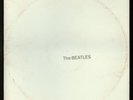
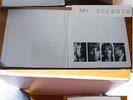
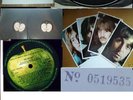
" The Beatles " LP - White Vinyl - 2 Disc Set - White Vinyl - Capitol - Inserts
$
87


Favourite Auctions
To save auctions to your favourites, please login
If you don't have an account, please register
Description
We do not ship internationally or to Alaska, Hawaii, US Protectorates, P.O. Boxes or APO/FPO addresses.
The Beatles (album)
The Beatles Original copies had the band's name blind embossed on a white background and were also numbered. Design by Richard Hamilton. Studio album by the Beatles Released 22 November 1968 Recorded 30 May – 14 October 1968 Studio EMI and Trident, London Genre
- Rock
- pop
(1967) The Beatles
(1968) Yellow Submarine
(1969) The Beatles North American chronology Magical Mystery Tour
(1967) The Beatles
(1968) Yellow Submarine
(1969)
The Beatles, also known as the White Album, is the ninth studio album and only double album by the English rock band the Beatles, released on 22 November 1968. Its plain white sleeve contains no graphics or text other than the band's name embossed,[a] which was intended as a direct contrast to the vivid cover artwork of the band's previous LP Sgt. Pepper's Lonely Hearts Club Band. The Beatles is recognised for its fragmentary style and diverse range of genres, including folk, British blues, ska, music hall and the avant-garde. It has since been viewed by some critics as a postmodern work, as well as among the greatest albums of all time.
Most of the songs on the album were written during March and April 1968 at a Transcendental Meditation course in Rishikesh, India. There, the only western instrument available to the band was the acoustic guitar; several of these songs remained acoustic on The Beatles and were recorded solo, or only by part of the group. The production aesthetic ensured that the album's sound was scaled-down and less reliant on studio innovation than their previous releases including 1966's Revolver and Sgt. Pepper's Lonely Hearts Club Band in 1967. The Beatles also broke with the band's tradition at the time of incorporating several musical styles in one song by keeping each piece of music consistently faithful to a select genre.
At the end of May 1968, the Beatles returned to EMI Studios in London to commence recording sessions that lasted until mid-October. During these sessions, arguments broke out among the foursome over creative differences and John Lennon's new partner, Yoko Ono, whose constant presence subverted the Beatles' policy of excluding wives and girlfriends from the studio. After a series of various problems, including producer George Martin taking an unannounced vacation and engineer Geoff Emerick suddenly quitting during a session, Ringo Starr left the band for two weeks in August. The same tensions continued throughout the following year and led to the band's break-up.
Packaging
The Beatles was issued on 22 November 1968 in Britain and three days later in the US. It was the third album to be released by Apple Records, following Harrison's Wonderwall Music, and Lennon's Two Virgins. The record was referred to as "the White Album" immediately upon release.
Pop artist Richard Hamilton designed the record sleeve in collaboration with McCartney. Hamilton's design was in stark contrast to Peter Blake's vivid cover art for Sgt. Pepper's Lonely Hearts Club Band, and consisted of a plain white sleeve. The band's name, in Helvetica, was crookedly blind embossed slightly below the middle of the album's right side. Later vinyl record releases in the US showed the title in grey printed (rather than embossed) letters. Each copy of the record featured a unique stamped serial number, "to create", in Hamilton's words, "the ironic situation of a numbered edition of something like five million copies". In 2008, an original pressing of the album with serial number 0000005 sold for £19,201 on eBay. In 2015, Ringo Starr's personal copy number 0000001 sold for a world record $790,000 at auction.
The sleeve included a poster comprising a montage of photographs, with the lyrics of the songs on the back, and a set of four photographic portraits taken by John Kelly during the autumn of 1968 that have themselves become iconic. The photographs for the poster were assembled by Hamilton and McCartney, and sorted them in a variety of ways over several days before arriving at the final result
During 1978 and 1979, for the album's tenth anniversary, EMI reissued the album pressed on limited edition white vinyl in several countriesTrack listing
All tracks written by Lennon–McCartney, except where noted. Lead singer credits per Castleman and Podrazik's 1976 book All Together Now.
Original release
Side one No. Title Lead vocals Length 1. "Back in the U.S.S.R." McCartney 2:43 2. "Dear Prudence" Lennon 3:56 3. "Glass Onion" Lennon 2:18 4. "Ob-La-Di, Ob-La-Da" McCartney 3:08 5. "Wild Honey Pie" McCartney 0:52 6. "The Continuing Story of Bungalow Bill" Lennon, with Yoko Ono 3:14 7. "While My Guitar Gently Weeps" (George Harrison) Harrison 4:45 8. "Happiness Is a Warm Gun" Lennon 2:47 Total length: 23:43 Side two No. Title Lead vocals Length 1. "Martha My Dear" McCartney 2:28 2. "I'm So Tired" Lennon 2:03 3. "Blackbird" McCartney 2:18 4. "Piggies" (Harrison) Harrison 2:04 5. "Rocky Raccoon" McCartney 3:33 6. "Don't Pass Me By" (Richard Starkey) Starr 3:51 7. "Why Don't We Do It in the Road?" McCartney 1:41 8. "I Will" McCartney 1:46 9. "Julia" Lennon 2:57 Total length: 22:41 Side three No. Title Lead vocals Length 1. "Birthday" McCartney with Lennon 2:42 2. "Yer Blues" Lennon 4:01 3. "Mother Nature's Son" McCartney 2:48 4. "Everybody's Got Something to Hide Except Me and My Monkey" Lennon 2:24 5. "Sexy Sadie" Lennon 3:15 6. "Helter Skelter" McCartney 4:30 7. "Long, Long, Long" (Harrison) Harrison 3:08 Total length: 22:48 Side four No. Title Lead vocals Length 1. "Revolution 1" Lennon 4:15 2. "Honey Pie" McCartney 2:41 3. "Savoy Truffle" (Harrison) Harrison 2:54 4. "Cry Baby Cry" Lennon, with McCartney 3:02 5. "Revolution 9" Speaking from Lennon, Harrison, Ono and George Martin 8:15 6. "Good Night" Starr 3:14 Total length: 24:21price rating