The Beatles "Sgt Peppers" UK 1st Mono + Flame Inner + push-out Insert 1967 g/f
£
26
$
35


Favourite Auctions
To save auctions to your favourites, please login
If you don't have an account, please register
Description
The Beatles ? "Sgt. Pepper's Lonely Hearts Club Band" Parlophone ?PMC 7027 UK 1st press
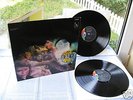
Mono Vinyl, LP, housed in a red half-tone print on white 'psychedelic' inner sleeve, which in turn is inside a Garrod & Lofthouse laminated gate-fold cover (flipback glue-tabs on inner spread). The LP was released in 1967.
The vinyl has one or two surface marks, but it plays through beautifully on my stereo, with only slight sporadic noise between tracks. The vinyl is housed in its original red half-tone print on white 'psychedelic' inner sleeve, which has come apart at the bottom seam, but is otherwise in good order - no writing. The Garrod & Lofthouse laminated gate-fold cover is generally in good condition - no rips or writing. The spine is worn and illegible. The push-out insert is also in good shape, again, intact with no tears or writing. Matrix / Runout (A-side run-out, stamped, variant 1): XEX 637-1 Matrix / Runout (B-side run-out, stamped, variant 1): XEX 638-1
"Sgt. Pepper's Lonely Hearts Club Band" is the Beatles' eighth studio album. Released on 26 May 1967 in the United Kingdom and 2 June 1967 in the United States, it was an immediate commercial and critical success, spending 27 weeks at the top of the UK albums chart and 15 weeks at number one in the US. On release, the album was lauded by the vast majority of critics for its innovations in music production, songwriting and graphic design, for bridging a cultural divide between popular music and legitimate art, and for providing a musical representation of its generation and the contemporary counterculture. It won four Grammy Awards in 1968, including Album of the Year, the first rock LP to receive this honour.
"Sgt. Pepper" is regarded by musicologists as an early concept album that advanced the use of extended form in popular music while continuing the artistic maturation seen on the Beatles' preceding releases. It has been described as one of the first art rock LPs, aiding the development of progressive rock, and credited with marking the beginning of the album era. An important work of British psychedelia, the album incorporates a range of stylistic influences, including vaudeville, circus, music hall, avant-garde, and Western and Indian classical music. In 2003, the Library of Congress placed "Sgt. Pepper" in the National Recording Registry, honouring the work as "culturally, historically, or aesthetically significant". That same year, Rolling Stone magazine ranked it number one in its list of the "500 Greatest Albums of All Time". Professor Kevin J. Dettmar, writing in the Oxford Encyclopedia of British Literature, described it as "the most important and influential rock and roll album ever recorded".
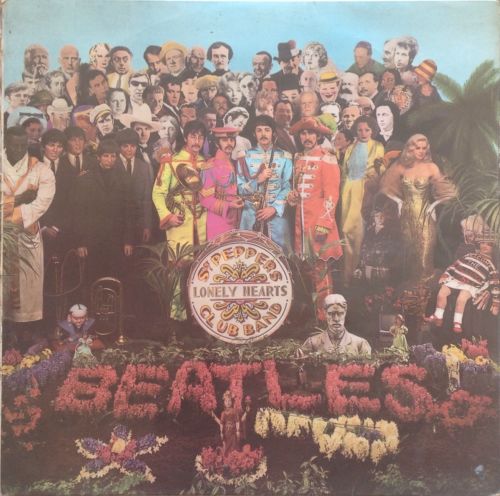
"Sgt. Pepper's" album cover was designed by the pop artists Peter Blake and Jann Haworth from an ink drawing by McCartney. It was art-directed by Robert Fraser and photographed by Michael Cooper. The front of the LP included a colourful collage featuring the Beatles in costume as the Sgt. Pepper's Lonely Hearts Club Band, standing with a group of life-sized cardboard cut-outs of famous people. Each of the Beatles sported a heavy moustache, after Harrison had first grown one as a disguise during his visit to India. The moustaches reflected the growing influence of hippie style trends, while the group's clothing "spoofed the vogue in Britain for military fashions", writes the Beatles biographer Jonathan Gould. The centre of the cover depicts the Beatles standing behind a bass drum on which fairground artist Joe Ephgrave painted the words of the album's title. In front of the drum is an arrangement of flowers that spell out "Beatles". The group were dressed in satin day-glo-coloured military-style uniforms that were manufactured by the theatrical costumer M. Berman Ltd in London. Right next to the Beatles are wax sculptures of the band members in their suits and mop-top haircuts from the Beatlemania era, borrowed from Madame Tussauds. The album's lyrics were printed in full on the back cover, the first time this had been done on a rock LP.
price rating