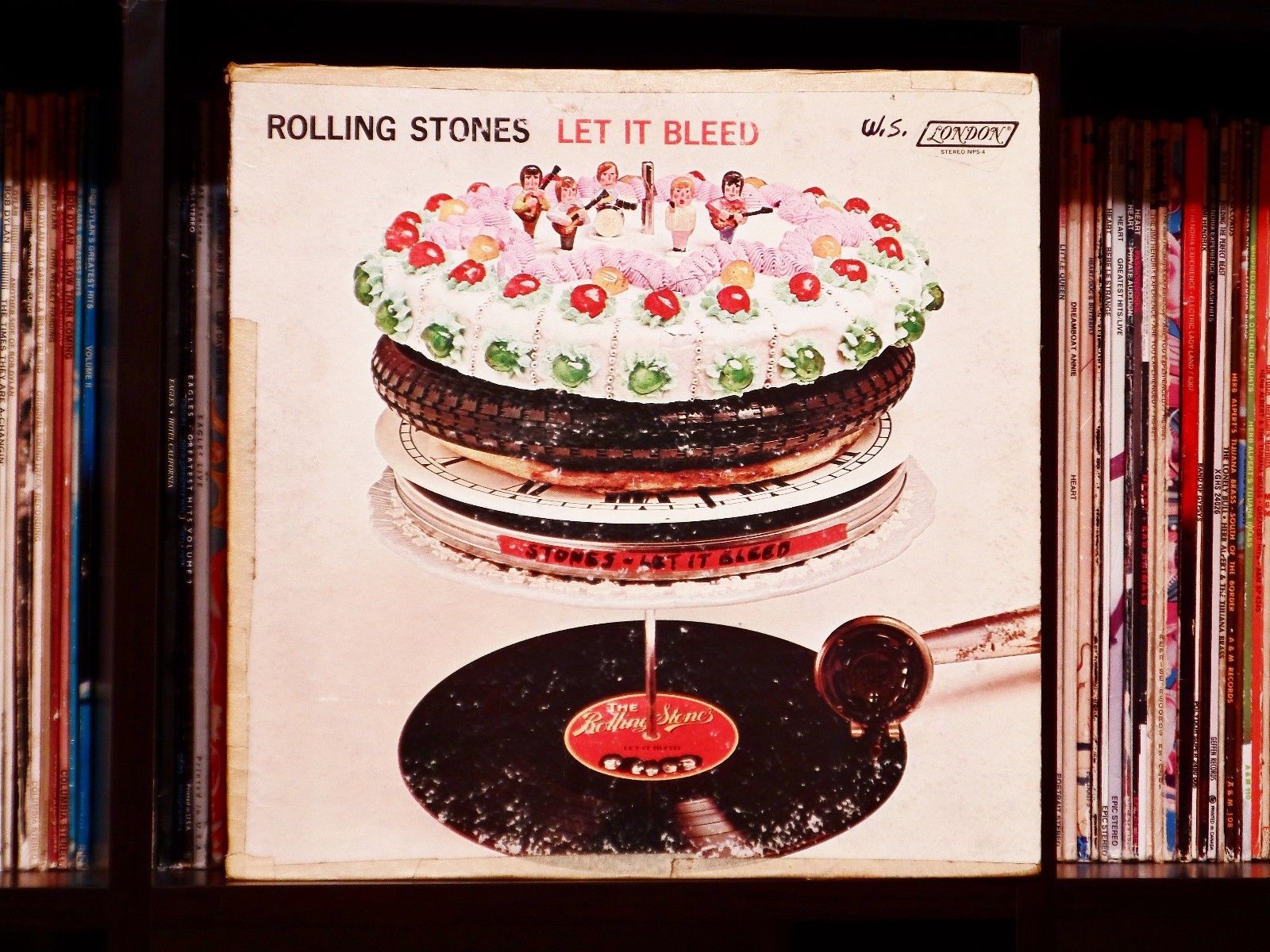
The Rolling Stones ? Let it Bleed ? Rare 1969 London Records Original Press LP
$
20


Favourite Auctions
To save auctions to your favourites, please login
If you don't have an account, please register
Description
Welcome to Classic Cadillac Records! My goal is to provide each and every customer with the best possible buying experience, no matter the size of the order. Unlike most sellers, I advertise all my items clearly and in as much detail as possible, without shouting at you in all caps. I take multiple high quality pictures and never use stock photos, so you know exactly what you’re buying. I take great pride in my work and go the extra mile, which can clearly be seen in my listings compared to other sellers that put minimal effort into theirs. I visually grade all my records as accurately as possible and will never grade anything above Near Mint unless it’s still sealed. Please note that a visual grade can differ from a play grade, and am happy to spot check a record upon request. All orders are shipped within 1 business day (usually sooner) and packed with extra care to ensure fast, safe arrival. I combine shipping on multiple orders to save you money and gladly ship worldwide. Please look closely at all pictures, read all relevant details and ask any questions you may have before buying. I offer a full 30-day return policy on everything I sell, so buy with confidence! And most importantly, thanks for looking!
Let It Bleed Studio album by The Rolling Stones Released 5 December 1969 Recorded November 1968, February–July, October–November 1969 Studio Olympic Studios, London; Elektra Studios, Los Angeles; Sunset Sound, Los Angeles[1] Genre Hard rock, blues, country blues Length 42:21 Label Decca (UK)London (US) Producer Jimmy Miller The Rolling Stones chronology Beggars Banquet
(1968) Let It Bleed
(1969) Sticky Fingers
(1971) Singles from Let It Bleed
- "Let It Bleed"/"You Got the Silver"
Released: January 1970 (Japan only)
Let It Bleed is the eighth British and tenth American album by English rock band the Rolling Stones, released in December 1969 by Decca Records in the United Kingdom and London Records in the United States. Released shortly after the band's 1969 American Tour, it is the follow-up to 1968's Beggars Banquet and the last album by the band to feature Brian Jones as well as the first to feature Mick Taylor.
Background
Although the Stones had begun the recording of "You Can't Always Get What You Want" in November 1968, before Beggars Banquet had been released, recording for Let It Bleed began in earnest in February 1969 and continued sporadically until early November. Brian Jones performs on only two tracks: playing the autoharp on "You Got the Silver", and percussion on "Midnight Rambler". His replacement, Mick Taylor, plays guitar on two tracks, "Country Honk" and "Live with Me", as well as on "Honky Tonk Women" which was recorded during the Let It Bleed sessions. Keith Richards, who had already shared vocal duties with Mick Jagger on "Connection" and sung separate lead vocals on parts of "Something Happened to Me Yesterday" and "Salt of the Earth", sang his first solo lead vocal on a Rolling Stones recording with "You Got the Silver". The London Bach Choir sang on "You Can't Always Get What You Want" but publicly disassociated itself from the album, citing what author Stephen Davis terms its "relentless drug ambience".
Let It Bleed was originally scheduled for release in July 1969. Although "Honky Tonk Women" was released as a single that month, the album itself suffered numerous delays and was eventually released in December 1969, after the band's US tour for it had already completed.[citation needed] The majority of the album was recorded at Olympic Studios in London, with further work taking place at Elektra Sound Recorders Studios, 962 La Cienega Boulevard, Los Angeles, California, 90069, while the Stones prepared for the tour. The Los Angeles-recorded portions included overdubs by guest musicians Merry Clayton (on "Gimme Shelter"), Byron Berline (on "Country Honk"), and Bobby Keys and Leon Russell (on "Live with Me"). Finally, an unreleased version of "I Don't Know The Reason Why (a. k. a. Hillside Blues)" was also recorded there in October 1969 with Mick Taylor.
Music and lyrics
Style and influences
Like Beggars Banquet the year before, as well as the subsequent two releases, the album marks a return to the group's more blues-based approach that was prominent in the pre-Aftermath period of their career. The main inspiration during this string of albums was American roots music and Let It Bleed is no exception, drawing heavily from gospel (evident in "Gimme Shelter" and "You Can't Always Get What You Want"), Hank Williams and Jimmie Rodgers ("Country Honk"), Chicago blues ("Midnight Rambler"), as well as country blues ("You Got The Silver", "Love In Vain") and country rock ("Let It Bleed").
You Can't Always Get What You Want MENU 0:00 A sample of The Rolling Stones's "You Can't Always Get What You Want" from Let It Bleed Problems playing this file? See media help.According to Don Heckman from The New York Times, Let It Bleed was a "heavy" and "passionately erotic" album of hard rock and blues, influenced by African-American music. Richie Unterberger, writing for AllMusic, said it "extends the rock and blues feel of Beggars Banquet into slightly harder-rocking, more demonically sexual territory."[12] Mojo magazine's James McNair felt the record had an emphasis on "earthy" country blues.
Due to their experimentation during the mid-1960s, the band had developed an eclectic approach to arrangements. Slide guitar playing is prominent (played entirely by Richards, except "Country Honk", which was performed by Mick Taylor), and is featured on all songs except "Gimme Shelter", "Live With Me" and "You Can't Always Get What You Want", giving the album an authentic blues feel throughout. In addition, an array of session musicians embellish the songs with various instruments. Alongside the de rigueur piano performances (Ian Stewart, Nicky Hopkins), the record included fiddle (Byron Berline), mandolin (Ry Cooder), organ and French horn (Al Kooper), as well as vibes (Bill Wyman) and autoharp (Wyman, Jones). Of more importance, however, was the debut of both renowned saxophonist Bobby Keys on "Live With Me", a musician who was integral at giving the group's arrangements a soul/jazz background, and guitarist Mick Taylor, who took on lead guitar duties with technically proficient playing, giving the band a harder rock sound during the late 1960s/early 1970s.
Lyrics
Generally, the album's lyrics deal with 1960s life; there is social commentary on the Vietnam War ("Gimme Shelter"), as well as the hippie movement, drug culture and politics ("You Can't Always Get What You Want"), but at the same time there are love-related topics, ranging from desolate ("Love In Vain", written by Robert Johnson), to heartwarming ("You Got The Silver", written by Richards), sensual, innuendo-filled ("Let It Bleed"), and humorous ("Live With Me"). Moreover, "Monkey Man" satirizes and comments on the band's public image and lifestyle while "Midnight Rambler" has a very cinematic, suspenseful approach, talking about its titular serial killer (inspired by Albert DeSalvo) in the third-person before Jagger slowly assumes the role after the first half of the song.
The lyricism found on Let It Bleed is often noted for its violent and cynical undercurrents. Jann S. Wenner, in a 1995 Rolling Stone interview with Jagger, described the album's songs as "disturbing" the scenery as "ugly" and asked Jagger if the Vietnam War played a role in the album's worldview. Jagger said: "I think so. Even though I was living in America only part time, I was influenced. All those images were on television. Plus, the spill out onto campuses".
Artwork
The album cover displays a surreal sculpture designed by Robert Brownjohn. The image consists of the Let It Bleed record being played by the tone-arm of an antique phonograph, and a record-changer spindle supporting several items stacked on a plate in place of a stack of records: a film canister labelled Stones – Let It Bleed, a clock dial, a pizza, a tyre and a cake with elaborate icing topped by figurines representing the band. The cake parts of the construction were prepared by then-unknown cookery writer Delia Smith. The reverse of the LP sleeve shows the same "record-stack" melange in a state of disarray. The artwork was inspired by the working title of the album, which was Automatic Changer.[22]
The album cover for Let It Bleed was among the ten chosen by the Royal Mail for a set of "Classic Album Cover" postage stamps issued in January 2010.
Jagger originally asked artist M. C. Escher to design a cover for the album; Escher declined.
Release and reception
Professional ratings Retrospective reviews Review scores Source Rating AllMusic Encyclopedia of Popular Music Entertainment Weekly A The Great Rock Discography 9/10 Music Story MusicHound Rock 5/5 NME 9/10 Rolling Stone The Rolling Stone Album GuideReleased in December, Let It Bleed reached number 1 in the UK (temporarily demoting The Beatles' Abbey Road) and number 3 on the Billboard Top LPs chart in the US, where it eventually went 2× platinum. In a contemporary review for Rolling Stone magazine, music critic Greil Marcus said that the middle of the album has "great" songs, but "Gimme Shelter" and "You Can't Always Get What You Want" "seem to matter most" because they "both reach for reality and end up confronting it, almost mastering what's real, or what reality will feel like as the years fade in."
Let It Bleed was the Stones' last album to be released in an official mono version, which is rare and highly sought-after today. The album was released in US as an LP record, reel to reel tape, audio cassette and 8-track cartridge in 1969, and as a remastered CD in 1986. In August 2002, it was reissued in a remastered CD and SACD digipak by ABKCO Records, and once more in 2010 by Universal Music Enterprises in a Japanese only SHM-SACD version.
In a retrospective review, NME magazine said that the album "tugs and teases" in various musical directions and called it "a classic". In his 2001 Stones biography, Stephen Davis said of the album "No rock record, before or since, has ever so completely captured the sense of palpable dread that hung over its era." In a five-star review for Rolling Stone in 2004, Gavin Edwards praised Keith Richard's guitar playing throughout the album and stated, "Whether it was spiritual, menstrual or visceral, the Stones made sure you went home covered in blood." Jason McNeil of PopMatters wrote that Beggars Banquet and Let It Bleed are "the two greatest albums the band’s (or anyone’s) ever made". In Steven Van Zandt's opinion, Let It Bleed was one in the Stones' series of four studio LPs – including Beggars Banquet (1968), Sticky Fingers (1971) and Exile on Main St. (1972) – that was "the greatest run of albums in history".
In 2000, Q magazine ranked it at number 28 in its list of "The 100 Greatest British Albums Ever". In 2001, the TV network VH1 placed Let It Bleed at 24th on their "100 Greatest Albums of R 'n' R" survey. In 1997, it was voted the 27th "Best Album Ever" by The Guardian. In 2003, Rolling Stone ranked it at number 32 on the magazine's list of the "500 Greatest Albums of All Time".
Let It Bleed has sold over 7 million copies worldwide since 1969.
Track listing
The track listing on the back of the album jacket did not follow the one on the album itself. According to Brownjohn, he altered it purely for visual reasons; the correct order was shown on the record's label. Additionally, "Gimme Shelter" is rendered as "Gimmie Shelter" on the jacket. Some releases have "Gimmie Shelter" on the cover, the inner sleeve and the LP label.
All songs written by Mick Jagger and Keith Richards, except "Love in Vain" by Robert Johnson. Early US editions of the album credit the song to Woody Payne, a pseudonym used by a music publisher of the songs of Robert Johnson.
Side one No. Title Length 1. "Gimme Shelter" 4:31 2. "Love in Vain" 4:19 3. "Country Honk" 3:09 4. "Live with Me" 3:33 5. "Let It Bleed" 5:26 Side two No. Title Length 6. "Midnight Rambler" 6:52 7. "You Got the Silver" 2:51 8. "Monkey Man" 4:12 9. "You Can't Always Get What You Want" 7:28price rating