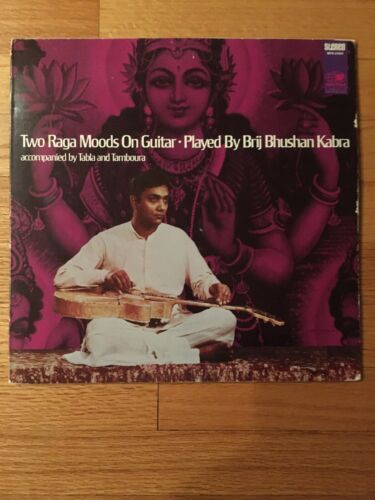
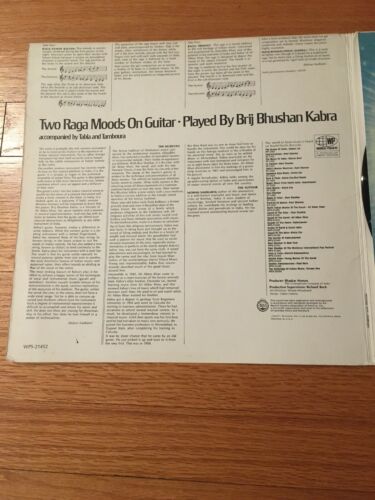
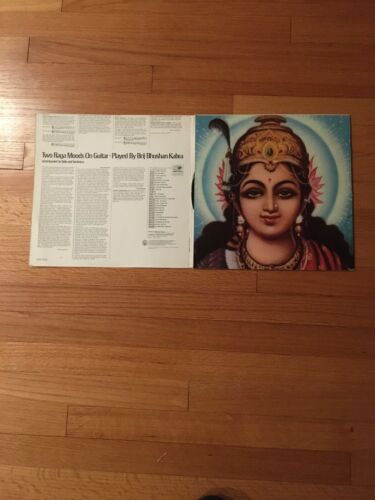
Two Raga Moods On Guitar • Played By Brij Bhushan Kabra WPS 21452 Vinyl LP
$
25

Favourite Auctions
To save auctions to your favourites, please login
If you don't have an account, please register
Description
A very nice copy of Two Raga Moods On Guitar • Played By Brij Bhushan Kabra ~ WPS 21452. The first LP of Indian classical guitar to be released in the U.S., 1968.
Born into a prominent family in Jodhpur, India in 1937, Kabra shocked his father, a patron of the classical arts who had studied sitar with the legendary Inayat Khan (father of sitarist Vilayat Khan), by embracing a Western instrument, an archtop Hofner guitar acquired for 250 rupees in 1958. Kabra’s elder brother, Damodar Lal, had studied sarod with Ali Akbar Khan, and so Kabra was expected to study sarod as well. Surprisingly, Ali Akbar Khan encouraged Kabra’s enthusiasm for guitar: “Don’t leave this,” he told Kabra after coaching him in the rudiments of Hindustani classical tradition. “I believe you are going to do something on it. There is something special about this instrument.”
The father who initially objected to Kabra’s interest in guitar then challenged his son by offering to present him in concert a year after he took up the instrument. “I started playing like a mad person,” Kabra told Henry Kaiser (Gultar Player, December 1985), because “up until that time, there had been no precedent for the guitar in Indian classical music.” Kabra’s solitary crusade to prove the guitar could hold its own in this tradition was a success: his 1959 concert debut was followed by further experiments with guitar (he would be the first to add the chikari, or rhythmic drone string) and, beginning in 1964, a recording career. “I had no fixed ideas about music or the instrument,” Kabra told Kaiser. “I developed my technique according to the music I wanted to play, by trial and error, and it kept getting better and better... As I went on, I found there was unlimited potential in it; the only question was how far I could draw on my own reserves, how much more I could learn to really bring it out of the instrument. But the instrument never said no. It has fantastic range, as far as the holding (sustaining) power of the note is concerned. No other instrument has that. For the most important part of Indian music, the alap, it is one of the most ideally suited instruments... the most important aspect of the alap - the modulations that the human voice can do, the grace notes it can produce - that can be achieved very well on the guitar.”
“The guitar’s entry into the Indian classical arena,” wrote Mohan Nadkarni in the notes to Kabra’s 1968 World Pacific album, Two Raga Moods on Guitar, “is looked upon as a welcome, if bold venture.” This sense of a new voice within Hindustani tradition doubtless drew young musicians to follow Kabra’s lead. “The guitar has now become quite a popular instrument in India,” he said a decade ago. “The real thing will start rolling when a lot of other young people come up.” And things have indeed rolled at a brisk clip as younger players have garnered international acclaim for the sound of Hindustani slide guitar.
price rating


