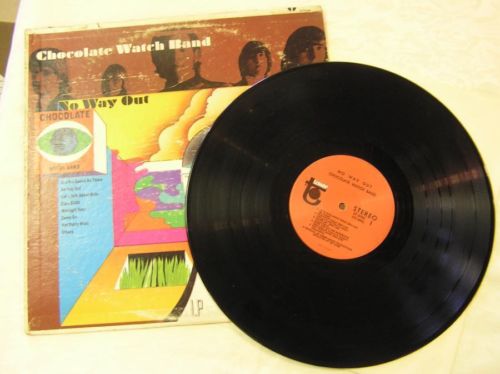
VG+ Original CHOCOLATE WATCHBAND No Way Out TOWER RECORDS ST5096 PSYCH VTG VINYL
$
123



Favourite Auctions
To save auctions to your favourites, please login
If you don't have an account, please register
Description
This Auction Is For This Original Vintage Vinyl 33 1/3 LP Record
by The Chocolate Watchband "No Way Out" Tower Records ST 5096
Grades -- Vinyl Record: Strong VG+ Label: VG+ Cover: VG
Please View the Many Pictures Below
More Info Below Pictures
This Auction Is For This Original Vintage Vinyl 33 1/3 LP Record by The Chocolate Watchband "No Way Out" Tower Records ST 5096
Grades -- Vinyl Record: Strong VG+ Label: VG+ Cover: VG
Let`s Talk About Girls - In The Midnight Hour - Come On - Dark Side Of The Mushroom - Hot Dusty Roads -
Are You Gonna Be There (At The Love-In) - Gone And Passes By - No Way Out - Expo 2000 - Gossamer Wings -
The Chocolate Watchband "No Way Out" Tower Records ST 5096
Original CHOCOLATE WATCHBAND No Way Out Tower Records ST5096 PSYCH VTG VINYL
This Auction Is For This Original Vintage Vinyl 33 1/3 LP Record
by The Chocolate Watchband "No Way Out" Tower Records ST 5096
Grades -- Vinyl Record: Strong VG+ Label: VG+ Cover: VG
Grades
Record: STRONG VG+ Very Nice Record, High Gloss
Label: VG+ Clean, Shows Very Minor Spindle Marks
Cover: VG High Gloss, Bright Colors, Shows Rounding or Bumbing at Corners, Shows Signs of Ring Wear, Top Seem Has Cello Tape Shows Signs of Seam Splits, Shows Slight Waffle at Gate, Does Have a Slight Musty Odor
Let's Talk About Girls -
In The Midnight Hour -
Come On -
Dark Side Of The Mushroom -
Hot Dusty Roads -
Are You Gonna Be There (At The Love-In) -
Gone And Passes By -
No Way Out -
Expo 2000 -
Gossamer Wings -
The Chocolate Watchband's debut album, No Way Out
was also their most heavily Rolling Stones-influenced album, but appreciating the album and what's on it (and what's not) requires some explanation. Released in September of 1967, No Way Out came at the end of the band's first 15 months of existence, a period that encompassed the recording and release of four singles of generally extraordinary quality, and as good as anything heard from any garage band anywhere during that period. Just two of those single tracks, "Are You Gonna Be There (At the Love-In)" and "No Way Out," ended up on the original ten-track LP, but even they could (and should) have been the core of an immensely powerful LP. Instead, out of the remaining songs, only two -- the group's nicely cranked-up version of Chuck Berry's "Come On" and the psychedelic Bo Diddley-based "Gone and Passes By" -- were recorded by the entire group and released in the form intended. The other six tracks included Watchband recordings, such as "Let's Talk About Girls," "In the Midnight Hour," and "Hot Dusty Road," on which lead singer David Aguilar's vocals had been replaced by those of session singer Don Bennett (co-author of the band's single "Are You Gonna Be There (At the Love-In)") and also embellished with extra instrumental overdubs; two instrumentals, "Expo 2000" and "Dark Side of the Mushroom," recorded by a group of studio musicians put together by engineer Richie Podolor; and, finally, the bizarre "Gossamer Wings," a psychedelic digression by Bennett and company that used the band's basic track from the 1966 single B-side "Loose Lip Sync Ship" as its jumping-off point. So what's here is not really representative of The Chocolate Watchband that was seen in the movie Riot on Sunset Strip, or heard on those four killer singles in 1966 and early 1967. All of that said, No Way Out is still an extremely impressive and enduring album that nicely straddles the garage punk and psychedelic genres; the four tracks cut by the band themselves are all highly potent, slashing, exciting, clever pieces of music. "Gone and Passes By" and "No Way Out" are sharp works of psychedelic punk music, the former mixing sitar music with a shimmering Bo Diddley beat to superbly seductive effect, while the latter is built on a twisting, jagged blues- and raga-based lead guitar line that recalls the late-1966 vintage Jefferson Airplane's work. And "Are You Gonna Be There (At the Love-In)" is a stirring, even threatening anthem to youthful defiance. Of the rest, "Let's Talk About Girls" is still a very good track and a killer opener for the album, despite the tampering by the producers, and "In the Midnight Hour" and "Hot Dusty Road" are not too far behind. As for the instrumentals, "Dark Side of the Mushroom" and "Expo 2000" are decent filler, even if they have nothing to do with the band. So the record, though flawed from day one of its release history, is still an essential '60s album in any collection.
Indeed, they were a unique phenomenon -- based on their recordings, they were a world-class garage punk act, if that's possible, beating the Ramones to the punch by a decade, and showing more consistency than, say, the Litter, and more originality and range than the Shadows of Knight. While American bands of the period usually either detoured into folk-rock on their way to more elusive flights of languid psychedelia, or fell back on gimmicks and dumbing down their image (à la Paul Revere & the Raiders) to sell records, the Watchband retained an amazing purity of purpose and intent -- they owed a considerable (and undeniable) debt to the Rolling Stones for various elements of their sound, but they kept pushing the envelope, at least in intensity, and may even have matched the Stones in their psychedelic ventures when the time came to ante-up musically; they were like the Stones imbued with the more reckless and creative spirit of the Pretty Things. And in another reality, with their intensity and purposefulness -- lead singer David Aguilar can still stir listeners on his best records 40 years later -- the Watchband might've been America's Rolling Stones. They had the sound to do it -- and left behind a buzzsaw-textured rendition of one classic Bob Dylan song, and even gave the Kinks some serious competition with their cover of Ray Davies' "I'm Not Like Everybody Else" -- but not the breaks. Indeed, no sooner was the group out of the starting gate when they were compromised and then done in by a combination of internal conflicts and managers and producers with their own agendas. So this world-class act didn't find a concert audience outside of California for 30 years, and never charted a record nationally, and if you ask most casual '60s rock fans about them, you'll probably get little more than a blank stare. In fact, most will probably remember their AVI Records labelmates the Standells more clearly, because they actually managed to chart a few singles, even though they were a lesser band.
the Chocolate Watchband got its start at Foothill College in Los Altos, California in 1965, when guitarists Mark Loomis and Ned Torney -- both ex-members of the Chapparals -- joined in a fledgling outfit that later included Danny Phay (vocals), Rich Young (bass), Jo Kemling (organ), and drummer Peter Curry (soon succeeded by Gary Andrijasevich). This early Los Gatos-based version of the Watchband emerged in 1965, just as the British Invasion was starting to crest, and, with their raw, lean sound built on British Invasion-style R&B and pop/rock, achieved great popularity at the college and the surrounding area. They never made any official, commercial recordings, but a pair of demo tracks that surfaced in the '90s reveals a solid performing unit with some inspired playing -- especially on the lead guitar -- and an attractive if not necessarily bracing overall sound, and a lot of potential. Most of the latter seemed destined to be unrealized when Torney and Phay took an offer from a rival group -- the Otherside, which had formed out of an earlier band called the Topsiders -- and abandoned the original Chocolate Watchband, with Kemling following their lead. Loomis found a temporary berth with a very busy surf band called the Shandells, but wanted to play to an audience older than the pre-teens who attended their shows; he also saw no reason why he couldn't take another run at success, especially as the exiting members had made no attempt to keep the Chocolate Watchband name -- he got Andrijasevich back, and recruited ex-Topsider guitarist Sean Tolby (who'd also been left high-and-dry by the personnel switch), and then grabbed the Shandells' bassist Bill Flores. That still meant finding a lead singer to replace Phay, and it was just about then that he discovered David Aguilar, who was (nominally) a biology major at San Jose State University -- Aguilar also sang like a punk god, had a stage presence to rival Mick Jagger, excellent musical sensibilities, and could even write songs.
Thus was reborn the Chocolate Watchband in the spring of 1966, and what re-emerged was a much more powerful and impressive unit. They didn't play in front of people until they'd done some crash development of a proper stage act in Loomis' garage. They hit the ground running, playing the best white R&B-based rock heard anywhere this side of London, with a stage act that rivalled that of the Rolling Stones for excitement (and wasn't hurt by the presence of Brian Jones-lookalike Sean Tolby on rhythm guitar). The fact that they played Vox instruments only helped, making them look incredibly cool and their music -- already very potent -- sound like little else that was being heard around the Bay area. They secured the services of a manager who, in turn, got them signed to Green Grass Productions, a company co-founded by ex-Four Preps vocalist Ed Cobb, which had a recording deal with Capitol Records by way of the latter's Tower Records subsidiary. They played gigs with the early Jefferson Airplane and Big Brother & the Holding Company, and looked to be headed for that same level of possible success that those acts were already seeing. There was one false start, however, in the form of their debut single, "Blues Theme" -- an instrumental written by Mike Curb and originally cut by Davie Allan & the Arrows for the movie The Wild Angels -- it was getting radio play, but the original label had declined to issue a single on it, so Cobb and company jumped in with the Watchband, rush-releasing their version to try and grab some sales and attention -- the record was credited to the Hogs, owing to the tune's being associated with a biker movie, and the presence of the sound of a Harley on it; though they couldn't have known it, this wouldn't be the last time that the Watchband's identity was an issue on their records; and for reasons that seem bewildering, it came out on the kid-oriented Hanna-Barbara Records label, home of soundtracks to The Flintstones and other cartoons. The presence of the delightfully bizarre, satiric Zappa-like "Loose Lip Sync Ship," credited to Aguilar and Loomis as composers, on the B-side, only added a final piece of weirdness to the puzzle of that first release. The single never charted, but it was still a good record, and not a bad beginning.
The band was playing locally to bigger audiences and for larger fees than ever by the fall of 1966, and it was around that time that events around them were to help create ripples in their career. That summer, the district in Los Angeles known as the Sunset Strip -- renowned in the '40s and '50s for nightspots like Ciro's and, later, Dino's (owned by Dean Martin and immortalized in the TV series 77 Sunset Strip), but more recently home to clubs featuring rock & roll, including the Whisky A-Go-Go -- saw a massive influx of teenagers and younger twenty-somethings, with long hair and attitude; they were a long way from the '50s habitues of the area's nightspots, and their presence led to a decision by the police and L.A. County Sheriff's office to crack down on nighttime activities. That, in turn, led to a series of escalating conflicts between cops and teens throughout the fall of 1966, culminating in a violent confrontation at a club called Pandora's Box, where rocks and garbage were thrown, people on both sides were hurt, and property was damaged. That incident made the news and led to the closing (and bulldozing) of the club -- whose luckless owners probably hadn't paid enough money to the right local officials -- and the whole event made it into song and popular culture in the context of protest music, Stephen Stills penned his wryly ironic, vaguely ominous "For What It's Worth," which was duly turned into a hit by Buffalo Springfield, and on a cheesier but more visceral level, American International Pictures generated the film Riot on Sunset Strip, an exploitation movie par excellence rushed out to theaters in early 1967. the Standells (who were also managed by Cobb and Green Grass) provided the title song, and the Chocolate Watchband turned in a couple of excellent numbers, "Don't Need Your Lovin'" and "Sitting There Standing," and managed to appear in the movie, which has since become a '60s cult classic.
Everything seemed to be moving in the right direction, including a second single, "Sweet Young Thing" b/w "It's All Over Now, Baby Blue," that oozed excitement and punk defiance. The A-side, authored by Ed Cobb, was as salacious as anything that the Rolling Stones or Them had ever issued, and even had the temerity to half-quote the central sitar riff from the Stones' recent single "Paint It Black," while Aguilar seemed to sum up the searing passions of the Stones' 13-minute "Goin' Home" in just three minutes, and mostly the last 30 seconds of the song -- with every instrument on the record seemingly cranked up to 11 and over-mic'ed, it was a larger-than-life performance issued on Tower's subsidiary Uptown label in December of 1966; the A-side was supported by a rendition of Bob Dylan's "It's All Over Now, Baby Blue" that used Them's arrangement as a jumping-off point but pumped up the wattage and gave Aguilar a great vocal canvas to work with.
They followed this up in February of 1967 with "Misty Lane" b/w "She Weaves a Tender Trap," which was a somewhat more lyrical, melodic song than they'd been working with. It had a great beat and was a good showcase for Aguilar and company, and was also perhaps a bit closer to the sort of records that Loomis hoped to be making. The B-side, authored by Cobb, was a piece of soft pop balladry, complete with an overdubbed reed and horn accompaniment that had the bandmembers playing at midtempo with an acoustic instrument or two in evidence, and Aguilar in an almost languid performance; it was pretty enough, and a credit to everyone involved, but it wasn't what the Watchband was about. In retrospect, the members might've become concerned about precisely what was going on behind the scenes and what the thinking of their management was, but they were busy playing lots of gigs, not only in the Bay area but all over California, and whatever their feelings about some of the music on the singles, those at least represented the group's work and the records were getting played on the radio locally.
Soon after came the two songs for Riot on Sunset Strip, which ended up on the movie's soundtrack album, and a fourth Watchband 45, "No Way Out" b/w "Are You Gonna Be There (At the Love-in)" -- and after the seeming digression of "Misty Lane," the band seemed to be back in its own bailiwick, with a double-sided piece of garage punk gold. "Are You Gonna Be There (At the Love-in)," which ended up being used in the exploitation movie The Love-Ins (in which the band was supposed to have a major role but mostly ended up on the cutting room floor, as a result of some sort of havoc they created on the set), still resonates 40 years later as a moment of triumph for everyone, and the Cobb-authored "No Way Out" wasn't far behind, a shimmering piece of full-blown psychedelia with a killer performance by Flores and Andrijasevich in the opening, and Loomis' guitar laying down a jagged psychedelic blues lead line, while Tolby's instrument chimed and crunched away in the background while Aguilar intoned the spaced-out lyrics; even the tape effects and distortion at the end were handled with restraint and class.
That record came and went in June of 1967, heralding the Summer of Love. The Watchband set to work cutting their first LP, which duly showed up in September of that year with the title No Way Out, and to the shock of the members, they discovered that only a pair of tracks, "Come On" and "Gone and Passes By," had made it onto the album intact. The vocals on almost half the record (including the opening track) had been given over to Don Bennett, a singer and songwriter (and co-author of "Are You Gonna Be There (At the Love In)"), and two of the tracks were by an entirely different band altogether, a studio group put together by engineers Richard Podolor and Bill Cooper. The album's flaws seemed to lead to the exposure of fissures just beneath the surface of their success. The first to go was Loomis, who could play practically anything but whose taste ran to more lyrical sounds -- he was getting tired of the Watchband's high-energy, blues-based sound on-stage -- and he cut out for the Tingle Guild, a folk-rock band, with Andrijasevich in tow. Their exit prompted David Aguilar to split, leaving Bill Flores and Sean Tolby as the sole active members of the Watchband.
This is where the band's history gets confusing. Flores and Tolby managed to put together a temporary lineup to fulfill the group's upcoming gigs -- Tim Abbott on guitar, Mark Whittaker on drums, and Chris Flinders as vocalist -- and they were good enough so that, as a live act, the Watchband barely skipped a beat. Flinders and Abbott left before the end of 1967, however, and once again the group was reduced to half a band. Aguilar came back for a short time, but by December of 1967 the Watchband, in terms of what it had started out to be or any of the original participants, was essentially history. That didn't dissuade their management or their label from exploiting the name -- Podolor assembled a group of studio musicians and put Don Bennett at the microphone once more, retrieved some outtakes from the original group's sessions, and a pair of songs completed by the band, and delivered The Inner Mystique. With its splashy collage cover and spaced-out digressions, it was a slightly late psychedelic release in February of 1968, but the content actually bridged several musical styles; the pure psychedelia was mostly Podolor's ex post facto creation in the form of the instrumental "Voyage of the Trieste" and the ornate, shimmering interpretation of "In the Past" (a track originally done by the Florida-based We the People). Speaking for the real Watchband, in defiant, sneering punk tones, was a glittering remixed version of "It's All Over Now, Baby Blue," a beautifully conceived and executed rendition of "I Ain't No Miracle Worker" (authored by Annette Tucker and Nancie Mantz, of Electric Prunes fame), and Aguilar's greatest musical triumph on record, his fiercely defiant rendition of Ray Davies' "I'm Not Like Everybody Else," where he and the band proved that they could hold their own with the Kinks as easily as the Stones.
The irony of No Way Out and The Inner Mystique is that, while they weren't fully (or, in the case of the latter, remotely) representative of the group's sound, they still constituted superb pieces of psychedelic garage punk. In later years, Tolby would explain that the group's albums were always a bit more psychedelic than the group was on-stage or on their singles, and didn't truly reflect their real sound. Cobb and Podolor wanted a certain kind of sound on the LPs that the band, even when it was intact, wasn't always prepared to deliver -- in an interview conducted in the early '80s, Cobb said that the group couldn't work in the studio without first indulging in the contents of "the box," which, like a psychedelic-era dessert tray, contained every popular controlled substance (including hallucinogenics) then circulating, and he gave that as the reason behind the reliance on Bennett and the "ghost" band put together by Podolor. To be fair, some of the Bennett-sung material, such as the cover of Wayne Proctor's "In the Past," may not sound like the real Watchband, but they were great records and shimmering examples of psychedelic punk with a great beat and memorable hooks. Additionally, the bandmembers have never corroborated Cobb's account, and it is difficult to believe that a band that was as tight on-stage as they were known to be, and with the reputations for brilliant shows, could have ever indulged too much in that kind of decadence; it would have shown up on-stage, and in the music, and they cut great singles.
Neither of the first two albums ever sold in huge numbers, as none of the singles connected to them ever charted nationally, but they did well enough so that Green Grass and Tower saw no reason not to go for a third bite of the apple. The company started with Sean Tolby, who had taken over lead guitar with the Watchband before the end, and he recruited Bill Flores into what became a kind of cross-generational Chocolate Watchband, featuring Loomis and Andrijasevich and original, 1965-vintage lead vocalist Danny Phay (who'd ended up, after the Otherside, in the Tingle Guild alongside Loomis and Andrijasevich). The resulting album, One Step Beyond, was -- with the notable exception of the driving rendition of Ashford & Simpson's "I Don't Need No Doctor" -- far more laid-back than any of the group's prior releases, reflecting the folk-rock sound that Loomis, Andrijasevich, and Phay had been generating. The songs were all originals and not bad, if not as exciting as the best work on the two prior LPs, and among those participating in the sessions was Moby Grape guitarist Jerry Miller, who played on "Devil's Motorcycle." With an album out and a lineup intact, the revived Watchband began getting bookings, and while Loomis was forced to back out for health reasons (replaced by Phil Scoma, of the Hydraulic Banana), the group did endure after a fashion until the beginning of 1970.
That probably would have ended the Watchband's story, but for the fact that their records were too good to ignore. They were mostly forgotten during the '70s, except by film cultists who discovered Riot on Sunset Strip from its frequent television showings and started seeking out their music. By the early '80s, however, the psychedelic-punk revival and the burgeoning interest in '60s garage rock (fostered by the release of the original Nuggets and other, similar, subsequent compilation albums) had gathered enough momentum so that their original LPs started changing hands for $100 or more per copy, and it wasn't too long into the decade before the rising demand led to the re-release of the Watchband's music, initially from Eva Records in France in pressings of dubious legality and quality, and later under actual license from genuine master materials, by an Australian label. The Inner Mystique, in particular, proved popular in this edition, which proceeded to sell by the gross to wholesalers and retailers on four continents. David Aguilar had moved onto a university professorship in the natural sciences, and other members were scattered across the map, but suddenly their music was in demand -- and newer bands, such as the Tryfles, began drawing on the Watchband for inspiration and source material. The reissue of their material on CD only raised the ante and the interest, as a best-of from Rhino Records was followed by Sundazed and Big Beat records' re-releases of the original LPs on CD, complete with bonus tracks during the early to mid- '90s and beyond. There was enough activity surrounding the group so that one bookstall worker in Union Square Park in New York used to brag of having been a member of the Watchband -- and people listened.
By the middle of the '90s, ex-members had discussed the possibility of a reunion, but no such event ever materialized until 1999, and by that time Sean Tolby was gone. With Aguilar, Tim Abbott (subbing for Mark Loomis, who pulled out), Bill Flores, and Gary Andrijasevich back together, and Michael Reese filling Tolby's spot, they played their first gigs in the spring of 1999. Those shows culminated in November of that year with their appearance at Cavestomp in New York, which resulted in the concert album At the Love-In Live! (2001); in between the Cavestomp gig and the CD's release, theWatchband issued the first studio album made up entirely of their own work.
It was a long wait, but it was worth it, especially the live album, as the band ran through their entire core repertory in excellent form. The event also got the group -- who seldom got much coverage off the West Coast -- their first ever coverage in The New York Times, 30 years after their last regular gig. And they're still at it, as of 2005, playing gigs in Europe and finally getting the worldwide recognition and fan adoration that should have been theirs in 1967.
VG+ Original CHOCOLATE WATCHBAND No Way Out TOWER RECORDS ST5096 PSYCH VTG VINYL
Vintage Vinyl Records brought to you by, Fox Music Company
FOX MUSIC vinyl records album lp cd
Fox Music Company is a Indie Record Store, Nestled in the Heart of Historic Watertown Wisconsin. Vinyl; Records; Long Plays; LPs; Albums; Wax Stacks or Stacks of Wax; 7's 10's or 12's, 45 rpm; 33 1/3 rpm; 78 rpm or Maybe...., for you It's Digital? Compact Disc; CD's; DVD's. Which Ever Your Favorite Term or Format, Fox Music has a Large Inventory of Records & CD's, New & Used.
Fox Music Company is located Downtown Watertown Wisconsin, in the Historic Merchants National Bank Building on the corner of First Street and Main Street. Our entrance is on First Street at the top of the wheel chair ramp. The City of Watertown is located in the South Eastern portion of Wisconsin and is centered where the counties of Dodge and Jefferson meet. The North side of Watertown sits in Dodge County, the South side in Jefferson County. In the East-West direction we are midway between Madison and Milwaukee
Vinyl Record Care and Maintenance
Cleanliness is absolutely mandatory if the optimum sound capability of the vinyl record is to be realized. A clean record will not only sound better, but last longer. It has been shown that repeated playing of dirty records can cause permanent damage to the vinyl. Preservation of valuable or irreplaceable records requires careful cleaning. Further more, stylus wear is greatly accelerated by playing dirty records, and with cartridges costing what they do these days, playing soiled records can lead to significant and unneeded expense.
Vinyl Records, What is a Vinyl Record??
Vinyl records were introduced and marketed as the unbreakable record, unlike its shellac counterpart of days gone by, that would break at the drop of a hat and becomes more brittle over time. Vinyl records are made from polyvinyl chloride (PVC) which has been proven to be a most stable material for sound recording. As a practical matter, vinyl records provide excellent sound quality when treated with care.Vinyl Records were the music source of choice for radio stations for decades, and the switch to digital music libraries by radio stations has not produced a noticeable improvement in sound quality..., as a note most radio stations severely reduce the dynamic range of their broadcasts and the allowed frequency bandwidth for a radio station is less than the bandwidth on a well-made record. Casual ears cannot detect a difference in quality between a CD and a clean new LP.
This is a Great Set of YouTube Videos on
"How Vinyl Records Are Made"
Storing Your Collectible Vinyl Records
Store your collectible vinyl records in our "poly sleeves" and protect them from dust, dirt, finger oils, and other airborne pollutants. Our polyethylene bags hold size and thickness tolerances and have passed the Photo Activity Test certifying that they are safe for long term storage.
Using a poly sleeve on the outer record cover keeps dust off the records and also protects
the graphics of your lps album cover or 7" picture sleeves. The artwork and the graphics that
cover your vinyl records are often just as valuable, if not more valuable than the records themselves.
Our polyethylene outer record sleeves are archival and will not cause
chemical reactions or harm the jacket graphics or the records themselves in any way.
Sleeves used for storing audio records should not have any plasticizers, additives or PVC in them.
All the materials have been lab and time tested for their superior storage qualities.
Please Visit Our Other Auctions
and eBay Store
FOX MUSIC vinyl records album lp cd
THANK YOU and GOOD LUCK!!
*FOX MUSIC vinyl records album lp cd
*5 Star Shipping
*Vinyl Grading System Outlined
*Vinyl Record Care and Maintenance
*Vinyl Records, What is a Vinyl Record??
*About Me Page
*Reviews and Guides
*eBay My World
Unless noted, every record is an original issue for the label and catalog number given. Here is a brief explanation of our grading system, followed by an overview of abbreviations you may encounter for cover and or label.
- SS Still Sealed - in factory-fresh condition
- M Mint - I don't use this grade.
- M- Mint Minus - a near perfect, probably unplayed record
- VG+ Very Good Plus close to like new with only superficial signs of use that don't affect play. Only well cared for records will grade out to VG+. Will satisfy all but the most demanding collector.
- VG Very Good - a used, reasonable copy. There will be obvious signs of wear and the possibility of light surface noise between tracks or during quiet passages, but still quite nice.
- VG- Very Good Minus - significant wear and marks and usually quite noticeable surface noise.
- G+ Good Plus. In the record world, 'Good' is not good! From here on down (Fair, Poor), we're talking about beat-up records.
- co = drill hole in label or jacket (or saw mark/cut corner on cover)
- cw = cover wear
- dj = promotional issue 45
- djt = dj timing strip (12" x 4" white sticker on cover detailing titles and playing time)
- es = electric stereo (the record industry's attempt at giving stereo-like sound characteristics to mono recordings)
- lbl = label
- ps = picture sleeve (for 45's)
- pc = picture cover (hard cover usually 45rpm Eps)
- re = reissue
- sl = slight
- sm= small
- tobc = tag on back cover
- tol = tag on label
- wlp = white label promo
- woc = writing on cover
- wol = writing on label
- #ol = number on label
- oc = on cover
- obc = on back cover
- promo stamp = usually gold embossed notice on jacket indicating that item intended for promotional use
- split seams, 4" split, 8" taped seam, etc... = all refer to cover damage
See my other listings for more great items!
PAYMENT MUST BE RECEIVED WITHIN SEVEN (7) DAYS FROM AUCTIONS END
We Accept Paypal - its FREE, SAFE and SECURE or
VISA - MASTERCARD - AMERICAN EXPRESS or DISCOVER cards,
In-Store 920-262-2007
5 STAR SHIPPING
ALL RECORDS ARE SHIPPED
IN A HEAVY CUSTOM CARDBOARD MAILER w/ STIFFENERS
Record and Jacket (cover) will be shipped separate (un-sleeved) from each other to prevent the record from cutting the record covers' seems, both will be shipped together in a new 3 mil poly sleeve.
For More Info About *5 Star Shipping
U.S.A. ORDERS SHIPPED by
U.S. POSTAL SERVICES
PRIORITY MAIL W/ DELIVERY CONFIRMATION or
media mail, w/ delivery confirmation
For More Info About *5 Star Shipping
OVER SEAS ORDERS SHIPPED by
U.S. POSTAL SERVICES
FIRST CLASS INTERNATIONAL MAIL or
Priority International Mail which includes insurance
For More Info About *5 Star Shipping
RETURNS
Fox Music must be contacted within three (3) days of your receipt of your winning item
and must be returned within fourteen (14) - Buyer pays return postage.
Thank You For Your Interest in Our Listings
Add to Favorite Sellers Other Items Feedback Contact About Page eBay Store
txzj pxzj1036 txzj67
price rating