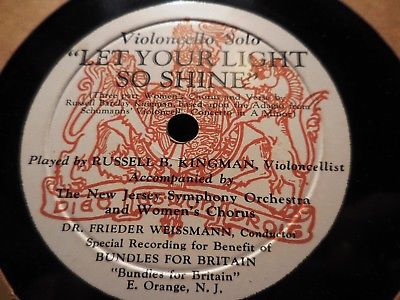
W WAR II BUNDLES FOR BRITAIN Picture Label Record RUSSELL KINGMAN Cello 78
$
20


Favourite Auctions
To save auctions to your favourites, please login
If you don't have an account, please register
Description
Shipping: All items will be packed safely in a sturdy package for safe shipping.
We ship internationally and offer combined shipping for multiple purchases.
Expedited, Priority Mail and FedEx shipping available
Once payment is received, we ship your item on the next business day.
I am currently selling a series of great classic European 78 rpm orchestral recordings on all the great European labels:
W WAR II BUNDLES FOR BRITAIN
1941 Picture Label Record RUSSELL KINGMAN Cello LET YOU LIGHT SO SHINE/ AIr from the suide iin D Maj Bach
New Jersey Symphony under Frieder Weissmann
In 1941 the New Jersey Symphony Orchestra records Russell Kingman's Let Your Light So Shine, and an arrangement of the Adagio of Robert Schumann's Cello Concerto for cello, chorus and orchestra. NJSO also makes a recording with Kingman as soloist of music by Bach. Proceeds went to Bundles for Britain, a WW II relief project.
Bundles for Britain was started in 1940 by Mrs. Latham as a knitting circle in a store front in New York City. Knitted goods—socks, gloves, hats, sweaters, and scarves—were made and shipped to Britain. Within Sixteen months, Latham expanded Bundles into an organization with 975 branches and almost a million contributors, and by the spring of 1941, it had delivered 40,000 sleeveless sweaters, 10,000 sweaters with sleeves, 30,000 scarves, 18,000 pairs of seaboot stockings, 50,000 pairs of socks, and 8,000 caps. By 1941, moreover, Bundles had also shipped ambulances, surgical instruments, medicines, cots, blankets, field-kitchen units, and operating tables, along with used clothing of all sorts. The total value of goods shipped reached $1,500,000; another $1,000,000 was raised in cash
12" 78 rpm recording.
Condition: EXCELLENT MINUS,some rubs, plays quiet w some swishy hiss
Bundles for Britain
While many of the smaller charities were covered by the activities of the BWRS, the major exception was the "Bundles for Britain" organisation, founded by Natalie Wales Latham.
Bundles for Britain was started in 1940 by Mrs. Latham as a knitting circle in a store front in New York City. Knitted goods—socks, gloves, hats, sweaters, and scarves—were made and shipped to Britain. Within Sixteen months, Latham expanded Bundles into an organization with 975 branches and almost a million contributors, and by the spring of 1941, it had delivered 40,000 sleeveless sweaters, 10,000 sweaters with sleeves, 30,000 scarves, 18,000 pairs of seaboot stockings, 50,000 pairs of socks, and 8,000 caps. By 1941, moreover, Bundles had also shipped ambulances, surgical instruments, medicines, cots, blankets, field-kitchen units, and operating tables, along with used clothing of all sorts. The total value of goods shipped reached $1,500,000; another $1,000,000 was raised in cash.[5][6]
Mrs. Latham was highly recognized for this wartime effort, being invested by King George VI as an honorary Commander of the Order of the British Empire in 1946,[7][8] the first non-British subject to receive this honor. Her story may have even served as inspiration for the Cary Grant movie Mr. Lucky. In 1953, she married, as her fourth husband, Lord Malcolm Douglas-Hamilton.
Russell Kingman, an amateur cellist, becomes the first president of the orchestra. He serves until 1936. The New Jersey Orchestra is incorporated. In 1929 Philip James steps down as music director. Rene Pollain replaces him.
In 1936 Charles E. Arnott replaces Russell Kingman as president. In 1937, the orchestra adopts the name the New Jersey Symphony Orchestra (= NJSO). In 1939 Rene Pollain, an American citizen, returns to France and is unable to return to the USA because of the outbreak of World War II. Guest conductors fill in for him. In 1940 Rene Pollain dies in France. Dr. Frieder Weissman is named music director. The season is expanded from three to four programs. Each is presented twice.
In 1941 the New Jersey Symphony Orchestra records Russell Kingman's Let Your Light So Shine, and an arrangement of the Adagio of Robert Schumann's Cello Concerto for cello, chorus and orchestra. NJSO also makes a recording with Kingman as soloist of music by Bach. Proceeds went to Bundles for Britain, a WW II relief project. Kingman, a cellist, also served as NJSO president from 1928 to 1936. In 1942, during World War II, the orchestra is composed mainly of women. In 1946 the Griffith Foundation manages the orchestra for a year. In 1947 Dr. Samuel Antek becomes music director and F. Stark Newberry becomes president. Dr. Antek introduces children's "Music is Fun" and Pops concerts. In 1948 the New Jersey Symphony makes it radio debut on Radio Station WNJR with lecture recitals by Dr. Edna McEachem, chairman of the music department at Montclair State College, now University. In 1950 Upsala College Choir is the first musical group to appear with the NJSO. Thereafter many different choral groups are featured.
In 1951 the Friends of the NJSO, a volunteer organization forms to promote the NJSO. Barclay Kingman, son of Russell, is elected president.
We offer combined shipping for one low shipping charge.
PLEASE CLICK HERE FOR MORE GREAT 78 rpm records
Please click the link below for all items for sale:
PLEASE CLICK HERE FOR Great Collectible Books, CDs & DVDs, Musical Scores and Turntable/ Phonograph Items
price rating