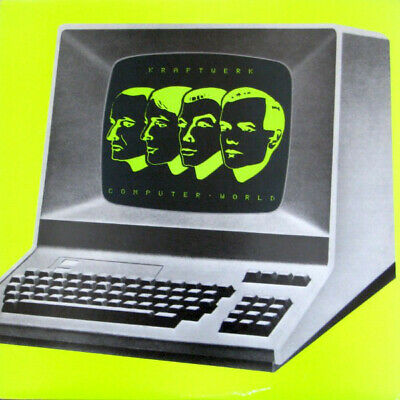
WARNER / WEA LP XHS-3549: Kraftwerk ?– Computer World - 1981 Canada NM
$
50
$ 50
Sold For
Jan 15, 2021
Sold Date
Mar 15, 2020
Start Date
1
Number Of Bids
USA
Country Of Seller
eBay
Sold at
Favourite Auctions
To save auctions to your favourites, please login
If you don't have an account, please register
Description
****Welcome to our listing, thanks very much for looking!
****See our own website! We have lots of out of print LPs and CDs! Find us on the web at -
hearthedifference.net
****Shipping cost is only an estimate - it depends on the actual weight and size of the package as well as the service required. We do not profit from shipping costs, so if we overcharge, we will refund the difference back to you. It's always best to wait for our invoice before paying for your item. We will combine shipping for multiple items purchased.
****Please see our other listings - new items added daily!
****To access our eBay store click on the little red door at the top right section of any of our eBay listings or, click on -
http://stores.ebay.com/Hear-The-Difference
Background -
The last great Kraftwerk album, Computer World captured the band right at the moment when its pioneering approach fully broke through in popular music, thanks to the rise of synth pop, hip-hop, and electro. As Arthur Baker sampled "Trans-Europe Express" for "Planet Rock" and disciples like Depeche Mode, OMD, and Gary Numan scored major hits, Computer World demonstrated that the old masters still had some last tricks up their collective sleeves. Compared to earlier albums, it fell readily in line with The Man-Machine, eschewing side-long efforts but with even more of an emphasis on shorter tracks mixed with longer but not epic compositions. While the well-established tropes of the band were used again -- electronically treated vocals, some provided by Speak and Spell toys; crisp rhythm blips; basslines and beats; haunting, quirky melodies -- there's a ready liveliness to the songs, like the addictive "Pocket Calculator," with its perfectly deadpan portrait of "the operator" and his favorite tool, and the almost winsome "Computer Love." Cannily, the lyrical focus on newly accessible technology instead of cryptic futurism and vanished pasts matched this new of-the-now stance, and the result was a perfect balance between the new world of the album title and a withdrawn, bemused consideration of that world. The title track itself, with its lists detailing major organizations presumably all wired up, echoes the flow of Trans-Europe Express, serene and pondering. "Pocket Calculator" itself is more outrageously fun, thanks to the technical observation that "by pressing down a special key it plays a little melody." Others would take the band's advances and run with them, but with Computer World Kraftwerk -- over a decade on from their start -- demonstrated how they had stayed not merely relevant, but prescient, when nearly all their contemporaries had long since burned out. - Ned RaggettDuring the mid-'70s, Germany's Kraftwerk established the sonic blueprint followed by an extraordinary number of artists in the decades to come. From the British new romantic movement to hip-hop to techno, the group's self-described "robot pop" -- hypnotically minimal, obliquely rhythmic music performed solely via electronic means -- resonates in virtually every new development to impact the contemporary pop scene of the late-20th century, and as pioneers of the electronic music form, their enduring influence cannot be overstated. Kraftwerk emerged from the same German experimental music community of the late '60s that spawned Can and Tangerine Dream; primary members Florian Schneider and Ralf Hütter first met as classical music students at the Dusseldorf Conservatory, originally teaming in the group Organisation and issuing a 1970 album, Tone Float, in the U.K. Schneider and Hütter soon disbanded Organisation, re-christening themselves Kraftwerk (German for "power station"), beginning work on their own studio (later dubbed Kling Klang), and immersing their music in the fledgling world of minimalist electronics; their 1971 debut, titled simply Kraftwerk 1, offered a hint of their unique aesthetic in its earliest form, already implementing innovations including Schneider's attempts at designing homemade rhythm machines.
A series of lineup shifts followed, and at one point Hütter even left the group; however, by the release of 1972's Kraftwerk 2, he and Schneider were again working in tandem. Recorded without a live drummer, the album's rhythms relied solely on a drum machine, creating a distinctly robotic feel without precedent -- the concept of purely technological music was, at the time, utterly alien to most musicians, as well as listeners. A series of well-received live performances followed before Kraftwerk began work on their breakthrough third LP, 1973's Ralf and Florian; honing their many ambitions down to a few simple yet extraordinarily innovative concepts, their music began growing more and more revelatory -- even their clean-cut, scientific image was in direct opposition to the dominant pop fashions of the time. Kraftwerk's first album to be issued in the U.S., 1974's Autobahn, was an international smash; an edited single version of the epic title track was a major hit at home and abroad, and in America the previously unknown group reached the upper rungs of the pop albums chart. Performed in large part on a Moog synthesizer, Autobahn crystallized the distinctive Kraftwerk sound while making the group's first clear overtures toward conventional pop structure and melody, establishing a permanent foothold for electronic music within the mainstream.
Kraftwerk resurfaced in 1975 with Radio-Activity, a concept album exploring the theme of radio communication; indicative of the group's new global popularity, it was released in both German and English-language editions, the latter appearing early the following year. Train travel emerged as the subject of 1977's Trans-Europe Express, which marked an increased movement toward seeming musical mechanization; the line became even further blurred with the follow-up, 1978's aptly titled The Man Machine, a work almost completely bereft of human touches. By this time, the members of Kraftwerk even publicly portrayed themselves as automatons, an image solidified by tracks like "We Are the Robots." Having reached the peak of their influence, however, the group disappeared from view, the first of many extended absences to follow; they did not return to action prior to 1981's Computer World, a meditation on the new global dominance of technology -- a society their music long ago predicted and pre-dated. After topping the British charts with the single "Computer Love," Kraftwerk again vanished, enjoying a five-year layoff culminating in the release of 1986's Electric Cafe. By now, however, pop music was dominated by synthesizers and drum machines, and the group's stature flagged; but for a 1991 best-of collection titled The Mix, they remained silent during most of the decade. They finally released a new single, "Expo 2000," in late 1999, and surprised fans by announcing tour dates. On the recording front, Kraftwerk celebrated the centennial anniversary of the Tour de France with a new version of their 1983 single "Tour de France," and followed with a full album (Tour de France Soundtracks) in August 2003. The live record Minimum-Maximum followed in 2005. The Catalogue box set appeared in 2009, which pulled together eight classic albums from the band's career. Each title was digitally remastered, a number of the releases were treated to redesigned cover art, and it also included rare photographs not part of each record's original release. In 2012, the band performed their studio albums from Autobahn to Tour de France at New York's Museum of Modern Art. The following year they repeated that performance in Düsseldorf and at the Tate Modern in London. Over the next few years they continued to tour, which culminated in them putting out the live release 3D the Catalogue. The collection captured the band's live performances from 2012-2016, and was presented with a Blu-ray option that included high definition 3-D video. - Jason Ankeny
-
LP made by WARNER / WEA Records, in CANADA
-
LP released in 1981
-
LP is recorded in STEREO
-
Record Catalog Number: XHS 3549
Kraftwerk
LP Title -
Computer World
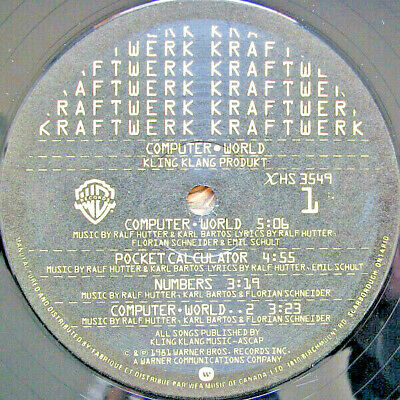
Tracks -A1. Computer World - Lyrics By – Emil Schult, Florian Schneider, Ralf Hutter Music By – Karl Bartos, Ralf Hutter - 5:06
A2. Pocket Calculator - Lyrics By – Emil Schult, Ralf Hutter Music By – Karl Bartos, Ralf Hutter - 4:55
A3. Numbers - Music By – Florian Schneider, Karl Bartos, Ralf Hutter - 3:19
A4. Computer World .. 2 - Music By – Florian Schneider, Karl Bartos, Ralf Hutter - 3:23
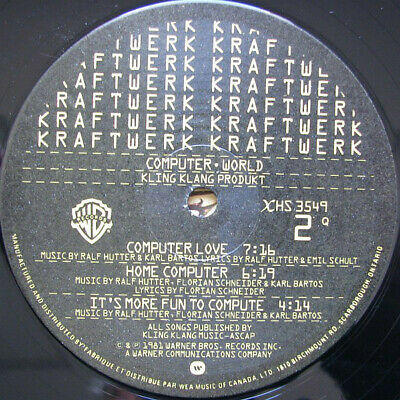
B1. Computer Love - Lyrics By – Emil Schult, Ralf Hutter Music By – Karl Bartos, Ralf Hutter - 7:16
B2. Home Computer - Lyrics By – Florian Schneider Music By – Florian Schneider, Karl Bartos, Ralf Hutter - 6:19
B3. It's More Fun To Compute - Music By – Florian Schneider, Karl Bartos, Ralf Hutter - 4:14
Performers / Credits / Other Information -
• Record Company – Warner Communications
• Manufactured By – WEA Music Of Canada, Ltd.
• Distributed By – WEA Music Of Canada, Ltd.
• Phonographic Copyright (p) – Warner Bros. Records Inc.
• Copyright (c) – Warner Bros. Records Inc.
• Pressed By – Quality Records Limited
• Published By – Kling Klang Music
• Recorded At – Klingklang Studio
• Technician [Kling Klang Studio] – Guenter Spachtholz, Joachim Dehmann
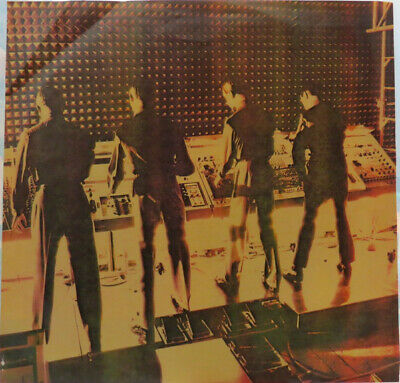
Includes printed inner sleeve
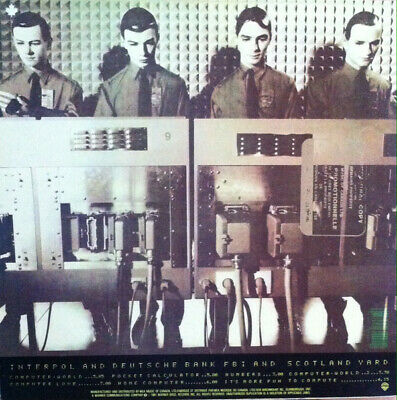
Printed on back cover: Maple leaf icon
Manufactured and Distributed by-WEA Music of Canada, Ltd./Fabriqué et Distribué par-WEA Musique du Canada Ltée.
A Warner Communications company. © 1981 Warner Bros. Records Inc.
Printed on spine:
? 1981 Warner Bros. Records Inc.
Printed on labels:
Kling Klang produkt
All songs published by Kling Klang Music-ASCAP
© & ? 1981 Warner Bros. Records Inc.
A Warner Communications company
Manufactured and Distributed by/Fabrique et Distribue par WEA Music of Canada Ltd.
Printed on inner sleeve:
Kling Klang produkt 1981 Duesseldorf Germany
Kling Klang Studio
© 1981 Warner Bros. Records Inc. XHS 3549
Durations in tracklist taken from labels. Durations on back cover differ:
A1: 5:05
A2: 5:00
A3: 3:00
A4: 3:30
B1: 7:00
B2: 6:00
B3: 4:15
All instances of "Computer World" appear on release as "Computer•World"
A remnant of the barcode from the US release is faintly visible on the back cover, but it's not machine readable.
• Matrix / Runout (Side A, etched, runout area): XHS-3549-A Q
• Matrix / Runout (Side B, etched, runout area): XHS-3549-B Q
• Pressing Plant ID (Side A & B labels): Q
• Rights Society: ASCAP
CONDITION Details:
The LP jacket is in near mint minus overall condition. The jacket is tight and clean, with NO cut out marks, NO seam splits and NO discoloration. The corners are solid with no obvious dings. The colors on the jacket are sharp and clean, with just light shelf wear along the seams and corners, nothing serious.
The LP is in near mint minus overall condition! The vinyl has no serious marks. It may have a light spider mark or two (caused by sliding the LP in and out of the inner sleeve). Spider marks may sound, depending on the sensitivity of your audio gear...some extraneous sound is inevitable and should be expected for a vintage LP. This LP retains much of the original gloss and sheen! There are NO serious spindle marks on the record labels either - an archival quality example and a better LP would be near impossible to find - this is the one you want for your BLUES collection.A Short Note About LP GRADING -
- Mint = Only used for sealed items.
- Near Mint = Virtually flawless in every way.
- Near Mint Minus = Item has some minor imperfections, some audible.
- Excellent = Item obviously played and enjoyed with some noise.
- Very Good Plus = Many more imperfections which are noticeable and obtrusive.
For best results, always thoroughly clean your LPs before playing them.
LPs can be audiophile quality pressings (any collector of fine MFSL, half speeds, direct to discs, Japanese/UK pressings etc., can attest to the difference a quality pressing can make to an audio system).
Don't let this rarity slip by!!!price rating