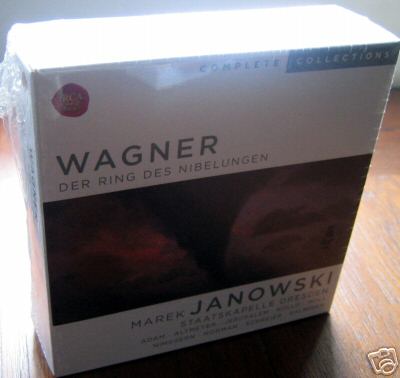
Wagner:Der Ring des Nibelungen*Janowski RCA 14cd*sealed
£
22
$
29


Favourite Auctions
To save auctions to your favourites, please login
If you don't have an account, please register
Description
Wagner: Des Ring Des Nibelungen
Janowski, Adam, Kollo, Moll
Release Date: 08/10/2004Label: Rca Victor Red Seal Catalog #: 55709 Spars Code: DDD
Conductor: Marek Janowski
Orchestra/Ensemble: Dresden Staatskapelle, Dresden State Opera Chorus
Number of Discs: 14
Recorded in: Stereo
condition: new and sealed
The All-Purpose RING
And so it is with its multitudinous recordings. Among the live versions, the earlier ones (Furtwaengler, Krauss, Knappertsbusch) suffer from murky sound, while even those in decent stereo (Boehm, Boulez, Sawallisch, Barenboim) feature thuds, clunks, and assorted live-performance anomalies that grow less endearing with each listening. As for the studio recordings, they're variously undermined by continuity problems (Solti, Karajan), subpar singing (Swarowsky), or deficiencies in tension and energy (Levine, Haitink).
Which brings us to this Marek Janowski set. One of the overlooked achievements of the waning LP era, it was the first all-digital RING, recorded in just 29 efficient months during the early 80s. Late in the same decade it was the first version to debut on CD, at the top of the 90s a mid-price edition emerged, and this dirt-cheap reissue now marks its first appearance in the 21st century. It's a bargain on anybody's terms, and after several return visits down through the years, I'm now ready to name it the cycle with the fewest things wrong and the most right.
First off, it's registered in clean, ungussied digital stereo of exceptional radiance and lucidity -- massed strings can be a tad opaque, hinting at its pioneer status, otherwise the color and fine detail are ravishing, plus the whole event has the definite feel of being recorded in long takes: it offers the commitment and intensity of a live performance minus the wrong notes and stage noises. Second, it showcases lithe, athletic playing from Dresden's underpublicized but authentically great orchestra -- strings turn on a dime, woodwind staccati are needle sharp, brass are lean and subtly integrated. In contrast to their only continental peers in this repertory -- the Vienna PO with its creamy sweetness and the the Berlin PO with its iron power -- the Dresdeners favor sheen, transparency, and fast reflexes, lightning as well as thunder. Yes, they can whip up a glowering storm in the SIEGFRIED Act III prelude, but you'll never hear a Rhine journey with more wit, sparkle, and agility.
Janowski's propulsive conducting is invaluable for two main reasons. 1) Beyond projecting the RING's well-known tempests and tensions, he also puts over its comedy and irony -- the sly mischief of the Rhinemaids, the gallows humor during the valkyrie confab, the sad silliness of the nibelung squawkfest in SIEGFRIED II iii. 2) He's exceptionally alert to Wagner's dramaturgy, to its NARRATIVE ebb, flow, and movement toward crisis. Janowski's pacing is ideal at the great turning points -- Alberich stealing the gold, Erda's intervention when Wotan won't give up the ring (Solti is oblivious here), the mounting violence in Siegfried's meeting with the Wanderer (here Karajan is gingerly), the tension building under Siegfried's narrative in GOETTERDAEMMERUNG III ii as he gradually incriminates himself. This is strong-minded, purposeful conducting that I suspect even Wagner himself would have admired.
The cast, too, is exemplary. For one thing, it's a true ensemble with the same talent staying on board to the finish: out of 12 recurring roles, 11 are single cast (sole exception: Mime, not fatally disruptive). Plus these singers, with unbeaten consistency, are both listenable and characterful. The set's original manufacturer, Ariola-Eurodisc, was a major player during the decade prior, recording both operatic rarities (Schubert, Orff) and standards (FIDELIO, CARMEN). Eurodisc had the budgets to sign up the biggest names, and here even bit parts can be stunningly cast -- Kurt Moll as Hunding, Lucia Popp and Hanna Schwarz as Rhinemaidens, Cheryl Studer and Ruth Falcon as walkueren. A couple of the supporting players are routine -- Stryczek's rough-and-ready Donner, Noecker's decently sung but undercharacterized Gunther -- otherwise Siegmund Nimsgern is the optimum Alberich, a full-bodied character baritone with a genuine legato and meaty high Gs, while Peter Schreier doubles Loge and the SIEGFRIED Mime with imagination, gusto, and -- gasp -- real singing.
And so it goes: Jessye Norman and Siegfried Jerusalem are a Sieglinde and Siegmund competitive with anybody's, Yvonne Minton a Fricka of icy loveliness, Ortrun Wenkel intense and specific as Erda and Waltraute, Norma Sharp cool and pretty as both Gutrune and the woodbird, while a young Matti Salminen turns in the most baleful Hagen since Frick -- and a Fafner so innately cavernous, his dragon scarcely needs any special miking. As for the three leads, our Wotan is Theo Adam, who probably clocked more stage hours in the role than anybody in Wagner history. By the time of the recording he'd logged 22 RING seasons, but his high bass still has plenty to offer -- interpretive savvy, trusty top notes, dead-center intonation. WALKUERE III iii finds the old pro in below-form voice, struggling for focus and steadiness; elsewhere, amazingly, his sound is firmer and more burnished than fifteen years earlier under Boehm (compare the "Abendlich strahlt" in RHEINGOLD, or SIEGFRIED III i). Overall he's a rugged, patriarchal Wotan and he catches the curve of the character superbly, politician, rageaholic, and shaman.
As his daughter Bruennhilde, California soprano Jeannine Altmeyer has been shamefully undervalued down through the years. I heard her LA Isolde in the mid 80s, and trust me, this is a big, carrying voice. Stack her against her recent peers: she has a fuller, steadier instrument than Behrens, a lovelier sound than Marton, the upper extension that Dernesch hadn't, and Jones's caterwauling is beneath discussion. No, she hasn't the slash and bite of dominatrix Bruennhildes like Nilsson and Varnay; instead she offers page after page of fresh, supple, centered sound, you pick the note. She's the aural equivalent of the young, willowy Bruennhilde in Arthur Rackham's watercolors, and it's high time we noticed: Altmeyer is the valkyrie easiest on the ears.
Lastly Rene Kollo's contributions are arguably his most valuable on disc. As John Culshaw once wrote, we must think of the younger Siegfried "as a youth instead of an adult," so dark-timbred tenors such as Melchior, Suthaus, and Windgassen can present big credibility problems. Kollo is near ideal: his silver sound is mainstream lyric tenor -- even chest tones preserve a basic leanness and lucidity -- but its fine-line definition means unexpected carrying power and maneuverability; in short, he's persuasively youthful yet he can cut through heavy orchestration. Some soft passages, though, catch him thinning the support out of the voice (e.g., "Es sangen die Voeglein" in SIEGFRIED I i), but it's still a splendid achievement, vividly phrased, both mercurial and meditative. And he's fine, too, as his elder self in GOETTERDAEMMERUNG, though not quite as indispensable.
All of which, taken together, accounts for this RING's front-to-back superiority -- digital stereo of documentary directness and transparency; podium leadership that articulates narrative structure while projecting not only its passion and poignance but (rare indeed) its comedy and irony; and a repertory casting policy that generates both good sound and plausible characterization. Yes, a couple of the bit players are substandard, but the leads are astonishingly persuasive -- Adam's leonine Wotan, Altmeyer's mellifluous Bruennhilde, and several who are arguably Best in Stereo: Kollo's Siegfried, Nimsgern's Alberich, Norman's Sieglinde, Schreier's Mime, Salminen's Fafner and Hagen. In short, it's the All-Purpose RING -- ideal for the first-time listener who really hopes the epic will make sense, excellent for the score-in-hand professional who wants a clear, dependable reference edition that actually does what his score says. For me it's the version that has stood up best under repeated listening; so treat it as your basic set, then supplement it, if you like, with choice alternatives -- Karajan's WALKUERE, say, or Solti's GOETTERDAEMMERUNG, or Krauss's mono edition. Individual Track Details: 1. Der Ring des Nibelungen by Richard Wagner
Performer: Jeanine Altmeyer (Soprano), René Kollo (Tenor), Theo Adam (Bass),
Hanna Schwarz (Mezzo Soprano), Lucia Popp (Soprano), Ortrun Wenkel (Mezzo Soprano),
Peter Schreier (Tenor), Jessye Norman (Soprano), Matti Salminen (Bass),
Yvonne Minton (Mezzo Soprano), Siegmund Nimsgern (Bass Baritone), Siegfried Jerusalem (Tenor),
Kurt Moll (Bass), Ortrun Wenkel (Alto), Eberhard Büchner (Tenor)
Conductor: Marek Janowski
Orchestra/Ensemble: Dresden Staatskapelle
Period: Romantic
Written: 1853-1874; Germany
Venue: St Luke's Church, Dresden
Language: German
2. Das Rheingold by Richard Wagner
Performer: Eberhard Büchner (Tenor), Peter Schreier (Tenor), Theo Adam (Bass),
Roland Bracht (Bass), Karl-Heinz Stryczek (Bass), Hanna Schwarz (Mezzo Soprano),
Matti Salminen (Bass), Marita Napier (Soprano), Siegmund Nimsgern (Bass Baritone),
Ortrun Wenkel (Alto), Christian Vogel (Tenor), Ute Priew (Mezzo Soprano),
Lucia Popp (Soprano), Yvonne Minton (Mezzo Soprano)
Conductor: Marek Janowski
Orchestra/Ensemble: Dresden Staatskapelle
Period: Romantic
Written: 1854; Germany
Venue: St Luke's Church, Dresden
Language: German
Notes: St Luke's Church, Dresden (12/08/1980 - 12/11/1980) 3. Die Walküre by Richard Wagner
Performer: Yvonne Minton (Mezzo Soprano), Eva-Maria Bundschuh (Soprano), Ortrun Wenkel (Mezzo Soprano),
Christel Borchers (Mezzo Soprano), Anne Gjevang (Alto), Ruth Falcon (Soprano),
Ute Priew (Mezzo Soprano), Kathleen Kuhlmann (Alto), Jessye Norman (Soprano),
Jeanine Altmeyer (Soprano), Theo Adam (Bass), Kurt Moll (Bass),
Siegfried Jerusalem (Tenor), Cheryl Studer (Soprano)
Conductor: Marek Janowski
Orchestra/Ensemble: Dresden Staatskapelle
Period: Romantic
Written: 1856; Germany
Venue: St Luke's Church, Dresden
Language: German
Notes: St Luke's Church, Dresden (08/22/1981 - 08/29/1981) 4. Siegfried by Richard Wagner
Performer: Theo Adam (Bass Baritone), Norma Sharp (Soprano), Jeanine Altmeyer (Soprano),
Ortrun Wenkel (Alto), Matti Salminen (Bass), Siegmund Nimsgern (Bass Baritone),
Peter Schreier (Tenor), René Kollo (Tenor)
Conductor: Marek Janowski
Orchestra/Ensemble: Dresden Staatskapelle
Period: Romantic
Written: 1871; Germany
Venue: St Luke's Church, Dresden
Language: German
Notes: St Luke's Church, Dresden (02/1982 - 03/1982) 5. Götterdämmerung by Richard Wagner
Performer: Lucia Popp (Soprano), Ruth Falcon (Soprano), Daphne Evangelatos (Mezzo Soprano),
Anne Gjevang (Alto), Norma Sharp (Soprano), Ortrun Wenkel (Mezzo Soprano),
Jeanine Altmeyer (Soprano), Matti Salminen (Bass), Siegmund Nimsgern (Bass Baritone),
Hans Günther Nöcker (Baritone), René Kollo (Tenor), Ute Priew (Mezzo Soprano),
Hanna Schwarz (Mezzo Soprano)
Conductor: Marek Janowski
Orchestra/Ensemble: Dresden Staatskapelle, Dresden State Opera Chorus
Period: Romantic
Written: 1861-1874; Germany
Venue: St Luke's Church, Dresden
Language: German
Notes: St Luke's Church, Dresden (01/1983 - 03/1983) Please Preview Other Auctions Of Interest
Combine Winning Auctions And Save On Shipping
I am happy to combine CDs and other items won
in the same 2-week period into a single shipment.
I CHARGE THE HEAVIEST ITEM FULL POSTAGE AND THE REST HALF OF THE ORIGINAL CHARGE.
please email me so I can prepare an invoice for you to pay from.
CDs are mailed in jewel cases, no exceptions.
Payment Options
Cash
Postal Order In Sterling
Personal Cheque
I do not accept
cheques from International customers.
************
This compact disc comes with all original artwork and covers
Please Preview
Other Current Auctions
*************
Worldwide
Shipping
price rating

![Cowboy Junkies - Such Ferocious Beauty [New Vinyl LP] Clear Vinyl, Green, Ltd Ed](https://www.popsike.org/php/thumbnail.php?url=https://www.popsike.pics/pix/20230608/394667931858.jpg)