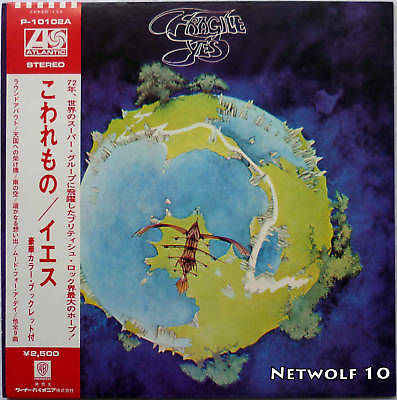
Yes - Fragile - LP - Japan with OBI
€
60
$
70


Favourite Auctions
To save auctions to your favourites, please login
If you don't have an account, please register
Description
dragonfly_100 Store
TO USA CUSTOMER
YES – FRAGILE – JAPAN PRESS WITH OBI
Descrizione Dettagliata – Detailed Description
Artista - Artist
Yes
Titolo - Title
Fragile
Stampa - Issue
Japan Press
Etichetta - Label
Warner – Pioneer / Atlantic Record
Anno - Year
1972
N° Catalogo – N° Catalog
P – 10102A
N° Dischi – N° LP
1
Commento - Comment
LP a copertina apribile riportante i testi in inglese nella parte interna. Vinile a 9 tracce, stampato da Warner Pioneer su etichetta verde e rossa “Atlantic”, completo di inserto di 2 pagine riportante note biografiche e discografiche in giapponese e con booklet fotografico cartonato a colori di 8 pagine. OBI a colori a sfondo bianco e rosso, riportante il prezzo di 2.500 Yen.
Gli Yes sono un gruppo musicale britannico formato nel 1968 e tuttora in attività, considerato tra i principali esponenti del rock progressivo. La band, che ha conosciuto il periodo di maggior successo negli anni settanta e ottanta, è stata fondata dal cantante Jon Anderson, il bassista Chris Squire il chitarrista Peter Banks, il tastierista Tony Kaye ed il batterista Bill Bruford, e nel corso degli anni ha visto la partecipazione dei chitarristi Steve Howe e Trevor Rabin, del batterista Alan White, dei tastieristi Rick Wakeman, Patrick Moraz, Igor Khoroshev, Geoff Downes, Tom Brislin ed Oliver Wakeman, e dei cantanti Trevor Horn e Benoît David. Grazie ad album come The Yes Album, Fragile, Close to the Edge e Relayer, gli Yes contribuiscono allo sviluppo della scena progressive inglese degli anni settanta, e negli anni ottanta riscuotono un notevole successo discografico e popolarità a livello mondiale con 90125. Proponendo un sofisticato rock sinfonico e romantico che fa largo uso di strumenti elettronici innovativi, come il sintetizzatore, il moog ed il mellotron la band definisce, insieme ad altre formazioni, tra le quali King Crimson e Genesis, i canoni stessi del prog. All'inizio degli anni settanta gli Yes continuano ad esibirsi in concerto nel Regno Unito e, occasionalmente, in altre nazioni europee.Il loro secondo album, Time and a Word, è realizzato col supporto di una orchestra sinfonica di 30 elementi. L'album include due cover: No Opportunity Necessary, No Experience Needed di Richie Havens, arricchita con il tema western del film Il grande paese, e Everydays di Stephen Stills. Come per l'album precedente, anche lo stile di Time and a Word risente molto dell'influenza di gruppi contemporanei, come i Beatles in Sweet Dreams o nella stessa traccia del titolo. Forti contrasti nella band, derivanti dall'impiego dell'orchestra, dal progressivo ridimensionamento del ruolo della chitarra e dal ridotto feeling di Peter Banks con lo stile musicale del gruppo portano, poco prima dell'uscita dell'album, all'abbandono del chitarrista.La sua uscita provoca la cancellazione delle date in calendario e il ritiro del gruppo in una fattoria sulla costa devoniana alla ricerca della propria direzione musicale, in attesa di trovare un sostituto all'altezza. Il suo posto viene preso da Steve Howe, un giovane e talentuoso "chitarrista prodigio", che ha al suo attivo numerose incisioni in gruppi come Tomorrow e Bodast. Howe appare sulla copertina dell'edizione americana di Time and a Word, sebbene non abbia partecipato alle incisioni dell'album. Nello stesso periodo la band conosce Eddie Offord, un produttore discografico molto noto, passato poi alla storia del rock proprio per il suo lavoro con la band e gli Emerson Lake & Palmer. Insieme a Howe e Offord viene realizzato, nel gennaio 1971, The Yes Album, un disco di notevole importanza, contenente quattro tra i brani migliori mai realizzati dalla band. L'album, balzando al sesto posto delle classifiche inglesi e al 40º di quelle americane, afferma la band sulla scena internazionale, tanto che nell'aprile '71 gli Yes intraprendono un tour negli Stati Uniti, come gruppo spalla dei Jethro Tull, dei Ten Years After e dei Black Sabbath. Nell'agosto del 1971 anche Tony Kaye, il cui percorso musicale resta fedele all'organo Hammond, mentre Jon e Chris si rivolgono all'emergente strumentazione elettronica, abbandona il gruppo per formare un proprio complesso, i Badger, e viene sostituito da un altro virtuoso, il tastierista degli Strawbs Rick Wakeman, che aveva in precedenza suonato come turnista per artisti di rilievo come David Bowie, Elton John, Lou Reed ed altri. Wakeman, musicista estremamente eclettico, in grado di suonare sia le tastiere acustiche che elettroniche, si dimostra ben presto una perfetta controparte per Howe, introducendo anche due nuovi elementi chiave nella strumentazione del gruppo, il mellotron ed il minimoog. La prima incisione di questa formazione, considerata la formazione "classica" degli Yes, fu un'interpretazione di dieci minuti del classico America di Paul Simon.Nel 1972 gli Yes incidono due album considerati pietre miliari del rock progressivo: Fragile, che include anche uno dei due singoli di successo del gruppo, Roundabout, e Close to the Edge, rispettivamente nel gennaio e nel settembre dello stesso anno. Entrambi riscuotono un notevole successo nelle classifiche sia europee che americane e sono seguiti dai rispettivi tour. Poco dopo l'uscita di Close to the Edge, Bruford abbandona gli Yes per passare ai King Crimson. Viene sostituito da Alan White, già batterista della Plastic Ono Band di John Lennon, che fa la sua apparizione sul vinile nel 1973, nel monumentale triplo live Yessongs. Fragile, considerato da molti l'epitome degli album di rock progressivo, segna anche l'inizio della lunga collaborazione fra gli Yes e l'artista Roger Dean, al quale si devono la maggior parte delle copertine degli album del gruppo, il disegno del loro celebre logo, l'organizzazione del merchandising e l'impianto scenografico utilizzato nei concerti. In Close to the Edge, l'album della suite omonima, di And You and I e di Siberian Khatru, considerato dai più il loro capolavoro, gli Yes raggiungono il vertice del loro cammino artistico. Molti fan considerano l'intero trittico, composto da The Yes Album, da Fragile e da Close to the Edge, l'apice della creatività degli Yes, in cui si definiscono i canoni dello Yessound, nel quale dominano gli arrangiamenti e i virtuosismi individuali;tali supporters sono spesso detti troopers, con riferimento a uno dei brani più famosi di quest'epoca degli Yes, Starship trooper. Nel 1973 gli Yes ottengono importanti riconoscimenti dalla critica musicale: vengono inseriti nelle classifiche annuali del prestigioso settimanale Melody Maker e votati miglior gruppo britannico ed internazionale. Analoghi i successi a livello individuale: Wakeman è il miglior tastierista, Squire occupa la piazza d'onore tra i bassisti, Anderson ed Howe sono terzi nelle rispettive classifiche.
Fragile è il loro quarto album in studio, pubblicato nel 1971. Fragile fu il primo lavoro degli Yes con Rick Wakeman alle tastiere. La formazione del gruppo che ha realizzato Fragile (Anderson, Howe, Squire, Bruford e Wakeman) viene da molti considerata la formazione "classica" per eccellenza, in particolare perché a essa si deve anche il successivo Close to the Edge, che viene generalmente considerato l'apice del gruppo. Anche Fragile contiene molti brani che continuano a essere annoverati fra i classici degli Yes; in particolare, la canzone Roundabout è stata uno dei due "hit single" della band, ed è probabilmente la canzone più nota degli Yes del primo periodo. Fragile fu pubblicato dalla Atlantic Records (codice 2401 019) nel Regno Unito nel novembre del 1971; la sua uscita negli Stati Uniti fu rimandata di due mesi per sfruttare il successo che stava ancora riscuotendo l'album precedente, The Yes Album. Una parte dei pezzi dell'album sono essenzialmente assoli dei diversi membri. Cans and Brahms è il brano solista suonato all'organo da Rick Wakeman, e ispirato al terzo movimento della quarta sinfonia di Johannes Brahms; We Have Heaven è una sorta di divertissement musicale in cui Jon Anderson canta tutte le parti di voce (tecnica poi ripresa nel suo album solista Olias of Sunhillow; il tema di We Have Heaven sarebbe anche ricomparso nel 1999 nel brano Can I? sull'album The Ladder); Five Per Cent for Nothing, che con i suoi 35 secondi è il brano più breve della discografia degli Yes, è un esercizio di ritmica di Bill Bruford; Mood for a Day è uno dei più noti brani di chitarra spagnola di Steve Howe; e infine The Fish (Schindleria Praematurus) è costruito attorno a una linea solista di basso di Chris Squire. I brani suonati dall'intero gruppo fanno tutti parte del repertorio classico degli Yes, e sono stati riproposti innumerevoli volte in concerto durante tutta la storia del gruppo. Nelle incisioni live esistono numerose versioni di Roundabout, che differiscono per l'introduzione iniziale o per la durata (soprattutto nelle esibizioni più recenti il brano viene generalmente abbreviato escludendo una sezione centrale). South Side of the Sky è l'unico pezzo a non essere stato proposto dal vivo per molto tempo, e la comparsa di questo brano nella setlist del tour degli Yes del 2003, arricchito di un "duello" finale fra la chitarra di Howe e la tastiera di Wakeman, è stato salutato dai vecchi fan come un graditissimo ritorno e una dei momenti più interessanti del tour (una registrazione del vivo di questa versione si trova nel DVD Yesspeak). Una cover di South Side, eseguita dagli Spock's Beard, si trova nel bonus disc dell'edizione limitata, in 3 CD, dell'album Snow. Fragile fu anche il primo album degli Yes ad avvalersi dell'opera di Roger Dean per la copertina. La copertura disegnata da Roger Dean raffigura un piccolo pianeta sul davanti. Sul retro, il pianeta incomincia a rompersi e la popolazione fugge nello spazio mediante una barca a vela di legno, un concetto che ha ispirato Jon Anderson per il suo album solista Olias di Sunhillow, così come il film isole galleggianti. La copertina di Yessongs si crede sia stata creata allo scopo di continuare il racconto. LP è accompagnato da un libretto promozionale contenente due ulteriori raffigurazioni sempre ad opera di Dean; la copertina raffigura cinque diverse creature nel mezzo di un groviglio di radici e il retro ritrae una persona intenta a salire una formazione rocciosa. L'interno del libretto promozionale consiste in diverse fotografie dei membri della band intervallate da piccole illustrazioni di Dean e dalle fotografie delle loro mogli, tra cui Jenny Anderson e Nikki Squire, e dei bambini. Wakeman ha assegnato una pagina alla fotografia del suo cane con un lungo elenco di ringraziamenti rivolto a tutti coloro che hanno contribuito ulteriormente alla sua carriera musicale. In particolare, è il commento "God Bless Brentford Football Club" (che ora supporta il Manchester City FC, dopo una controversia), insieme con “P.S. One future offspring."
LP gatefold showing the lyrics in English on the inside. 9 track vinyl, printed by Warner Pioneer label on the green and red "Atlantic", complete with an insert of 2 pages showing biographical notes and record in Japanese and hardcover color photo booklet of 8 pages. OBI color red and white background, showing the price of 2.500 yen.
The Yes I am a British band formed in 1968 and still in operation, considered one of the main exponents of progressive rock. The band, which has experienced the most successful period in the seventies and eighties, was founded by vocalist Jon Anderson, bassist Chris Squire, guitarist Peter Banks, keyboardist Tony Kaye and drummer Bill Bruford, and over the years has the participation of guitarist Steve Howe and Trevor Rabin, drummer Alan White, the keyboardist Rick Wakeman, Patrick Moraz, Igor Khoroshev, Geoff Downes, Tom Brislin and Oliver Wakeman, and vocalist Trevor Horn and David Benoit. With albums like The Yes Album, Fragile, Close to the Edge and Relayer, Yes contribute to the development of the English progressive scene of the seventies and eighties with great success and popularity worldwide record with 90,125. Offering a sophisticated and romantic symphonic rock that makes extensive use of innovative electronic instruments like synthesizers, Moog and Mellotron defines the band, along with other bands, including King Crimson and Genesis, the royalties of prog. In the early seventies the Yes continue to perform in concert in the United Kingdom and occasionally in other countries europee.Il their second album, Time and a Word is made with the support of a symphony orchestra of 30 items. The album includes two covers: No Opportunity Necessary, No Experience Needed Richie Havens, enriched with the western theme of the film The Big Country, and everydays Stephen Stills. Like the previous album, the style of Time and a Word is most felt the influence of contemporary groups like the Beatles in Sweet Dreams or the same title track. Strong contrasts in the band, resulting from the orchestra, the progressive reduction of the role of the guitar and the reduced feeling of Peter Banks with the musical style of the lead shortly before the album's abandonment of the guitarist. Its output will erase the calendar dates and recall of the group on a farm on the coast in search of the Devonian own musical direction, waiting to find a replacement match. His place is taken by Steve Howe, a young and talented "guitar prodigy, who has to his credit numerous recordings in groups such as Tomorrow and Bodast. Howe appears on the cover of American Time and a Word, although it has participated in recordings of the album. At the same time, the band knows Eddie Offord, a well-known record producer, then moved to the history of rock just for his work with the band and Emerson Lake & Palmer. Along with Howe and Offord is implemented in January 1971, The Yes Album, an album of considerable importance, containing four of the best songs ever made by the band. The album, jumping to sixth on the British charts and the 40 th American ones, says the band on the international scene in April '71 so that the Yes undertake a U.S. tour as the opening act for Jethro Tull, Ten of Years After and Black Sabbath. In August 1971, Tony Kaye, whose musical journey is sticking on Hammond organ, while Jon and Chris are turning to the emerging electronic instruments, left the group to form their own complex, the Badger, and was replaced by another virtuous, the Strawbs keyboard player Rick Wakeman, who had previously played as a sideman for major artists like David Bowie, Elton John, Lou Reed and others. Wakeman, extremely versatile musician, able to play both acoustic and electronic keyboards, it soon proves a perfect counterpart for Howe, introducing two new key elements in the instrumentation of the group, the Mellotron and the Minimoog. The first recording of this training, given the training "classic" for Yes, ten minutes was an interpretation of the classic American Paul Simon.Nel 1972 Yes affect the two albums considered milestones of progressive rock: Fragile, which also includes a the two hit singles group, Roundabout, and Close to the Edge, in January and in September the same year. Both a significant success in both European and American charts and was followed by their tour. Shortly after the release of Close to the Edge, the Yes Bruford leaves to go to King Crimson. Is replaced by Alan White, former drummer of the Plastic Ono Band John Lennon, who makes his appearance on vinyl in 1973, in the monumental triple live Yessongs. Fragile, considered by many the epitome of progressive rock albums, it also marks the beginning of a long collaboration between the Yes and artist Roger Dean, to whom we owe most of the album the group, the design of their famous logo, the organization of merchandise and equipment used in spectacular concerts. In Close to the Edge, the album's suite same name, And You and I and Siberian Khatru, widely seen their masterpiece, Yes reach the summit of their artistic journey. Many fans consider the entire triptych, consisting of The Yes Album, Fragile and Close to the Edge to the pinnacle of creativity Yes, setting out the fees of Yessound, which dominate the arrangements and individual virtuosity, and these supporters are often called troopers with reference to one of the most famous songs of this era of Yes, Starship Trooper. In 1973 he achieved critical acclaim Yes Music: annual rankings are included in the prestigious weekly Melody Maker and voted best British group and international. Similar successes at the individual level: the best keyboardist Wakeman, Squire takes the place of honor among bassists, Anderson and Howe are third in their respective classifications.
Fragile is their fourth studio album, released in 1971. Fragile was the first working with Rick Wakeman of Yes on keyboards. The formation of the group that produced Fragile (Anderson, Howe, Squire, Wakeman and Bruford) training is considered by many "classical" par excellence, in particular because it must, too, Close to the Edge, which is generally considered the apex of the group. Fragile also contains several tracks that continue to be counted among the classics of Yes, in particular, the song Roundabout is one of the two hit singles "band, and is probably the most popular song of Yes the first period. Fragile was released by Atlantic Records (code 2401 019) in the United Kingdom in November 1971, and its output to the United States was postponed for two months to build on the success that he was still enjoying the previous album, The Yes Album. One of the pieces are essentially solo album of the different States. Cans and Brahms is the song solo organ played by Rick Wakeman, and inspired the third movement of Brahms' Fourth Symphony, We Have Heaven is a kind of musical divertissement in which Jon Anderson sings all the vocals (a technique later taken in his solo album Olias of Sunhillow; the theme of We Have Heaven would also reappeared in 1999 in the song Can I? Album The Ladder), Five Per Cent for Nothing, with its 35 seconds is the shortest track of discography Yes', is an exercise in rhythm Bill Bruford; Mood for a Day is one of the most popular songs of Spanish guitar of Steve Howe, and finally The Fish (Schindleria Praematurus) is built around a solo bass line by Chris Squire. The songs played by the whole group are all part of the classical repertoire of Yes, and have been replicated countless times in concert during the band's history. In live recordings, there are numerous versions of Roundabout, which differ in the initial introduction or as long (especially in more recent performances, the track is generally shortened by excluding the middle section). South Side of the Sky is the only piece that has not been brought to live a long time, and the appearance of this song in the setlist of the tour for Yes in 2003, enriched with a "duel" between the end of Howe's guitar and Wakeman keyboard, was hailed by fans as an old and a very welcome return of the most interesting of the tour (a live recording of this version is the DVD Yesspeak). A cover of South Side, performed by Spock's Beard, is in the bonus disc limited edition, 3 CD, Album Snow. Fragile was the first Yes album to benefit the work of Roger Dean for the cover. Cover designed by Roger Dean represents a small planet on the front. On the back, the planet begins to break and the population flees into space via a wooden sailboat, a concept that inspired Jon Anderson for his solo album Olias of Sunhillow, as the film floating islands. The cover of Yessongs is believed to have been created to continue the story. The LP is accompanied by a booklet containing two promotional further representations by Dean always, the cover depicts five different creatures in the midst of a tangle of roots and the back depicts a busy person to climb a rock formation. The inside of the book consists of several promotional photos of the band members interspersed with small pictures of Dean and photographs of their wives, including Jenny Anderson and Nikki Squire, and children. Wakeman has allocated one page at a photo of his dog with a long list of thanks for all those who helped further his musical career. In particular, the comment "God Bless Brentford Football Club" (which now supports Manchester City FC after a dispute), along with "PS One future offspring. "
Condizioni - Conditions
Copertina
Cover
NM
Vinile
Vinyl
NM
Testi
Liric Sheet
NM
Booklet
NM
Obi
NM
Foto Dettagliate
Modalità di pagamento e condizioni generali – Shipping and Payment
Contattatemi per ulteriori informazioni o richieste di sconti per acquisti multipli.
Accetto pagamenti solo con Paypal e bonifico bancario.
Per i pagamenti effettuati tramite Paypal, si accettano solo spedizioni tracciabili.
Il pagamento dovrà avvenire entro 7 giorni dalla chiusura dell’ acquisto ( a meno che il compratore non comunichi le sue motivazioni). Trascorso tale termine l’ oggetto sarà rimesso in vendita con conseguente rilascio di feedback negativo.
Tutte le foto utilizzate nelle mie aste sono sempre riferite ai reali oggetti in vendita.
Tutti gli imballi, sia per i dvd che per i vinili, saranno effettuati nel miglior modo possibile, per evitare danneggiamenti del prodotto durante il trasporto.
Contact me for more information or requests for discounts for multiple purchases.
I accept payments only through Paypal and bank transfer.
For payments made via Paypal, we only accept shipments traceable.
Payment must be within 7 days from the closure of purchase (unless the buyer does not give reasons). After that time, the object will be relisted for sale, with consequent release of negative feedback.
All photos used in my auctions are always referring to real objects in the sale.
All packaging, both for the dvd for the vinyl, will be made in the best possible way, to avoid damage of the product during transport. Any duty or customs for incoming items are the responsibility of buyer.
Tipologie di Spedizione e costi per l’ Italia
Posta Raccomandata
Per Acquisti fino a 350 grammi
6,50 euro
Per Acquisti da 350 grammi a 1 Kg
8,50 euro
Pacco celere 3
Per Acquisti oltre 1 Kg
11 euro
Tipologie di Spedizione e costi per l’ Estero – Shipping’s metod and cost
Posta Raccomandata
ZONA 1
ZONA 2
ZONA 3
Europa,
Bacino del Mediterraneo
Africa,
Asia,
Americhe
Oceania
For Purchases of up to 350 grams
Per Acquisti fino a 350 grammi
11 euro
14 euro
18 euro
For Purchases from 350 grams to 1 kg
Per Acquisti da 350 grammi a 1 Kg
15 euro
19 euro
26 euro
For Purchases of 1 Kg to 2 Kg
Per Acquisti da 1 Kg a 2 Kg
21 euro
31 euro
36 euro
price rating