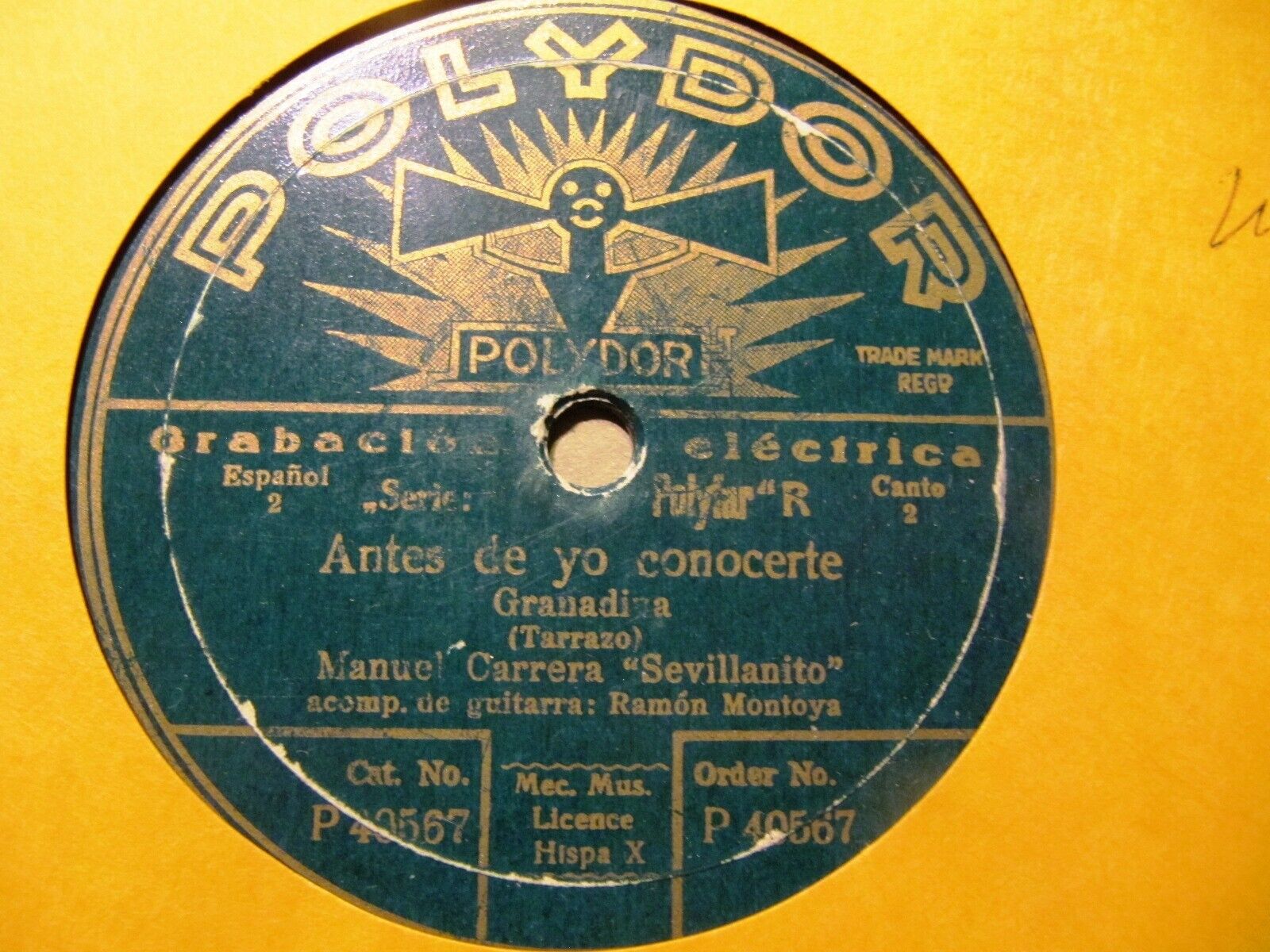
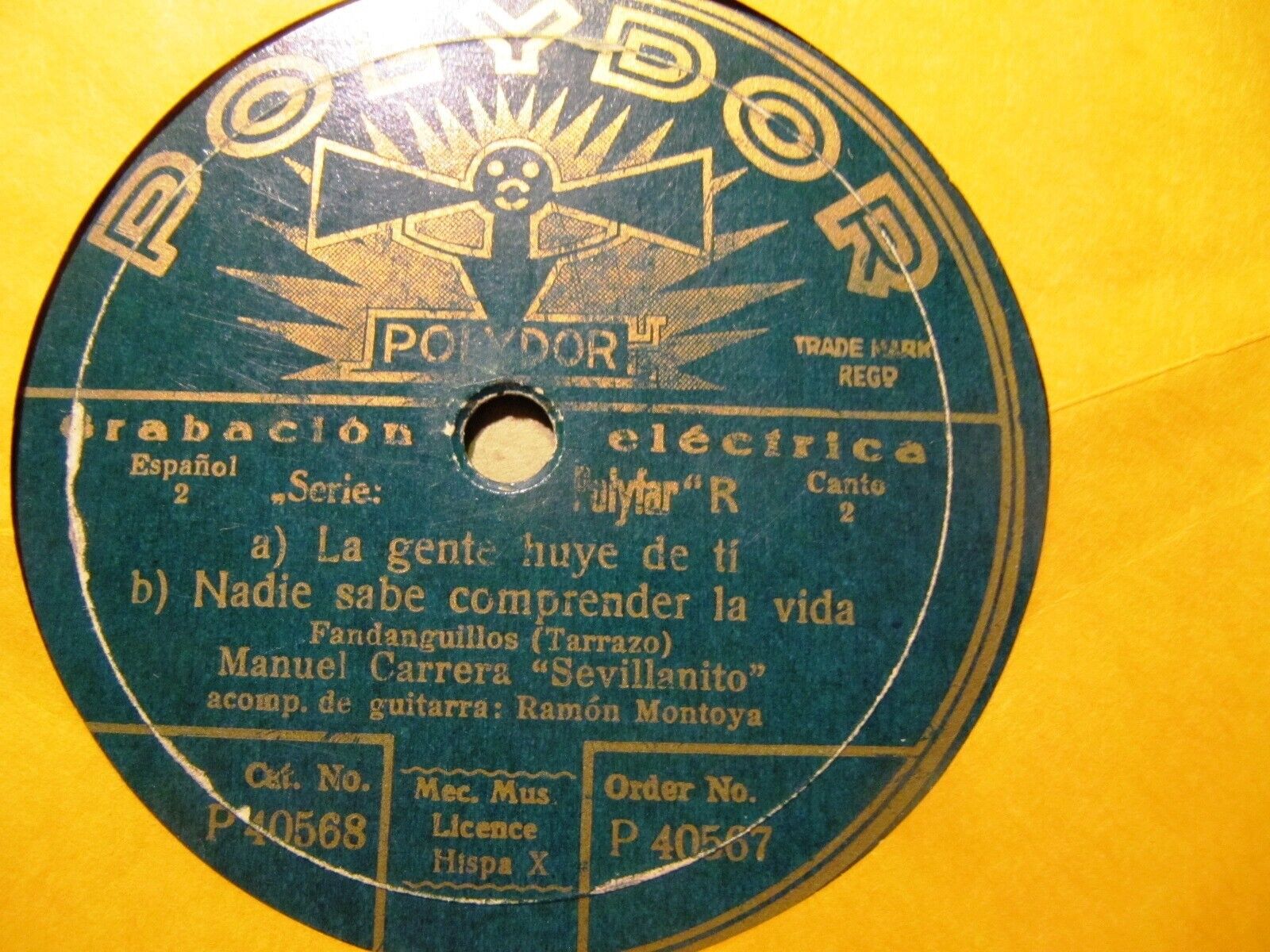
1931 RAMON MONTOYA Flamenco GUITAR Manuel Carrera EL SEVILLANITO POLYDOR 40567
$
175


Favourite Auctions
To save auctions to your favourites, please login
If you don't have an account, please register
Description
A series of great Latin, Spanish, Portuguese and Brazilian dance and folk songs
Check out more Latin recordings for sale by clicking the link below
Over 100 Latin recordings available now!
Legendary Gypsy Guitarist RAMON MONTOYA and Manuel Carrera Espinosa El Sevillanito in Spanish FLAMENCO
Antes de yo conocerte Granadina (Tarrago)/
a.) La gente hute de ti b) Nadie sabe comprender la vida Fandaguillos (Tarrago)/
Orig Issue POLYDOR 10" 78 rpm
CONDITION: EXCELLENT MINUS, unworn some rubs, plays very quiet lightest hiss
A SUPERB COPY
MANUEL CARRERA ESPINOSA, payo cantaor, better known throughout the world in the history of the art of flamenco singing with the artistic name of EL SEVILLANITO, was born in Cantillana (Seville) in 1898, and died in Seville in 1976. According to his own statements to the magazine Cante Andaluz, corresponding to March 1930, in which he confessed to being thirty-two years old at the time, he performed for the first time in Seville, aged fourteen, charging twenty pesetas. Next, with the theatrical company of María Guerrero and Fernando Mendoza, he toured all of Spain and America.
Seville and the whole of Spain,
they will always remember you,
those great fandangos,
so pure and beautiful
that you knew how to create,
with that greatness and style
they can never be forgotten,
for the good fan
El Sevillanito as cantapr
you will always be immortal
View of the town of Cantillana (Seville)
town of Cantillana (Seville)
Later he won the Prince of Asturias Cup in Malaga, in a contest attended by twenty-five interpreters. He made numerous recordings, mainly fandangos, some of them in a trio with El Carbonerillo and Pepe Pinto. In 1930, he performed in the flamenco play Nobleza gitana, at the Pavón theater in Madrid, with Manuel Vallejo, and the same year he played the role of Pepe Luis, in the Granada and Sobrevila play La hija de Juan Simón, premiered at the Teatro de La Latina de Madrid, along with La Andalucita, La Gabriela, Niño de Almadén, Niño de la Puerta del Ángel and José Ortega. He resided for many years in Barcelona. In a Sevillian nursing home he remained until his death.
Born of gypsy origin near Toledo, Ramon Montoya (1880-1949) frequented the Cafe de la Marina as a child, endlessly watching the fingers of the great fin de siecle guitarists. He was the cousin of Carlos Montoya, who pursued a resounding American career; Ramon never learned how to read music himself, but created his own technique, using his creative genius to synthesize all that he saw and heard. He was quickly sought out by the greatest Flamenca artists, such as Antonio Chacon (who considered Montoya to be the finest accompanist), Nina de los peines, Argentinita and Joselito, but for a long time he ignored international agents and the major concert halls, where he would have been a smash. Montoya gave guitar lessons to Marius de Zayas, whose son Rodrigo de Zayas become a great and well known Seville musicologist, a specialist in classical Andalusian music. In 1936, Marias de Zayas suggested that Montoya, who had only recorded accompaniment, record his first solo album in Paris: “Arte clasico flamenco”. a triumphal concert was given at the Casino in Biarritz on September 7, 1936. The man who agreed to produce the records underwritten by de Zayas – reissued here – was Levy-Alvarez, head of “La Boite Musique” in Paris.
price rating