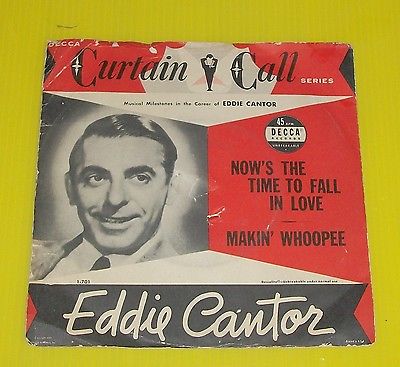
1951 45 EDDIE CANTOR CURTAIN CALL DECCA RECORD MAKIN WHOOPEE NOW TIME FALL LOVE
$
15


Favourite Auctions
To save auctions to your favourites, please login
If you don't have an account, please register
Description
cbenhob store
<img src="http://ti2.auctiva.com/web/aswCredit.gif" border="0"><br><a href="http://www.auctiva.com/?how=scLnk2" target="_blank"><img src="http://ti2.auctiva.com/images/sc1line2.gif" border="0"></a>
45RPM EDDIE CANTOR CURTAIN CALL DECCA RECORD MAKIN WHOOPEE NOW TIME FALL IN LOVE
GREETINGS, FEEL FREE
TO
"SHOP NAKED."©
We deal in items we believe others will enjoy and want to purchase.
We are not experts.
We welcome any comments, questions, or concerns.
WE ARE TARGETING A GLOBAL MARKET PLACE.
Thanks in advance for your patronage.
Please Be sure to add WDG to your favorites list!
NOW FOR YOUR VIEWING PLEASURE…
Eddie Cantor
Now's The Time To Fall In Love / Makin' Whoopee
Label: Decca ?– 9-11045
"Curtain Call" 1-701 Picture Sleeve
Format: Vinyl, 7", 45 RPM
Country: US
Released:
Genre: Ragtime, Pop
Style: Music Hall
Tracklist Hide Credits
A ( Potatoes Are Cheaper- Tomatoes Are Cheaper) / Now's The Time To Fall In Love
Composed By – Al Lewis, Al Sherman
B Makin' Whoopee
Composed By – Gus Kahn, Walter Donaldson
Barcode and Other Identifiers
Label Code: 45W-69143-3
Etched
TRIED. TESTED. PLAYED.
EX RECORD
ACCEPTABLE PICTURE SLEEVE
YOUR SATISFACTION IS GUARANTEED
BOX 2
https://www.youtube.com/watch?v=87Xh3rlLy3Q
https://www.youtube.com/watch?v=Y1NnJIRgnxc
----------------------------------------------
FYI
Eddie Cantor (c. September 21, 1892 – October 10, 1964), born Edward Israel Iskowitz, was an American "illustrated song" performer, comedian, dancer, singer, actor and songwriter. Familiar to Broadway, radio, movie and early television audiences, this "Apostle of Pep" was regarded almost as a family member by millions because his top-rated radio shows revealed intimate stories and amusing anecdotes about his wife Ida and five daughters. Some of his hits include "Makin' Whoopee", "Ida", "If You Knew Susie", "Ma! He's Makin' Eyes at Me", "Margie", and "How Ya Gonna Keep 'em Down on the Farm (After They've Seen Paree)?" He also wrote a few songs, including "Merrily We Roll Along", the Merrie Melodies Warner Bros. cartoon theme.
His eye-rolling song-and-dance routines eventually led to his nickname, "Banjo Eyes". In 1933, the artist Frederick J. Garner caricatured Cantor with large round eyes resembling the drum-like pot of a banjo. Cantor's eyes became his trademark, often exaggerated in illustrations, and leading to his appearance on Broadway in the musical Banjo Eyes (1941).
His charity and humanitarian work was extensive, and he is credited with coining the phrase and helping to develop The March of Dimes.
Cantor was born in New York City, the son of Russian Jewish immigrants, Meta and Mechel Itzkowitz. The precise date of his birth is unknown. His mother died in childbirth one year after his birth, and his father died of pneumonia when Eddie was 2, leaving him to be raised by his beloved grandmother, Esther Kantrowitz. As a child, he attended Surprise Lake Camp. A misunderstanding when signing her grandson for school gave him her last name of Kantrowitz (shortened by the clerk to Kanter). Esther died on January 29, 1917, two days before he signed a long-term contract with Florenz Ziegfeld Jr. to appear in his Follies.
He had adopted the first name "Eddie" when he met his future wife Ida Tobias in 1913, because she felt that "Izzy" wasn't the right name for an actor. Cantor married Ida in 1914. They had five daughters, Marjorie, Natalie, Edna, Marilyn and Janet, who provided comic fodder for Cantor's longtime running gag, especially on radio, about his five unmarriageable daughters. Several radio historians, including Gerald Nachman (Raised on Radio), have said that this gag did not always sit well with the girls.
He was the second president of the Screen Actors Guild, serving from 1933 to 1935. He invented the title "The March of Dimes" for the donation campaigns of the National Foundation for Infantile Paralysis, which was organized to combat polio. It was a play on the The March of Time newsreels popular at the time. He began the first campaign on his radio show in January 1938, asking people to mail a dime to President Franklin D. Roosevelt. At that time, Roosevelt was assumed to be the most notable American victim of polio. Other entertainers joined in the appeal via their own shows, and the White House mail room was deluged with 2,680,000 dimes.
Cantor was awarded an honorary Academy Award in 1956 for distinguished service to the film industry.
Following the death of daughter Marjorie at the age of 44, both Eddie's and Ida's health declined rapidly. Ida died in August 1962 of "cardiac insufficiency". On October 10, 1964 in Beverly Hills, California, Eddie Cantor suffered another heart attack and died, aged 72. He was buried in Hillside Memorial Park Cemetery in Culver City, California.
Stage
Saloon songs to vaudeville
By his early teens Cantor began winning talent contests at local theaters and started appearing on stage. One of his earliest paying jobs was doubling as a waiter and performer, singing for tips at Carey Walsh's Coney Island saloon, where a young Jimmy Durante accompanied him on piano. He made his first public appearance in Vaudeville in 1907 at New York's Clinton Music Hall. In 1912, he was the only performer over the age of 20 to appear in Gus Edwards's Kid Kabaret, where he created his first blackface character, "Jefferson". He later toured with Al Lee as the team "Cantor & Lee". Critical praise from that show got the attention of Broadway's top producer, Florenz Ziegfeld, who gave Cantor a spot in the Ziegfeld rooftop post-show, Midnight Frolic (1917).
Broadway
A year later, Cantor made his Broadway debut in the Ziegfeld Follies of 1917. He continued in the Follies until 1927, a period considered the best years of the long-running revue. For several years Cantor co-starred in an act with pioneer comedian Bert Williams, both appearing in blackface; Cantor played Williams's fresh-talking son. Other co-stars with Cantor during his time in the Follies included Will Rogers, Marilyn Miller, Fanny Brice and W.C. Fields. He moved on to stardom in book musicals, starting with Kid Boots (1923) and Whoopee! (1928). On tour with Banjo Eyes, he romanced the unknown Jacqueline Susann, who had a small part in the show, and went on to become the best-selling author of Valley of the Dolls.
Radio
Cantor appeared on radio as early as February 3, 1922, as indicated by this news item from Connecticut's Bridgeport Telegram:
Local radio operators listened to one of the finest programs yet produced over the radiophone last night. The program of entertainment which included some of the stars of Broadway musical comedy and vaudeville was broadcast from the Newark, N. J. station WDY and the Pittsburgh station KDKA, both of the Westinghouse Electric and Manufacturing Company. The Newark entertainment started at 7 o'clock: a children's half-hour of music and fairy stories; Hawaiian airs and violin solo; 8:00, news of the day; and at 8:20, a radio party with nationally known comedians participating; 9:55, Arlington time signals and 10:01, a government weather report. G. E. Nothnagle, who conducts a radiophone station at his home 176 Waldemere Avenue said last night that he was delighted with the program, especially with the numbers sung by Eddie Cantor. The weather conditions are excellent for receiving, he continued, the tone and the quality of the messages was fine.
Cantor's appearance with Rudy Vallee on Vallee's The Fleischmann's Yeast Hour on February 5, 1931 led to a four-week tryout with NBC's The Chase and Sanborn Hour. Replacing Maurice Chevalier, who was returning to Paris, Cantor joined Chase and Sanborn on September 13, 1931. This hour-long Sunday evening variety series teamed Cantor with announcer Jimmy Wallington and violinist Dave Rubinoff. The show established Cantor as a leading comedian, and his scriptwriter, David Freedman, as “the Captain of Comedy.” Freedman's team included, among others, Samuel "Doc" Kurtzman, who also wrote for song-and-dance man, Al Jolson, and the comedian Jack Benny. Cantor soon became the world's highest-paid radio star. His shows began with a crowd chanting "We want Can-tor! We want Can-tor!", a phrase said to have originated in vaudeville, when the audience chanted to chase off an act on the bill before Cantor. Cantor's theme song was his own lyric to the Leo Robin/Richard Whiting song, "One Hour with You". His radio sidekicks included Bert Gordon, (comic Barney Gorodetsky, aka "The Mad Russian") and Harry Parke (better known as "Parkyakarkus"). Cantor also discovered and helped guide the career of singer Dinah Shore, first featuring her on his radio show in 1940, as well as other performers, including Deanna Durbin, Bobby Breen in 1936 and Eddie Fisher in 1949.
Indicative of his effect on the mass audience, he agreed in November 1934 to introduce a new song by the songwriters J. Fred Coots and Haven Gillespie that other well-known artists had rejected as being "silly" and "childish". The song, "Santa Claus Is Comin' to Town", immediately had orders for 100,000 copies of sheet music the next day. It sold 400,000 copies by Christmas of that year.
His NBC radio show, Time to Smile, was broadcast from 1940 to 1946, followed by his Pabst Blue Ribbon Show from 1946 through 1949. He also served as emcee of The $64 Question during 1949–50, and hosted a weekly disc jockey program for Philip Morris during the 1952–53 season. In addition to film and radio, Cantor recorded for Hit of the Week Records, then again for Columbia, for Banner and Decca and various small labels.
His heavy political involvement began early in his career, including his participation in the strike to form Actors Equity in 1919, provoking the anger of father figure and producer, Florenz Ziegfeld. At the 1939 New York World's Fair, Cantor publicly denounced antisemitic radio personality Father Charles Coughlin and was dropped by his sponsor, Camel cigarettes. A year and a half later, it was his friend Jack Benny who was able to get him back on the air.
Recordings
Cantor began making phonograph records in 1917, recording both comedy songs and routines and popular songs of the day, first for Victor, then for Aeoleon-Vocalion, Pathé and Emerson. From 1921 through 1925 he had an exclusive contract with Columbia Records, returning to Victor for the remainder of the decade.
Cantor was one of the era's most successful entertainers, but the 1929 stock market crash took away his multi-millionaire status and left him deeply in debt. However, Cantor's relentless attention to his own earnings in order to avoid the poverty he knew growing up caused him to use his writing talent, quickly building a new bank account with his highly popular, bestselling books of humor and cartoons about his experience, Caught Short! A Saga of Wailing Wall Street in 1929 "A.C." (After Crash), and Yoo-Hoo, Prosperity!
Cantor was also a composer, with his most famous song seldom attributed to him. In 1935, along with Charles Tobias and Murray Mencher, Cantor wrote "Merrily We Roll Along", which he recorded in the 1950s. It was adapted as the themesong for the Merrie Melodies series of animated cartoons, distributed by Warner Brothers Pictures between 1937 and 1964. Cantor himself was frequently caricatured in Warner cartoons of the period, (see Film and television: Animation).
Film and television
Cantor also bounced back between movies and radio. He had previously appeared in a number of short films, performing his Follies songs and comedy routines, and two silent features (Special Delivery and Kid Boots) in the 1920s. He was offered the lead in The Jazz Singer after it was turned down by George Jessel. Cantor also turned the role down (so it went to Al Jolson), but he became a leading Hollywood star in 1930 with the film version of Whoopee!, shot in two-color Technicolor. He continued making films over the next two decades until his last starring role in If You Knew Susie (1948).
(STOCK PICTURE FOR DISPLAY ONLY)
---------------------------
Thanks for choosing this auction. You may email for alternate payment arrangements. We combine shipping. Please pay promptly after the auction. The item will be shipped upon receipt of funds. Remember if you are outside the continental US there will be additional shipping costs. Also, INTERNATIONAL CUSTOMS is the international buyers obligation and must be aware of their own customs laws. We cannot be responsible for seized or quarentine purchases. If your shipping costs seems high, it is because we ensure that your purchase is well packed, quickly delivered, and insured to arrive safe and sound. WE ARE GOING GREEN, SO WE DO SOMETIMES USE CLEAN RECYCLED MATERIALS TO SHIP. DO NOT BE TOO PERSNICKETY.
Please leave feedback when you have received the item and are satisfied. Please respond when you have received the item * If you were pleased with this transaction, please respond with all 5 stars! If you are not pleased, let us know via e-mail. Our goal is for 5-star service. We want you to be a satisfied, return customer.
Please express any concerns or questions. More pictures are available upon request. The winning bid will incur the cost of S/H INSURED FEDEX OR USPS. See rate calculator or email FOR ESTIMATE. International Bidders are Welcome but be mindful if your country is excluded from safe shipping. Additional costs will be applied to postage outside the continental US. It is advisable to contact us first as this cost can inflate quickly.
Thanks for perusing THIS and ALL our auctions.
Please Check out our other items!
WE like the curious and odd.
BUY, BYE!!
<div style="text-align:center"><a style="text-decoration:none" href="http://mostpopular.sellathon.com/?id=AC147140"><img src="http://www.sellathon.com/Resources/Images/countercredit.gif" border="0"></a></div>
price rating