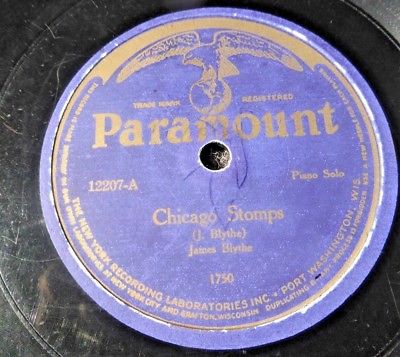
78 RPM Paramount 12207 earliest Boogie-Woogie piano James Blythe CHICAGO STOMPS
$
31


Favourite Auctions
To save auctions to your favourites, please login
If you don't have an account, please register
Description
FIRST TIME EVER LISTED ON EBAY!!!
1924 Ten-inch 78 rpm record on the
PARAMOUNT label Record No. 12207
A: (1750) Piano Solo by James Blythe
Chicago Stomps
B: (1751)Piano Solo by James Blythe
Armour Ave. Struggle
Condition: G : Plays through fine with surface noise and pops.
...its not that this record is badly worn, its just that it was probably not sleeved for the past 80 years and so it has picked up major scuffs and light scratches. Please note: The last two pictures make the record look better than it really is...
from Wikipedia: Blythe was born in South Keene, Kentucky to former slaves turned-sharecroppers Richard and Rena Blythe. He was the youngest of five children to survive birth and became interested in the piano after observing local ragtime players. In 1917, he moved to Chicago, Illinois where he worked in the Mavis Talcum Powder Company and studied the rudiments of piano, playing under the tutelage of orchestra leader Clarence M. Jones, who found some success as an arranger. Although Blythe's life between 1919 and 1922 is obscured, it is speculated that he began preparing compositions in Jones's recording studio and performed at nearby music clubs.[2]
In early 1922, Blythe was hired by the Columbia Music Roll Company to record piano rolls that were accessible at home and early nickelodeons. Modeling some of his style after the teachings of Jones, he applied an increasingly popular octave and boogie bass, with signature rhythmic breaks, to as many as 300 credited recordings for Columbia and later Capitol, when the company was reorganized in 1924. Writer Bill Edwards remarks that, despite the limitations of piano rolls, Blythe "was able to take simple popular songs and create an engaging performance from them in short order. Many of these were taken from the simple sheet music and expanded to include blues riffs, stride or boogie-woogie bass, and even pseudo-novelty figures. Musicians around Chicago and beyond worked to emulate his engaging style as his fame grew".
In April 1924, Blythe entered the recording studio with co-writer Alex J. Robinson to record for Paramount Records. One of the songs, "Chicago Stomp", became Blythe's most popular recording and made him the earliest boogie-woogie pianist to be recorded. It has also been suggested that his 1925 recording of "Jimmie Blues" influenced the work of Clarence "Pine Top" Smith and Albert Ammons. Blythe recorded with his own studio groups, including Blythe's Sinful Five, Jimmy Blythe and his Ragamuffins, and Blythe's Washboard Band, which usually featured clarinetist Jimmy O'Bryant. He accompanied recording sessions by Johnny Dodds, Ma Rainey, and Jimmy Bertrand, and made duets with Buddy Burton and Charlie Clark. In some instances when he penned songs with Robinson and other musicians such as Trixie Smith, he used the pseudonyms "Duke Owens" and "George Jefferson"
I know how to pack 78's so that they arrive safe and unbroken
Shipping: I charge the actual cost for me to ship you the item, not including materials which are free.
Shipping to the US is $6.00 via Media Mail mailed from the US.
Shipping to the rest of the world is $16.00. If you buy more than one
I will combine shipping for substantial savings for you.
price rating


![Hum - You'd Prefer An Astronaut LP [Vinyl NEW] 180gm White Smoke #'d Ltd. Ed](https://www.popsike.org/php/thumbnail.php?url=https://www.popsike.pics/pix/20150403/321714871902.jpg)