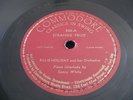
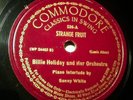
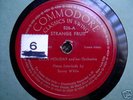
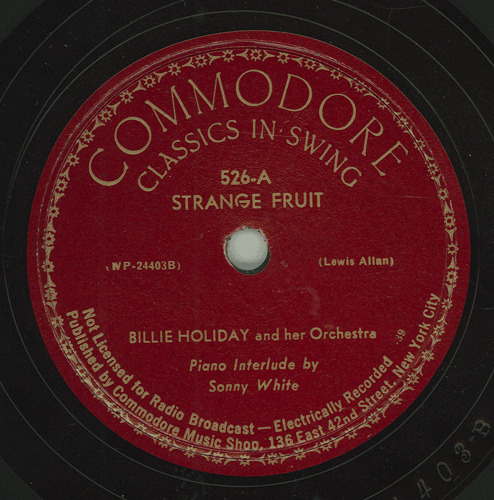
BILLIE HOLIDAY (1939) Strange Fruit / Commodore 78rpm
$
82


Favourite Auctions
To save auctions to your favourites, please login
If you don't have an account, please register
Description
BILLIE HOLIDAY
Strange Fruit (1939)
Neither jazz nor blues nor ballad but a protest song in the form of a dirge, "Strange Fruit" occupies a category of one in American popular music. Born of the collaboration between a 36-year-old Jewish, English teacher and the singer Billie Holiday, the song was conceived at a moment in our cultural history in which a large number of artists struggled to fuse their politics with their art.
Abel Meeropol wrote the anti-lynching poem in January 1937. He later set the poem to music. Over the next few years, "Strange Fruit" would be performed regularly at left-wing rallies by Meeropol's wife, members of the teachers' union and assorted soloists and ensembles. In early 1939, Meeropol took his song to Barney Josephson, the founder and owner of Cafe Society, the integrated Greenwich Village cabaret that had become a gathering place for left-wingers, intellectuals, artists, writers and jazz lovers.
Josephson gave the song to Holiday. Years later he told a British documentary filmmaker, that Holiday had no idea what it was about, but sang it anyway. Despite Josephson's claim, Holiday, who had suffered from racism all her life, needed no help in understanding Meeropol's words. What she needed help with - and Josephson provided it - was finding a way to get audience members to look up from their drinks and stop chatting long enough to listen to a song about a lynching. To prepare his patrons for "Strange Fruit," Margolick writes, Josephson "decreed elaborate stage directions for each of the three nightly performances. Holiday was to close each set with it. Before she began, all service stopped. Waiters, cashiers, busboys were all immobilized. The room went completely dark, save for a pin spot on Holiday's face. When she was finished and the lights went out, she was to walk off the stage, and no matter how thunderous the ovation, she was never to return for a bow."
After Holiday's record company, Columbia, refused to record "Strange Fruit" because of the incendiary lyrics and because her producer, John Hammond, did not much like it, Holiday took the song to Milt Gabler, a politically engaged record producer who ran his own label, Commodore Records, out of a music store on East 42nd Street.
The song was recorded in April 1939 and released that summer. The impact was immediate. Samuel Grafton, a reporter for The New York Post, devoted a column to the record, which, he confessed, "has obsessed me for two days. . . . It will, even after the 10th hearing, make you blink and hold onto your chair."
Southern trees bear a strange fruit,
Blood on the leaves and blood at the root,
Black body swinging in the Southern breeze,
Strange fruit hanging from the poplar trees.
Pastoral scene of the gallant South,
The bulging eyes and the twisted mouth,
Scent of magnolia sweet and fresh,
And the sudden smell of burning flesh!
"Strange Fruit" is, first and last, a song about a lynching. Though the number of lynchings had declined from near 80 in 1919 to 24 in 1933 and 18 in 1935, the image of the "black body swinging in the Southern breeze" had been indelibly burned into the consciousness of black Americans. Black activists and their supporters, led by the N.A.A.C.P., had been campaigning for a federal anti-lynching statute since 1919. Even without the support of President Franklin D. Roosevelt, who refused to endorse the legislation because he feared antagonizing Southern Democrats, an anti-lynching bill had been passed by the House in 1935, only to be buried in the Senate. In 1940, one year after the release of "Strange Fruit," another anti-lynching bill passed the House, but it too died in the Democratic controlled Senate.
Holiday recorded "Strange Fruit" four times after the 1939 Commodore session, the last in a televised London concert in February 1959. She died that summer. [DAVID NASAW – New York Times]
LISTEN TO PART OF THIS RECORD HERE!
This original Commodore Records pressing is flipped with "Fine And Mellow," which is from an April 1939 session. It's a great, slow blues number.
CONDITION: This record is VG++, very nearly like a new record and what noise you hear is in the materials it’s pressed on.
ODD RECORDS ARE A REEL GEORGE SPECIALTY! CHECK MY OTHER AUCTIONS
WANT YOUR PURCHASE CONVERTED TO A DIGITALLY REMASTERED CD? WRITE FOR DETAILS!
price rating




![Isaac Hayes - Black Moses 2xLP Vinyl] |New Large Foldout Sleeve](https://www.popsike.org/php/thumbnail.php?url=https://www.popsike.pics/pix/20211031/324858840793.jpg)