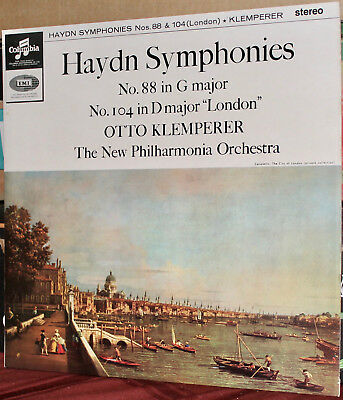
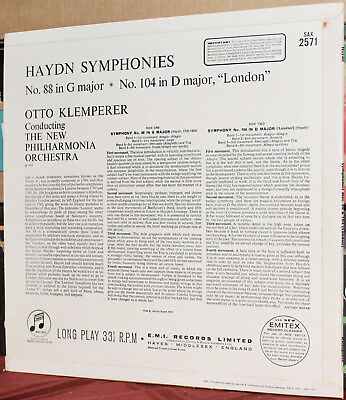
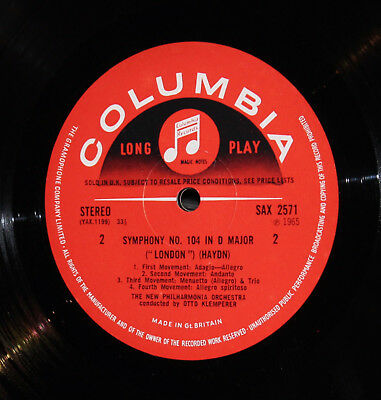
COLUMBIA UK LP SAX-2571: HAYDN - Symphonies Nos. 88 & 104 - KLEMPERER - 1965 UK
C$
100
$
72

C$ 100
Sold For
Sep 2, 2020
Sold Date
Jan 3, 2018
Start Date
1
Number Of Bids
Canada
Country Of Seller
eBay
Sold at
Favourite Auctions
To save auctions to your favourites, please login
If you don't have an account, please register
Description
****Welcome to our listing, thanks very much for looking!
****See our own website! We have lots of out of print LPs and CDs! Find us on the web at -
hearthedifference.net
****Shipping cost is only an estimate - it depends on the actual weight and size of the package as well as the service required. We do not profit from shipping costs, so if we overcharge, we will refund the difference back to you. It's always best to wait for our invoice before paying for your item. We will combine shipping for multiple items purchased.
****Please see our other listings - new items added daily!
****To access our eBay store click on the little red door at the top right section of any of our eBay listings or, click on -
http://stores.ebay.com/Hear-The-Difference
Background -
Otto Nossan Klemperer (14 May 1885 – 6 July 1973) was a German-born conductor and composer. He is widely regarded as one of the leading conductors of the 20th century.German conductor Otto Klemperer attended the Hoch Conservatorium in Frankfurt-am-Main, studied violin and piano at the Klindworth-Scharwenka and Stern Conservatories in Berlin, and composition with the German composer Pfitzner. He made his début in Berlin in 1905, where he conducted fifty performances of Offenbach's Orpheus in the Underworld, not a work that would now be identified with Klemperer's serious and profoundly personal approach to music.
Shortly afterwards, he visited Gustav Mahler in Vienna and impressed the composer by playing a scherzo from a Mahler symphony by memory at the piano. With Mahler's personal recommendation, Klemperer was appointed choirmaster and conductor at the German Opera in Prague. He held this post for three years, during which he returned to Vienna to assist in rehearsals for Mahler's later symphonies. Again with Mahler's help, he became conductor at the Hamburg Opera in 1910. There followed a succession of appointments in Barmen (1913), Strasbourg (1914-1916), Cologne (1916-1924) and Wiesbaden (1924-1927) and visits to Barcelona, Rome, the U.S.S.R., and the U.S. between 1920 and 1936.
In 1927, he was engaged as director of the Kroll Opera House in Berlin, where he remained until 1931 when political pressures and financial difficulties forced its closure. In addition to better-known operas, Klemperer introduced new works which ran counter to the Nazis' idealized view of German culture, such as Schoenberg's Die glückliche Hand and Erwartung; Hindemith's two operas, Cardillac and Neues von Tag; and Janacek's From the House of the Dead. Indeed, Klemperer was then noted more for his interest in contemporary music than for his interpretations of the mainstream Classical and Romantic repertory on which, in later life, he concentrated almost entirely.
After a highly successful series of London concerts in 1929, Klemperer returned to Germany in 1931 to conduct the Berlin State Opera. As a Jew, he was in danger of persecution and, though honored with a gold medal for his "outstanding contribution to German culture," a German newspaper of the time sourly commented "[h]is whole outlook ran counter to German thought and feeling."
Klemperer was dismissed in 1933 and fled with his family first to Austria and later to Switzerland. While there, he was appointed conductor of the Los Angeles Philharmonic Orchestra and lived in California from 1935 to 1939 during which he also conducted the New York Philharmonic and Philadelphia Symphony Orchestra. In 1937, he helped to reorganize the Pittsburgh Symphony Orchestra, though refused to become its conductor.
Following a brain tumor that left him partially paralyzed, his career faltered. In 1940, Klemperer became a U.S. citizen, but his sufferings were increased by a manic depressive state characterized by recurring cycles of exhilaration and depression. In 1951, an accident at the Montreal airport forced Klemperer to conduct from a chair. To prove himself competent, he hired an orchestra to perform a concert of works of his own choice at Carnegie Hall. It was a success but, after an argument with American immigration authorities, Klemperer returned to Europe where he continued conducting in Italy, Sweden, Switzerland, and France.
In the early 1950s Klemperer experienced difficulties arising from his U.S. citizenship. American union policies made it difficult for him to record in Europe, while his left-wing views made him increasingly unpopular with the State Department and FBI: in 1952 the United States refused to renew his passport. In 1954 Klemperer again returned to Europe, and acquired a German passport.
His career was turned around in 1954 by the London-based producer Walter Legge, who recorded Klemperer conducting Beethoven, Brahms and much else with his hand-picked orchestra, the Philharmonia, for the EMI label. He became the first principal conductor of the Philharmonia in 1959. He settled in Switzerland. Klemperer also worked at the Royal Opera House Covent Garden, sometimes stage-directing as well as conducting, as in a 1963 production of Richard Wagner's Lohengrin. He also conducted Mozart's The Magic Flute there in 1962.
A severe fall during a visit to Montreal in 1951 forced Klemperer subsequently to conduct seated in a chair. A severe burning accident further paralyzed him, which resulted from his smoking in bed and trying to douse the flames with the contents of a bottle of spirits of camphor nearby. Through Klemperer's problems with his health, the tireless and unwavering support and assistance of Klemperer's daughter Lotte was crucial to his success.
The peak of Klemperer's career came in 1959 with the Philharmonia Orchestra, based in London. When attempts were made to disband the orchestra in 1964, its members appointed him president, and the orchestra was reconstituted. As the New Philharmonia, the group reached new heights in the Beethoven cycles during the early 1960s. In the same period he conducted at Covent Garden Opera House. - Roy Brewer
Symphony No. 88 in G major (Hoboken I/88) was written by Joseph Haydn. It is occasionally referred to as The Letter V referring to an older method of cataloguing Haydn's symphonic output.
The symphony was completed in 1787. It is one of Haydn's best-known works, even though it is not one of the Paris or London symphonies and does not have a descriptive nickname.
The work is in standard four movement form and scored for flute, two oboes, two bassoons, two horns, two trumpets, timpani, continuo (harpsichord) and strings.
• Adagio — Allegro
• Largo
• Menuetto: Allegretto
• Finale. Allegro con spirito
The first movement begins with a brief introduction which quickly settles to the dominant chord to prepare for the main body of the movement. The strings open the Allegro stating the main theme and the rest of the movement develops from there, with almost every statement deriving from a previous idea. The exposition is monothematic and the development continues to make use of that single melodic idea. In the recapitulation, the initial statement of the theme is embellished by a solo flute.
The slow movement in D major consists mainly of embellishments of the legato oboe and solo cello theme which opens it, though every so often is punctuated by chords played by the whole orchestra. After hearing this slow movement, Johannes Brahms is said to have remarked, 'I want my Ninth Symphony to sound like this'. It is the first of Haydn's symphonies to use trumpets and timpani in the slow movement. Mozart had previously used trumpets and timpani in the slow movement of his Linz Symphony.
The minuet is in G major. The trio has an unusual feature to it: after stating a rather simple theme, the fifths held in the bassoons and violas shift down a fourth in parallel, an effect typically avoided by the classical composers.
The finale is a sonata-rondo, with the rondo theme first presented in binary form. The first section of this is noteworthy for ending on unusual cadence on the mediant. A "perpetual-motion finale," it is considered one of the most cheerful Haydn ever wrote.
The Symphony No. 104 in D major (H. 1/104) is Joseph Haydn's final symphony. It is the last of the twelve London symphonies, and is known (somewhat arbitrarily, given the existence of eleven others) as the London Symphony. In Germany it is commonly known as the Salomon Symphony after Johann Peter Salomon, who arranged Haydn's two tours of London, even though it is one of three of the last twelve symphonies written for Viotti's Opera Concerts, rather than for Salomon.
The work was composed in 1795 while Haydn was living in London, and premiered there at the King's Theatre on 4 May 1795, in a concert featuring exclusively Haydn's own compositions and directed by the composer. The premiere was a success; Haydn wrote in his diary "The whole company was thoroughly pleased and so was I. I made 4000 gulden on this evening: such a thing is possible only in England."
The work is scored for two flutes, two oboes, two clarinets in A, two bassoons, two horns in D and G, two trumpets in D, timpani and strings.
In the world of Haydn Symphonies on LP in London, there was first Beecham and the RPO and then a sequence from Klemperer and the Philharmonia. Of course this is a gross simplification and there were other performances, but these two old lions tended to dominate British perceptions and catalogues well into the 1960s and early 1970s by which time they were being well overtaken by new trends in performance.
The symphonies were recorded in the early 1960s. The overview must of course note the relatively large string sections and the familiar Klemperer ear for wind detailing. As is the case with Beecham’s recordings speeds can now sound, given the recent developments in speed and articulation, somewhat portly. This specifically relates to the Minuets. Otherwise there is much to admire.
No.88 is strong and sinewy especially the cellos and basses in the Largo with the very forward wind statements elegantly tapered – some may say too much so. True, the Minuet is slow-ish but the Ländler has plenty of charm and typical Klemperer sonority. Linear continuity ensures that it keeps on track.
The London is perhaps even better. The wind chording here is tremendously vital and precise and once again Klemperer manages to distil considerable power into the symphony’s Adagio introduction. The slow movement itself is notably well detailed and cantilevered and this performance, made in 1964, shows the partnership of conductor and orchestra at something like its best.
Of grace and refinement there are perhaps fewer traces, but one wouldn’t necessarily seek them in a Klemperer performance, certainly of Haydn. Where Beecham was a Cavalier, Klemperer was a Roundhead in this kind of thing. His is a determinist, utterly symphonic set of performances if one can put it that way, one which took account of textual editorialising in a way that Beecham did not; the Robbins Landon editions were available to both and Klemperer did institute some changes.
To that extent though, the symphonies are over-balanced towards the serioso. Admirers of the conductor will be grateful to have these performances. - Jonathan Woolf
The sound is typical of warm 60's stereo and these are grand, serious, beautifully played performances which bring out the interior voices in Haydn's scoring owing to the lucidity and perfect balance of Klemperer's disposition of his instruments - including, of course, the famous division of the first and second violins and the prominence of the woodwind, Tempi are relatively slow but everything is played with such elegance and affection that the slow movements do not limp or drag. Hearing this music as "old and tired" is, I think, a classic example of projecting a pre-conceived idea onto what is actually there; these are lovely renderings of the music per se but also a memento of the kind of sonority Klemperer achieved with a great orchestra; the playing is a delight. - Ralph Moore
When you think of Haydn interpreters, conductor Otto Klemperer may not be the first name that springs to mind. One tends to think of Klemperer in terms of grand, large-scale productions, recordings of Beethoven, Brahms, Bruckner, Mahler, Wagner, that kind of thing. Yet he had a felicitous touch with lighter material as well, as his discs of Haydn, Mendelssohn, Mozart, Schubert, and Schumann demonstrate. If you haven't heard his Haydn, you're in for a treat.
This is big-scale Haydn, generally slow and steady and deliberate, emphasizing the music's architecture rather than displaying the overt jauntiness of, say, a Beecham or the energetic ardor of a period-instruments group. In most cases, Klemperer's Haydn is like listening to the composer with new ears.
Outstanding among the symphonies presented are Nos. 88 and 104. They are enchantingly beautiful performance, the argument strong and the rhythms feather light. They are no modern digital affairs, moving without heart or soul, nor are they an old grandfather snoozing laboriously in a corner. These symphonies are graceful and ornate, all filigree and glass, inviting us to relax and take our time. These symphonies combine refinement and reason in perfect eighteenth-century order. I enjoyed these performances immensely.
These interpretations are for people seeking perhaps something a little out of the ordinary, yet the interpretations remain rooted firmly in the classical tradition. The readings are uniquely personal and, as such, variable; but when the music is good, it's worth a hundred of anything else.
Sonically, the disc holds up pretty well, too. The recordings derive from sessions from the early 1960s, with little difference among them. They are all full and warm and wide-ranging, with good breadth and detailing. The recordings sound just fine. - John J. Puccio
-
LP made by COLUMBIA UK // EMI Records, in the UK / England / Great Britain
-
LP released in 1965
-
LP is recorded in STEREO
-
Record Catalog Number: SAX 2571
-
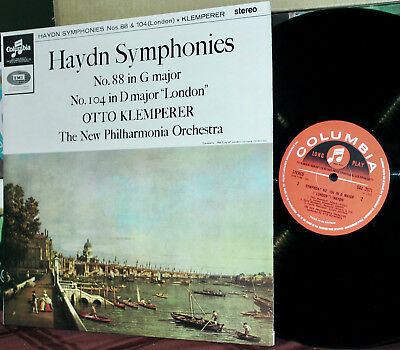
Record Labels are primarily RED with BLACK & WHITE lettering (aka Columbia Red/Notes label), with the COLUMBIA logo on the labels. This is the EARLIEST stereo version made by Columbia UK - a Blue/Silver version was never issued.
Haydn // Otto Klemperer
LP Title & Music on this rare item -
1. Symphony no 88 in G major, H 1 no 88 by Franz Joseph Haydn
Conductor: Otto Klemperer
Orchestra/Ensemble: New Philharmonia Orchestra
Period: Classical
Written: circa 1787 ; Eszterhazá, Hungary
Venue: England
Length: 21 Minutes 4 Secs.
2. Symphony no 104 in D major, H 1 no 104 "London" by Franz Joseph Haydn
Conductor: Otto Klemperer
Orchestra/Ensemble: New Philharmonia Orchestra
Period: Classical
Written: 1795; London, England
Venue: England
Length: 31 Minutes 15 Secs.
Symphony No. 88 In G
Composed By – Joseph Haydn
AI Adagio - Allegro 6:50
AII Largo 5:53
AIII Menuetto (Allegretto) And Trio 4:25
AIV Allegro Con Spirito 3:55
Symphony No. 104 In D ("London")
Composed By – Joseph Haydn
BI Adagio - Allegro 8:58
BII Andante 10:12
BIII Menuetto (Allegro) And Trio 4:57
BIV Allegro Spiritoso 7:15
Performers on this LP include -
• Composed By – Joseph Haydn
• Conductor – Otto Klemperer
• Orchestra – New Philharmonia Orchestra
Other Information -
Recording first published 1965.
Recorded In England.
Columbia 1st Stereo Pressing Red Semi Label.
Mono version = 33CX 1931
CONDITION Details:
The LP JACKET is in near mint minus condition! The jacket has NO seam splits or crushed corners. The corners and seams are solid with just some light shelf wear. The jacket has flipped over or "clam shell" seams at the top and bottom and the front is covered in clear plastic, otherwise known as "CLARIFOIL". The colors on the jacket are sharp and clean (see pictures with this listing as they are of the actual item).
The LP is in excellent plus condition. We found that the vinyl looked excellent on this vintage LP! There are some light marks on the vinyl (nothing serious) and the LP retains much of the original gloss and sheen. It does have a bit of dust and perhaps a finger print or two on the vinyl so it should be cleaned before playing for best results. There are NO serious spindle marks on the record labels. That said, acquiring a vintage LP like this is for the performance and rarity of the LP, not necessarily for the sound quality. A Short Note About LP GRADING -- Mint = Only used for sealed items.
- Near Mint = Virtually flawless in every way.
- Near Mint Minus = Item has some minor imperfections, some audible.
- Excellent = Item obviously played and enjoyed with some noise.
- Very Good Plus = Many more imperfections which are noticeable and obtrusive.
For best results, always properly clean your LPs before playing them.
The LP is an audiophile quality pressing (any collector of fine MFSL, half speeds, direct to discs, Japanese/UK pressings etc., can attest to the difference a quality pressing can make to an audio system).
Don't let this rarity slip by!!!
price rating
![[12 LP Vol. 1-12] Herbert von Karajan, The Vienna Philharmonic Symphony Orches](https://www.popsike.org/php/thumbnail.php?url=https://www.popsike.pics/pix/20201025/284056897723.jpg)