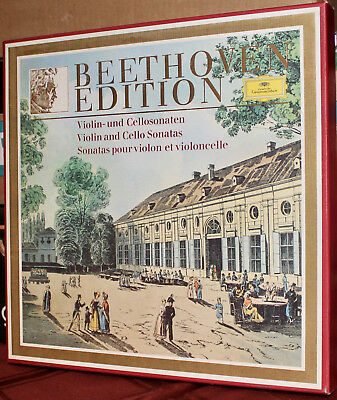
DGG 8-LPs 2721-133: BEETHOVEN Violin & Cello Sonatas - FOURNIER, KEMPFF 1977 DEU
$
100
$ 100
Sold For
May 23, 2020
Sold Date
Jan 19, 2018
Start Date
1
Number Of Bids
USA
Country Of Seller
eBay
Sold at
Favourite Auctions
To save auctions to your favourites, please login
If you don't have an account, please register
Description
****Welcome to our listing, thanks very much for looking!
****See our own website! We have lots of out of print LPs and CDs! Find us on the web at -
hearthedifference.net
****Shipping cost is only an estimate - it depends on the actual weight and size of the package as well as the service required. We do not profit from shipping costs, so if we overcharge, we will refund the difference back to you. It's always best to wait for our invoice before paying for your item. We will combine shipping for multiple items purchased.
****Please see our other listings - new items added daily!
****To access our eBay store click on the little red door at the top right section of any of our eBay listings or, click on -
http://stores.ebay.com/Hear-The-Difference
Background -
Wilhelm Walter Friedrich Kempff (25 November 1895 – 23 May 1991) was a German pianist and composer. Although his repertoire included Bach, Mozart, Chopin, Schumann, Liszt and Brahms, Kempff was particularly well known for his interpretations of the music of Ludwig van Beethoven and Franz Schubert. He recorded the complete collection of their piano sonatas. He is considered to have been one of the chief exponents of the Germanic tradition during the 20th century and one of the greatest pianists of all time.One of the twentieth century's most important pianists, Wilhelm Kempff found warmth in Beethoven where many others discovered only stress and passion. Concentrating on the composers of the late Classical and early-to-middle Romantic periods, Kempff achieved graceful, amiable results while not neglecting the sterner core of this music. His nobility of purpose was everywhere evident, made manifest through lucid textures, an adherence to a flowing legato, and tonal shading. In addition, he was a composer whose oeuvre included two symphonies, four operas, songs, and solo piano works.
Trained first by his Lutheran church musician father, Kempff studied privately before entering Berlin's Hochschule für Musik at age 9. In 1914, he traveled to Potsdam for further studies at the Viktoriagymnasium before returning to Berlin to finish his work at the Hochschule and enroll at the university. At age 20, Kempff served as organist and pianist on a tour of Germany and Scandinavia by the Berlin Cathedral Choir. A successful 1917 piano recital at the Berlin Singakademie led to an engagement the following year with the Berlin Philharmonic, the first of innumerable collaborations with that august ensemble. During the 1920s and 1930s, he toured South America and Japan, as well as many parts of Europe, adding to his reputation for uncompromising musicianship and personable interpretation. At the same time, he taught, serving first as director at the Stuttgart Musikhochschule from 1924 to 1929 and, later, as piano instructor at Potsdam's Mamorpalais for the decade before WWII. The war kept his activities confined to Germany, but with its end, Kempff once more resumed a busy performance schedule.
England and America heard Kempff only later. In London, the public, including a large number of German émigrés, applauded him upon his first appearance there in 1951. Not until 1964 did New York hear the pianist in person, although by then his many Deutsche Grammophon recordings had already established his stature for Americans. Indeed, Kempff's long and fruitful relationship with that label had brought to the market a long list of desirable recordings, among them the complete Beethoven piano concerti; the sonatas; a relaxed, but rewarding survey with Wolfgang Schneiderhan of the Beethoven violin sonatas; and various collections of Schubert, Schumann, Chopin, and Brahms. - Erik Eriksson
Pierre Léon Marie Fournier (24 June 1906 – 8 January 1986) was a French cellist who was called the "aristocrat of cellists," on account of his elegant musicianship and majestic sound.
Pierre Léon Marie Fournier was born into a military family. His father was a general; his mother was musical and taught him piano lessons. At the age of 9, he suffered a mild attack of polio. Weakness of his legs made pedaling the piano difficult. So he turned to the cello, and after making rapid progress, he was admitted to the Paris Conservatoire. His teachers there were Paul Bazelaire and Anton Hekking; he graduated in 1924 at the age of 17. Fournier made his debut the year after his graduation. This was a solo appearance with the Concerts Colonne Orchestra, which received favorable notices. The almost invariable comment in reviews was the perfection of his bowing technique. He began a successful career as a touring concert artist and as a performer in chamber music concerts, gaining a great reputation in Europe.
In 1937 to 1939, he was the director of cello studies at the Ecole Normal. It was often said that he became a friendly rival with his contemporary, cellist Paul Tortelier, and after attending a Tortelier concert remarked to him, "Paul, I wish I had your left hand." Tortelier responded, "Pierre, I wish I had your right." To Fournier, the secret of his great right hand (i.e., bowing technique) was keeping the elbow high, holding the bow firmly, but allowing the hand and arm to move fluidly. He prescribed the Sevcik violin bowing studies for his cello students.
In 1941, he became a member of the faculty at the Paris Conservatoire, but during the war years, his concert touring career was impossible. Once the war was over, though, was able to resume and he rapidly increased in fame and international stature. His old audience found that he had grown in artistic depth. Hungarian violinist Joseph Szigeti, meeting Fournier in rehearsals for a 1947 Edinburgh Festival appearance, had not heard him for over ten years and wrote that he was "tremendously impressed by the Apollonian beauty and poise that his playing had acquired in the intervening years. Szigeti, Fournier, violist William Primrose, and pianist Artur Schnabel formed a piano quartet in those years and gave some fabled concerts at which they played virtually all of Schubert's and Brahms' piano chamber music. Sadly, the BBC acetate air checks of this cycle were allowed to deteriorate and have been lost.
Fournier made his first U.S. tour in 1948. His chamber music partner Artur Schnabel spread the word among cellists, other musicians, and critics that they were to be visited by a great new cellist. The New York and Boston critics were ecstatic. He had to give up his Conservatoire post because of his expanding concert career; he appeared in Moscow for the first time in 1959. Commentator Lev Grinberg wrote that he was notable for a romantic interpretation; clarity of form; vivid phrasing; and clean, broad bowing all "aimed at revealing the content."
He had a broad repertoire, including Bach, Boccherini, the Romantics, Debussy, Hindemith, and Prokofiev. Composers Martinu, Martinon, Martin, Roussel, and Poulenc all wrote works for him. He had a standing Friday night date to privately play chamber music with Alfred Cortot, the eminent French pianist, at which they might be visited by musicians like Jacques Thibaud. In 1953, he became a Chevalier of the Legion of Honor and was promoted to officer in 1963.
In 1972, he retired to Switzerland and gave master classes. He still gave concerts, even as late as 1984 when he was 78, and a London critic praised the fluency of his playing and his strong and solid left-hand technique. - Joseph Stevenson
Yehudi Menuhin, Baron Menuhin, OM KBE (22 April 1916 – 12 March 1999) was an American-born violinist and conductor who spent most of his performing career in Britain. He is widely considered one of the greatest violinists of the 20th century.
The legendary violinist Yehudi Menuhin was the eldest child of Russian-born Hebrew scholars who met in Palestine, emigrated to New York City, and moved to San Francisco soon after their son's birth. After just three years of violin study, Yehudi made a legendary debut at age seven with the local symphony. His Carnegie Hall debut three years later, in the Beethoven Violin Concerto, garnered praise that likened him to Mozart as a prodigy, whereupon the family (which now included sisters Hephzibah and Yaltah) lived gypsy-like in hotels wherever Yehudi was engaged at enormous fees. But the child's talent was instinctive. As Fritz Kreisler was to remark later on, "Because the young Menuhin had anticipated so early and so much of what nature had given him, I foresaw that he would have great difficulties." And he did.
When an eminent elder colleague requested a scale after the boy had played Lalo's Symphonie espagnole flawlessly, Menuhin wrote in his autobiography, Unfinished Journey, "I groped all over the fingerboard like a blind mouse.... I played the violin without being prepared for violin playing." He began recording early on (playing among other works Elgar's Violin Concerto at 16, with the composer conducting) and continued to concertize, making a world tour of 73 cities during his 19th year. At the end, however, he felt "tired, indifferent, and sad," and in 1936 began an 18-month sabbatical. Menuhin resumed playing in 1938, but never after with the sublime confidence of his preadolescent years.
During World War II he gave more than 500 concerts for Allied and American troops, but stirred a hornet's nest of controversy as the first major Jewish artist to perform in post war Germany. Likewise, after the Six Day War in the Middle East, he was vilified for performing charity concerts in Arab countries. Increasingly he devoted himself to the training of young artists, both near London (which became his home in 1952) and at Gstaad, Switzerland. Also in 1952 he went to India, became a disciple of yoga, and a colleague of sitarist Ravi Shankar. He recorded with Shankar, as he did subsequently with jazz violinist Stéphane Grappelli. In the middle 1950s Menuhin took up conducting, but was no better schooled than he had been as a child violinist -- and he was conspicuously less successful despite having made a steady stream of recordings begninning in 1958. At age 82 he was guest conducting the Warsaw Symphony on tour when he suffered a fatal heart attack in Berlin.
Menuhin was named Chevalier of the Légion d'honneur in 1948, to the British knighthood in 1965, and to a Lordship in 1993. For his work on behalf of peace worldwide, he was named ambassador of goodwill to UNESCO in 1992. His dedication to the "minds and hearts" of young musicians well may be remembered after his pre-adult celebrity has faded to black. Menuhin married twice, fathered four children, and played frequent recitals with sisters Hephzibah (1920-1981), starting in 1930, and years later with Yaltah (1922-2001), notably at the Bath Festival he founded and directed in the 1960s. - Roger Dettmer
Recorded for the Beethoven bicentenary in 1970, violinist Yehudi Menuhin and pianist Wilhelm Kempff's recordings of the composer's complete violin sonatas are excerpted here to couple the two best-known: the "Spring" and "Kreutzer" sonatas. Before the fact, the partnership seemed unlikely to succeed, Menuhin being warm-toned, romantically lyrical, and rhythmically impulsive and Kempff dry-toned, classically polished, and rhythmically reserved. And although acknowledged on release as a wonderful addition to an already distinguished discography for these core repertoire works, it was also admitted that Menuhin and Kempff's performances succeeded in spite of the performers -- and succeeded brilliantly. Neither player changed his fundamental nature: Menuhin's tone is as ineffably sweet in the "Spring's" Adagio molto espressivo as Kempff's is decisively dry; Kempff's tempos are as ineluctably propulsive in the "Kreutzer's" closing Presto as Menuhin's are inevitably impetuous. Yet the performances do succeed. Menuhin's warmth softened Kempff's severity, Kempff's firmness strengthened Menuhin's resolve, and together they created performances much greater than the sum of their parts. This disc will make a fine introduction to the works and a welcome addition to any collection of Beethoven's violin sonatas -- though fans of the works are likely going to want to hear all of Menuhin and Kempff's recordings. Deutsche Grammophon's stereo sound is so vivid the listener can feel the heat from Menuhin's bow. - James Leonard
Menuhin and Kempff’s 1970 recordings of Beethoven’s Spring and Kreutzer sonatas are exceptionally elegant, fresh and immediate. Their approach does not have the richness of Perlman and Ashkenazy’s readings – Menuhin’s tone is tauter and less opulent than Perlman’s and the piano sound is more refined – but the air of delicacy is wholly effective, underlined by Kempff’s crisp articulation. The pace is on the reflective side, and the Allegro and Adagio of the Spring Sonata are a little lacking in colour, but Menuhin and Kempff reap rewards in the melting lightness of the scherzo, and the vivid, spirited Rondo. The Kreutzer Sonata is more consistent: the Presto is fiery and muscular, while the variations are eminently graceful. The scampering finale, though not taken at Perlman and Ashkenazy’s whirlwind pace, is eloquent and invigorating. What Menuhin and Kempff’s recordings may lack in dramatic intensity, they make up for in elegance and sheer charm. - Catherine Nelson
"We find Kempff again asserting his personality on the Menuhin discs of Beethoven's violin sonatas. Around 1970 Menuhin was playing especially well, and Kempff is admirably crisp, though he does sometimes assert himself a little too much. On the Oistrakh/Philips discs Oborin is more reticent and better balanced but in consequence, perhaps, not quite so interesting. Menuhin is at his smoothest and silkiest in the lovely Spring Sonata—a little too leisurely, perhaps, in the slow movement—as also in the charming G major, Op. 96 which must be many people's favourite, and he is magnificent in the technical difficulties of the Kreutzer. (Unlike Oistrakh he makes all the repeats.) Occasionally the Menuhin discs reveal their age, and some of the early sonatas, for instance the A minor Op. 23, sound as though they are being played to a large audience in a concert hall; Oistrakh and Oborin better suggest a chamber-music atmosphere and are a shade better balanced. But in the rather naive but charming early pieces Beethoven wrote for violin and piano Menuhin tones down his personality and with great charm captures the simplicity of the Rondo (the main tune, was subsequently purloined by Kreisler, with alterations). The music sounds as though it had been intended for beginners and is none the worse for that, beginners need more pieces of this quality. The 12 variations are on the first of the arias Figaro sings in Mozart's opera, ''Se vuol ballare''. These have touches of sophistication, and Beethoven actually quotes the tune correctly; usually when writing variations on someone else's tune he wrote it down from memory and made a number of small mistakes.” -- Gramophone [6/1987]
Before anything else is said, it has to be admitted that the 1963 recording with Mstislav Rostropovich and Sviatoslav Richter is beyond all argument the greatest set of Beethoven's cello sonatas ever recorded. Nevertheless, for the single best recording of Beethoven's cello sonata, it should be this 1965 recording by Pierre Fournier and Wilhelm Kempff. Because while Rostropovich and Richter are the greater virtuosos, their virtuosity is also inevitably the prism through which Beethoven's music radiates and his music is colored by their virtuosity. But Fournier and Kempff are arguably the greater musicians because they are not so much the prism as the lens through which Beethoven's music flows, and his music is ineluctably clarified by their musicianship. When one hears the ardent objectivity of their Sonatas, Op. 5; the dramatic lyricism of their Sonata, Op. 69; the exhilarating serenity of their Sonatas, Op. 102; the serious fun of their Mozart Variations; or the playful strength of their Handel Variations, one is hearing less of Fournier and Kempff and more of Beethoven. The consummate musicianship renders their playing translucent, letting the clear light of Beethoven's music shine through. As great as Rostropovich and Richter are -- and they are very, very, very great -- it is Fournier and Kempff who contain more of Beethoven because they includes less of themselves. - James Leonard
Pierre Fournier’s 1965 collaboration with Wilhelm Kempff yielded one of the greatest complete recordings of the Beethoven cello sonatas. Their account of Op. 69 epitomises the nobility and eloquence of these unparalleled interpretations, and CD transfers are remarkably spacious and detailed. Anthony Pleeth’s cycle, with fortepianist Melvyn Tan, was the first to employ modern reproductions of instruments of the Beethovenian epoch. These artists make the historical concessions without minimising the drama and passion of the music; the sound is warm, but insufficiently focused. - Michael Jameson
The obvious point of comparison here is the live recording of the same repertoire that Fournier made with Kempff some six years later, also for DG. And there are major differences between the two. Firstly, Fournier's contribution is both sweeter and surer in the earlier recording; secondly, his instrument was far better recorded in 1959––the live 1965 Paris concerts lend him (at least in the remasterings as sampled) a cavernous tone that partially obscures the subtler aspects of his playing; and thirdly, Kempff's jewelled but fanciful pianism (try the magical downward scale in the eleventh Handel variation––track 17) is in vivid contrast to Gulda's more forthright but ultimately less spontaneous studio manner. There's a fourth main difference, too: the observation of Op. 69's first movement repeat by Gulda, which Kempff (or Fournier) saw fit to omit.
However, when it comes to making a choice between the two, I have to say that I prefer the earlier set. Although less loose-limbed than Kempff, Gulda plays with greater concentration (on this occasion it is Kempff who sounds as if he might have one foot in the jazz camp); he also has the benefit of a fuller, more resilient piano tone, a quality which pays dividends where the music needs it most, i.e. in the first movements of Op. 102 Nos. 1 and 2. And there's no denying that where long-breathed solo lines predominate, the advantage of having a cellist very much in the peak of technical condition (as Fournier is with Gulda) is a further advantage. Not that he fails Kempff (on the contrary, there are some instances where Fournier, too, shows an extra spark of spontaneity); it's just that six years witnessed a slight deterioration in his tone.
The competition isn't exactly overwhelming. In mid-price terms, it is dominated by Serkin and Casals, a tougher, grainier, more technically fallible alternative, less well recorded than either DG set, but with its own special charisma. However, if you need a quality library recommendation, then Gulda and Fournier have my vote. - Gramophone
-
LP made by DGG - Deutsche Grammophon Records, in GERMANY
-
LP released in 1977
-
LP is recorded in STEREO
-
Record Catalog Number: 2721 133
-
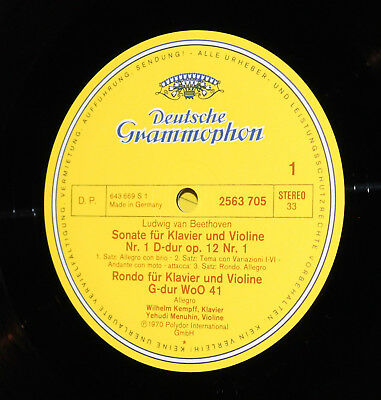
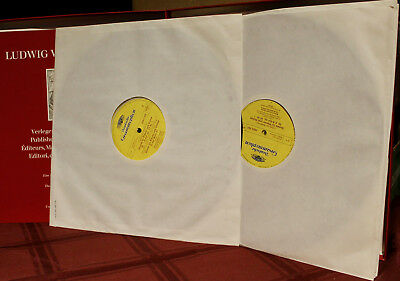
Record Labels are primarily YELLOW with RED, BLUE and GOLD lettering - featuring the DGG records logo.
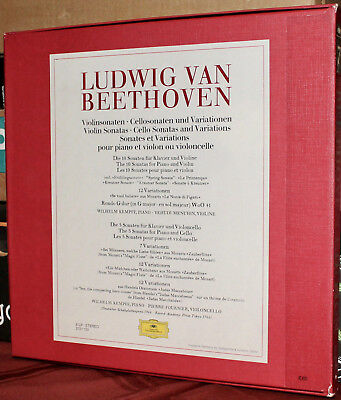
Beethoven // Fournier / Kempff / Menuhin
8-LP title and music on this rare item -
Beethoven Edition - Violin and Cello Sonatas
Tracks -Sonate Für Klavier Und Violine Nr. 1 D-Dur Op. 12 Nr. 1
A1 1. Satz: Allegro Con Brio
A2 2. Satz: Tema Con Variazioni I-IV Andante Con Moto - Attacca
A3 3. Satz: Rondo. Allegro
Rondo Für Klavier Und Violine G-Dur Wo0 41
A4 Allegro
Sonate Für Klavier Und Violine Nr. 2 A-Dur Op. 12 Nr. 2
B1 1. Satz: Allegro Vivace
B2 2. Satz: Andante Piu Tosto Allegretto
B3 3. Satz: Allegro Piacevole
Zwölf Variationen Über Das Thema "Se Vuol Ballare" Aus Mozarts Oper "Le Nozze Di Figaro" Für Klavier Und Violine F-Dur Wo0 40
B4 Tema. Allegretto - Variazioni I-XII - Coda
Sonate Für Klavier Und Violine Nr. 3 Es-Dur Op. 12 Nr. 3
C1 1. Satz: Allegro Con Spirito
C2 2. Satz: Adagio Con Molt'espressione
C3 3. Satz: Rondo. Allegro Molto
Sonate Für Klavier Und Violine Nr. 4 A-Moll Op. 23
D1 1. Satz: Presto
D2 2. Satz: Andante Scherzoso Piu Allegretto
D3 3. Satz: Allegro Molto
Sonate Für Klavier Und Violine Nr. 5 F-Dur Op. 24 "Frühlings-Sonate"
E1 1. Satz: Allegro
E2 2. Satz: Adagio Molto Espressivo
E3 3. Satz: Scherzo Allegro Molto - Attacca
E4 4. Satz: Rondo. Allegro Ma Non Troppo
Sonate Für Klavier Und Violine Nr. 6 A-Dur Op. 30 Nr. 1
F1 1. Satz: Allegro
F2 2. Satz: Adagio Molto Espressivo
F3 3. Satz: Allegretto Con Variazioni I-VI
Sonate Für Klavier Und Violine Nr. 7 C-Moll Op. 30 Nr. 2
G1 1. Satz: Allegro Con Brio
G2 2. Satz: Adagio Cantabile
G3 3. Satz: Scherzo Allegro
G4 4. Satz: Finale. Allegro - Presto
Sonate Für Klavier Und Violine Nr. 10 G-Dur Op. 96
H1 1. Satz: Allegro Moderato
H2 2. Satz: Adagio Espressione - Attacca
H3 3. Satz: Scherzo Allegro
H4 4. Satz: Poco Allegretto - Adagio - Tempo I - Allegro - Poco Adagio - Presto
Sonate Für Klavier Und Violincello F-Dur Op. 5 Nr. 1
I1 1. Satz: Adagio Sostenuto - Allegro
I2 2. Satz: Rondo. Allegro Vivace
Sonate Für Klavier Und Violincello G-Moll Op. 5 Nr. 2
J1 1. Satz Adagio Sostenuto Ed Espressivo - Allegro Molto Piu Tosto Presto
J2 2. Satz: Rondo. Allegro
Sonate Für Klavier Und Violincello A-Dur Op. 69
K1 1. Satz: Allegro Ma Non Tanto
K2 2. Satz: Scherzo. Allegro Molto
K3 3. Satz: Adagio Cantabile - Allegro Vivace
Sonate Für Klavier Und Violincello C-Dur Op. 102 Nr. 1
L1 1. Satz: Andante - Allegro Vivace
L2 2. Satz: Adagio - Allegro Vivace
L3 Sieben Variationen Es-Dur Über Das Thema "Bei Männern, Welche Liebe Fühlen" Aus Mozarts "Zauberflöte" Für Klavier Und Violincello Wo0 46
Sonate Für Klavier Und Violincello D-Dur Op. 102 Nr. 2
M1 1. Satz: Allegro Con Brio
M2 2. Satz: Adagio Con Molto Sentimento D'affetto - Attacca
M3 3. Satz: Allegro Fugato
N1 Zwölf Variationen G-Dur Über Ein Thema Aus Händels Oratorium "Judas Makkäus" Für Klavir Und Violincello Wo0 45
N2 Zwölf Variationen F-Dur Über Das Thema "Ein Mädchen Oder Weibchen" Aus Mozarts "Zauberflöte" Für Klavier Und Violoncello Op. 66
Sonate Für Klavier Und Violine Nr. 9 A-Dur Op. 47 "Kreutzer-Sonate"
O1 1. Satz: Adagio Sostenuto - Presto - Adagio - Tempo I
O2 2. Satz: Andante Con Variazioni I-IV
P1 3. Satz: Finale. Presto
Sonate Für Klavier Und Violine Nr. 8 G-Dur Op. 30 Nr. 3
P2 1. Satz: Allegro Assai
P3 2. Satz: Tempo Di Menuetto, Ma Molto Moderato E Grazioso
P4 3. Satz: Allegro Vivace
Performers / Credits -
• Cello – Pierre Fournier (tracks: I1 to N2)
• Composed By – Ludwig Van Beethoven
• Piano – Wilhelm Kempff
• Violin – Yehudi Menuhin (tracks: A1 to H4, O1 to P4)
Other Information -
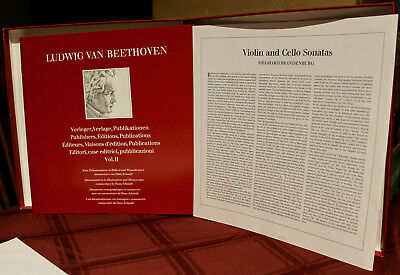
Includes 2 booklets / inserts
? 1966, 1970 & 1977 Polydor International GmbH, Hamburg.
Printed in Germany by Schwerdtle & Schantz, Berlin
Inserts printed in Germany by Neef, Wittingen
Made in Germany
CONDITION Details:
The 8-LP box is in near mint minus condition! The box has NO splits or crushed corners - just gorgeous! The corners and seams are solid with just some light shelf wear. There is a tiny drill hole at the bottom of the box spine. The colors on the box are sharp and clean (see pictures with this listing as they are of the actual item).
The set comes complete with 2 large format paper inserts/librettos.
The 8-LPs are in near mint minus condition! We found that the vinyl looked superb on this vintage LP set. There are no significant marks and the LPs retain much of the original gloss and sheen - obviously well taken care of! They do have a bit of dust and perhaps a finger print or two on them so they should be cleaned before playing. There are NO serious spindle marks on the record labels either. Just beautifully made vinyl! That said, acquiring a vintage LP like this is for the performance and rarity of the LP, not necessarily for the sound quality.A Short Note About LP GRADING -
- Mint = Only used for sealed items.
- Near Mint = Virtually flawless in every way.
- Near Mint Minus = Item has some minor imperfections, some audible.
- Excellent = Item obviously played and enjoyed with some noise.
- Very Good Plus = Many more imperfections which are noticeable and obtrusive.
For best results, always thoroughly clean your LPs before playing them.
LPs can be audiophile quality pressings (any collector of fine MFSL, half speeds, direct to discs, Japanese/UK pressings etc., can attest to the difference a quality pressing can make to an audio system).
Don't let this rarity slip by!!!price rating