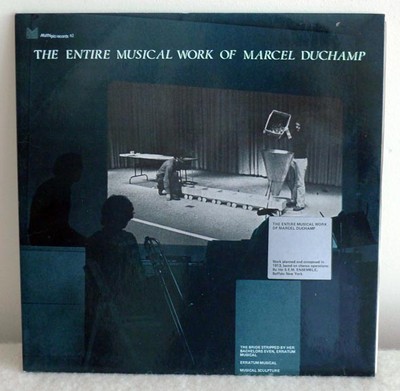
MARCEL DUCHAMP entire musical work LP 1976 avant fluxus marchetti multhipla cage
$
176


Favourite Auctions
To save auctions to your favourites, please login
If you don't have an account, please register
Description
Marcel Duchamp "The Entire Musical Work" LP issued by Multhipla (n.1) in Italy, 1976. gatefold sleeve. ****** Rec:m / Cov:ex ****** First record issued by mythical Multhipla Records (the contemporary art division of Cramps Records), the very rare Marcel Duchamp LP has always been on top of the desires of many discaholics. A perfect copy is now offered here for you pleasure. Of the many creators in other fields who turned their hand to writing music (Jean-Jacques Rousseau, Friedrich Nietzsche, Ezra Pound) to name a very few, Marcel Duchamp is not one whose name springs immediately to mind. Associated with dada and surrealism, Duchamp worked in a variety of media and left a handful of musical sketches created between 1912 and 1915 that were realized by Petr Kotik and the S.E.M. Ensemble in the late '70s. Duchamp left two notated pieces and a conceptual work that must be entirely realized by the performer. The notated pieces were created completely by chance operations, predating Cage's work by many decades. The first, for three voices, was written by pulling cards with pitches out of a hat. In spite of the simplicity of its concept it's a virtuoso piece to perform because the singers must have perfect pitch and a range of two octaves. Here the performers first sing their individual lines and then combine them in various configurations until all are singing together. It's an intriguing and lovely piece. The singers perform with absolute purity and precision so that the dissonances are unambiguous, but what's perhaps most astonishing are the moments when the chance operation produces a unison in the voices, or a triad, or a conventional cadence. Duchamp's "La mariée mise à nu par ses célibataires meme", a sketch for his famous glass and metal construction of the same name, is subtitled "Erratum Musical", and its material is derived from a mechanically complex procedure involving a giant funnel, numbered balls, and a toy train. The first version of "Sculpture Musicale" aptly casts John Cage in a prominent role as it was Cage to whom Duchamp gave the "score" in the late 60s. It reads, in toto (translated from the French), "musical sculpture. Sounds lasting and leaving from different places and forming a sounding sculpture that lasts." This gorgeous performance consists simply of Cage, in his inimitable soft voice, reciting the score's words (in French), ordered so as to form a self-referential acrostic when printed which contains words from the score as a vertical spine, over ambient street and automotive sounds. Petr Kotik's variation on the work utilizes a music box which seems to be manually interfered with enough for the first several minutes to render unrecognizable its actual composition, which makes itself known halfway through: "Somewhere My Love". It's very charming, in fact. The bulk of the disc is comprised of two renditions of "La Mariée mise à nu par ses célibataires même. Erratum Musical". The first is designed to be performed on a "mechanical piano" and is here realized via a piano roll transcribed by Kotik taking the numbers that appear on the score and assigning note values to them. The resultant music, not dissimilar in character to the other version of "Erratum Musical" on its own, proceeds in an almost stately, if random, fashion, the booming single and dual notes resounding over the constant background thrum of the piano motor. The second part of Duchamp's score described a mechanism wherein numbered balls tumbled through a funnel into "cars", the sequence and placement of the cars determining the score. Kotik essentially constructed such a device, then transcribed the results for a quintet consisting of himself (alto flute), Bern Neill (trumpet), Rob Bethea (trombone), Gwendolyn Toth (celeste) and Chris Nappi (marimbaphone). Though the tempo is never explicitly spelled out, Kotik begins with the same steady rhythm we've encountered previously before shifting gears to a more sprightly reading and begins to interpolate the initial random outcomes, allowing his intuition some degree of reign. He succeeds in balancing the contemplative with the playful, with some especially lovely sonorities developed. Needless to say, it sounds like nothing else being produced around 1915 or several decades thereafter. Capital!****** The records looks like they have never been played. Top conditions! ****** Please wait to receive my invoice before sending the payment after the auction ends. Attention! Real postage costs are not USD 4 as all the items are located in Doha, Qatar (which has a very safe and professional post system). Postage costs registered up to 1 Kilo (generally 3 LPs): to Europe and Japan is USD 16,50 / to America and Oceania is USD 22,50. Postage costs registered up to 2 Kilos: to Europe and Japan is USD 28,00 / to America and Oceania is USD 34,00. ****** More ebay auctions of ultra rare sonic arts, fluxus, sound poetry LP and K7 editions in the coming weeks. ****** Thank you for your kind attention and good luck with your bids.