MOZART SONATAS PARLOPHONE ALBUM 7 RECORDS KRAUS GOLDBER
$
53


Favourite Auctions
To save auctions to your favourites, please login
If you don't have an account, please register
Description
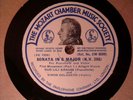
This is for a 7 record set of Mozart sonatas for violin and piano. Simon Goldberg plays violin and Lili Kraus plays piano. All records are in excellent condition. I could not see any scratches, in fact I wonder if they were ever played. The album is good, a small tear at top left corner and outside corners are worn. I took a photo of inside cover that is spotted but the paper is dry and tight. The following infomation I found at another site. High bidder to pay actual shipping cost only. One of the lessor known British Record Societies of the 1930s was the Parlophone MOZART CHAMBER SOCIETY, which featured the "ideal" Duo of Lili Kraus piano and Szymon Goldberg Violin. In the late 30s, 8 Mozart Sonatas, two Mozart Duos, the Hindemith Violin Sonata and three of the Beethoven sonatas were recorded. Lili Krauss & Simon (Szymon) Goldberg - Mozart Sonatas1937 Mozart Chamber Music Soc./ Parlophone 7-record Set Mozart Chamber Music Society / Parlophone SW 8000 thru SW 8006 (England), 12-inch, 78 RPM, 7-record Set "From England have come the finest pre war recordings of pianist Lili Kraus and violinist Szymon Goldberg..." Lili Krauss (Pianoforte) and Simon (Szymon) Goldberg (Violin) performing Sonata in C Major (K.V. 296), Sonata in E Flat Major (K.V. 481), and Sonata in G Major (K.V. 379) (Mozart), for pianoforte and violin 1937 British Parlophone issue on special Mozart Picture Label 7x 12" 78 rpm records with original album From a review in THE GRAMOPHONE That great violinist and teacher Carl Flesch, not one to confer praise lightly, called the partnership of Goldberg (one of what he called his two "outstanding" pupils, the other being Max Rostal) and Kraus "exemplary"; and certainly their Mozart sonatas for Parlophone in the 1930s were universally praised as highlights of the recorded chamber-music repertory. At that time Mozart's violin sonatas, when they were played at all, were often treated either in nineteenth-century romantic style or, at the other extreme, in a falsely prim manner: in those days long before the appetite for 'authenticity' this duo struck a balance which still convinces and appeals. Goldberg's clean intonation, sensitivity to tonal gradation and crisp bowing (especially his light staccato) give constant pleasure, and Kraus had an unerring ear for matching up her tone so that the piano—still the senior partner in Mozart's day—was never overassertive: if she had a failing, it was that, like her teacher Schnabel, she had a tendency to hurry (as in the triplets of K377's first movement here). The Mozart sonatas presented were written in the seven years from 1778 and reveal a conspicuous development in treating the two instruments as equals: compare K296 (the theme of its Andante borrowed from J. C. Bach) and K481, with its remarkable modulations in the Adagio and its final Beethovenish variations (with brilliant piano writing). Throughout, however, the two artists work as a closely-integrated pair, producing buoyancy in the C major's first movement, gaiety in that of the F major and a beautifully shaped and nuanced theme of its Andante; in the B flat they exhibit grace and a deeply felt Andantino; Goldberg's archel volant in K380's alert first movement is a delight, and its bucolic final rondeau is played with delicacy. Tempos are well judged.
price rating