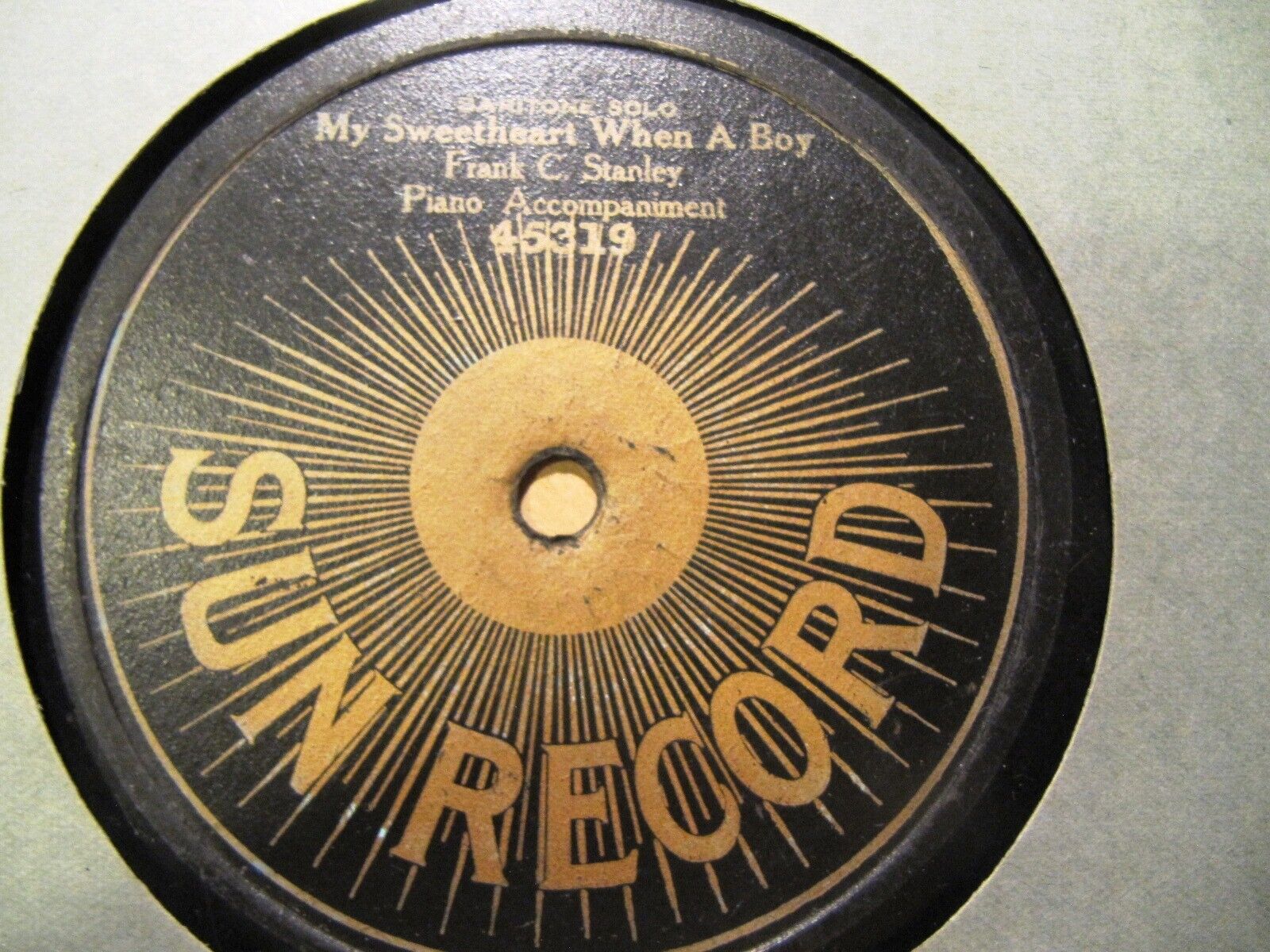
Open Air SUN RECORD 45319 MY SWEETHEART WHEN A BOY Leeds & Catlin Records
$
35


Favourite Auctions
To save auctions to your favourites, please login
If you don't have an account, please register
Description
A series of great JAZZ Records from early Ragtime to Beb-Bop on 78 rpm Victrola Records
More great Jazz and Vocal Records in my other listings!
Rare first Sun Record label made by Leeds and Catlin was one of most beautiful simple label designs.
Leeds and Catlin was an early record pioneer, and the only label that resisted the Victor-Columbia monopoly law suits until 1909.
This label has no connection to the Elvis Presley Sun Label
Advertised as "Open-Air" Record for Outdoor Use
SUN RECORD 45319
MY SWEETHEART WHEN A BOY (Morgan)
Frank Stanley w piano
Matrix 8461
Listed Nov 1906
Advertised as "Open-Air" Record Leeds applied this designation to selected recordings that were said to be suitable for outdoor use due to their greater volume. Although the company claimed the recordings were made by a "special process," auditioned copies are not noticeably louder than Leeds' usual output.
Please see top of the page for condition
Sun — Sun replaced Imperial as Leeds’ flagship brand in late 1907. The first known advertisements for Sun appeared in September of that year, and the first catalog was published a month later. (Imperial remained in production after Sun’s introduction, as an export label). Sun’s label design was reworked at some point; originally, the rays extended fully to the top of the label, overlapping the title and artist credits. Sun’s catalog numbering continued that of Imperial, which had continued the original Leeds series with the addition of 40000 (e.g., Sun 44663 = Imperial 44663 = Leeds 4663). Early releases included reissues of many Leeds foil-label–period recordings.
Leeds & Catlin Records
ca. 1899-1909
The Leeds & Catlin Company was organized in 1899 from the remains of the earlier Walcutt & Leeds Company and the same, Ltd. The latter two were using the facilities of the North American Phonograph Company, which had gone bankrupt in 1894 and was legally sold to Cleveland Walcutt, Edward F. Leeds and Walter Miller (who soon left). Brother Loring Leeds then joined in 1896. Of questionable legally though was their subsequent use of the equipment to record, make and market their own brown wax cylinders given patent protections still presumably held by Edison and Columbia. Strangely though, it briefly supplied Edison during 1897-1898 while Edison's own studios were being set-up. Litigation came from Columbia as early as 1896 for infringement of the Bell-Tainter patent (covering basic sound recording and reproduction) which led to its reorganization into a Ltd. Company and then finally the new incarnation with L. Reade Catlin.
Brown wax cylinder production resumed and reached around a thousand titles before a switch was made to disc records in 1903. This then put Leeds & Catlin into further conflict with Columbia and Victor over other patents. In the meantime though, a very short-lived seven-inch line gave way to a standard-ten that numbered around two thousand titles by the end in 1909. Pressing quality was quite poor at first with some improvement being made over the years, including abandoning a thick rim that left the playing area thin and prone to cracking. Columbia soon challenged them in court over the right to its Jones Patent, which covered lateral recording on a wax master that was then electroplated. Leeds labels were first pressed in relief on the shellac and covered with gold or green-colored foil before yielding to the more traditional paper variety, probably because of cost. This then brought Victor to the litigation table since it claimed a patent on using paper labels. Victor also sued in defense of its Berliner patent, which covered a tone arm propelled by the groove instead of the phonograph motor. These cases went back-and-forth through the courts for the rest of the decade while Leeds continued to produce and even expand with a Middletown, Connecticut plant.
The company also created several sub-labels and supplied masters to client labels like Oxford, Busy Bee and Aretino. The Foil-Label "Leeds Records" was replaced by the "Imperial Record" while the "Concert Record" was also produced as a more budget-offering. Later on, Imperial was replaced by the "Sun Record" within the U.S. market and then the double-sided "Peerless Record" made a brief appearance before the company was shut down. However, masters were shared between all these labels despite price and prestige. Also, no company credits were listed on the labels after the Foil-Label. Perhaps this was an attempt to put some legal distance between product and company?
Some European talent was brought to record in the New York studio but the discs met with little profit. A few disc masters were also imported from the German "Favorite" label. A Grand Opera series also failed and a 1907 attempt to bring back the cylinder under the "Radium" name never took off. Standard fare by the freelance recording artists like Billy Murray, Collins and Harlan, Len Spencer and Henry Burr was popular though. Oddly, the Big Three continued to employ them as well without threat for also recording for "infringing companies".
Constant litigation took its toll on the company however. Attempts to address them were rejected by the courts like a sticker on the back of the discs warning buyers to only use a mechanically-propelled tone arm. The Company also claimed in arguments a right of repair-and-replacement to replace broken and worn Victor/Columbia discs with Leeds discs. The Supreme Court dealt the fatal decision in 1909 with the company being closed and properties auctioned off soon after. No studio session notes survive so all information either comes from contemporary trade publications or the records themselves.
price rating




![Otis Redding The Dock Of The Bay LP ORIGINAL 1st issue 68' Great Press [Ex/Vg]](https://www.popsike.org/php/thumbnail.php?url=https://www.popsike.pics/pix/20231202/134836747963.jpg)