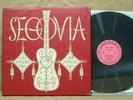
Segovia Golden Jubilee Classical Guitar Vinyl 3-LP Record Box Set MCA3-19000 VG+
$
26


Favourite Auctions
To save auctions to your favourites, please login
If you don't have an account, please register
Description
Andres Segovia Golden Jubilee Classical Guitar Vinyl 3-LP Record Box Set MCA3-19000 VG+
Record Grade per Goldmine Standard: VG+
SIDE ONE 1. Prelude and Allegro de murcia Santiago de Murcia, the composer of this Prelude and Allegro, was a Spanish guitarist of the end of the 17th and beginning of the 18th centuries. His treatise on the guitar, brought out in 1714, was the last in which tablature was used. 2. Study No. 1 in C sor 3. Study No. 9 in A minor sor Fernando Sor, the Spanish composer and guitarist, has been called "the Beethoven of the guitar." The desig- nation is apt in the sense that in Sor's hands the guitar reached the peak of its development. As a composer for his instrument, Sor raised guitar music to heights which have not been surpassed. Born in Barcelona in 1780, Sor received his musical education at the Montserrat Monastery. His early ac- tivities after leaving Montserrat were varied, and did not foreshadow the splendor he achieved later as a master of the guitar. He became an officer in the army, but continued his studies in composition and absorbed the music of Haydn and Mozart. He composed a suc- cessful opera in two acts. There followed ballets, sym- phonies, chamber music, church music. Later he moved to London, where.he first became prominent as a guitar virtuoso. His fame spread, and he travelled all over Europe, including Russia, the Mecca of all travelling virtuosi at that time. Sor's guitar compositions were not written as bra- vura pieces. Though many of them were intended as exercises and studies, they are works full of rich beauty and melody. They were neglected for many decades even up to our own times, when new interest in the instrument has again produced performers able to meet their technical and musical demands. In his guitar studies Sor achieved what Andres Segovia has called "the right balance between the pedagogical pur- pose and the natural musical beauty." The listener, for whom the musical interest predominates, cannot fail to be struck by the remarkable melodic grace and beauty of the two Studies recorded here. 4. Sonata "Homage to Boccherini" CA5TELNUOVO-TEDESCO Mario Castelnuovo-Tedesco was born in Italy in 1895. The eminent composer of operas, orchestral, ballet, film, choral, vocal and chamber music now makes his home in California. He wrote his Sonata "Homage to Boccherini" in 1933 at the suggestion of Andres Segovia. The composer has said of this work: "The Sonata is in four movements, but it is mainly in the first movement, Allegro con spirito, and in the Min- uetto, that one can find the graciousness which was so characteristic of Boccherini. The Andantino, quasi canzone, on the other hand, refers to Boccherini's "romantic" mood, while the Finale: Vivo ed energico, highlights the bravura elements always present in his music." 5. Fandango rodrigo Joaquin Rodrigo was born in 1902 near Valencia and pursued his early musical studies in that city. From 1927 to 1932 he studied with Paul Dukas in Paris, and he returned to Paris later to undertake historical re- search under the direction of Maurice Emmanuel and Andre Pirro. Rodrigo settled in Madrid in 1939, the year in which he first came to general attention with his Concierto de Aranjuez for guitar. He has com- posed concertos for piano, violin, cello, and harp, numerous songs and instrumental solo pieces, and a large-scale choral work, Ausencias de Dulcinea, which was awarded the prize for a composition in honor of the four-hundredth anniversary of the birth of Cer- vantes, observed in 1949. Sehor Rodrigo is professor of the history of music at the Central University of Madrid. The composer has written of the Fandango: "The work consists of three dances: Passacaglia, Fandango and Zapateado, dedicated to Andres Segovia, and composed a few weeks before the Fantasia para un gentilhombre (1954). "The fandango was a very popular dance in the 18th century; it was the dance both of the nobility and the masses. The 'Fandangos at candlelight' were very fa- mous occasions, and these reunions very often ended in brawls. The fandango is a slow dance and some- times includes ballads which are sung. Its origin is uncertain, though many experts claim the fandango is of Arabian descent. "Except in the trio of the central section, this Fan- dango does not employ popular themes, but it is in- spired by the 'sevillanas,' an extremely intricate in- strumental folk dance. The melodic style reflects the gallantry and pomp of the 18th century in Spain and especially in Madrid." SIDE TWO 1. Passacaglia roncalli 2. Gigua RONCALLI Gavotta roncalli Ludovico Roncalli was an Italian guitarist of the 17th century. The major work by which he is known today is the "Capricci armonici sopra la chitarra Spagnola." The Passacaglia, transcribed from the tablature into modern notation, is taken from this work, which dates from 1692. The Gigua and Gavotta are from a "Suite in G for Spanish Guitar." 3. Study No. 20 in C major sor 4. Two Minuets sor This lively Study No. 20 and the two charming Min- uets are three further examples of Sor's style and musical quality. 5. Spanish Dance No. 10 in G granados The fame of Enrique Granados, the great Spanish pianist and composer (1867-1916), rests now largely on his colorful piano works, of which the most widely known are the twelve Danzas Espagnolas, inspired by the rich Spanish folklore. Andres Segovia performs here a highly effective transcription of Granados' Spanish Dance No. 10. SIDE THREE 1. Prelude s. l. weiss-ponce with rafael puyana, Harpsichord German composer and lutenist, Sylvius Leopold Weiss (1686-1750) was one of the most famous musicians of his day. He was regarded as Europe's outstanding lute player, renowned for his tone and technique and his skill at improvisation. He served in the employ of sev- eral European courts, and was known personally to Handel and Bach. This Prelude was transcribed by the Mexican composer Manuel Ponce, and is played here in Ponce's arrangement with harpsichord accompani- ment by the noted South American harpsichordist, Rafael Puyana. 2. Pieces caracteristiques torroba Preambulo—Oliveras—Cancion— Albada—Los Mayos—Panorama Federico Moreno Torroba, the contemporary Spanish composer, is probably best known for his many popu- lar Spanish zarzuelas. He has written extensively for the guitar. Though not a guitarist himself, he shows again in the work recorded here that he has a thor- ough, sympathetic understanding of the instrument, and writes for it music both colorful and gratifying to listener and performer. The Pieces caracteristiques make up an atmospheric suite. The first four numbers (prefaced by a Prelude) are short: a songful piece entitled Oliveras, a melan- choly Cancion, a lively Albada (Serenade), and a pic- turesque piece describing the brilliant life of the Mayos. True to its title, the final piece, the most ambi- tious of the suite, conjures up the aura of Spain itself. 3. Antano ESPLa Oscar Espla is a native of Alicante, in southeastern Spain, where he was born in 1889. As a musician and composer, he is mainly self-taught, but he studied briefly in Germany with Max Reger. Although Espla's music is influenced by and in part based on the folk- lore of his native region, there is little about it that may be called characteristically Spanish. Espla's wide travels through Europe in search of new ideas and new cultures led him to adopt a scale of his own formation for many of his works. It lends an individual character to his music, though it is not applied inflexibly and does not deprive his work of an appealing lyric qual- ity. Among his compositions are symphonic poems for orchestra, music for the theater, and chamber music. Espla is best known for his piano works. Antano is one of his characteristic miniatures. 4. Allegro in A major ponce Many who know the celebrated melody of "Estrellita" may not know that its composer was Manuel Ponce. The song is often thought of as a folk tune, though it is actually one of a collection of songs published by Ponce as early as 1914. In his music the Mexican com- poser (1886-1948) draws on native Mexican themes and rhythms, and after the middle 1920's (when he studied in Paris) his works show the influence of the French impressionists. In addition to orchestral and chamber music, concerti, songs and piano works, Ponce wrote a great deal of music for Segovia. The Allegro in A Major recorded here is taken from the Sonata No. 1 for Guitar, written for Segovia in 1925. SIDE FOUR 1. "The Old Castle" from Pictures at an Exhibition mussorgsky-segovia Andres Segovia transcribed this beautifully songful section of Mussorgsky's piano suite, making of it a dreamy miniature, more magical and haunting than is possible at the keyboard. The Old Castle, like the other parts of the suite, was based on impressions gained by Mussorgsky at an exhibition of paintings by his friend Victor Hartmann. When Andres Segovia made his debut in Paris in 1924, distinguished luminaries from the spheres of mus.c, art and literature honored him by their presence. Roussel, Falla, Paul Dukas, Madame Debussy, Joaquin Nin joined in the tribute to Segovia. Roussel had writ- ten a short piece for him, which he called "Segovia," and which Segovia first performed on that historic oc- casion. 3. Study SEGOVIA Of especial interest and great beauty is this melodious Study which Segovia himself composed during conva- lescence from an illness. 4. Three Pieces for Guitar tansman Canzonetta—Alla Pollaca—Berceuse d'Orient Alexander Tansman, the distinguished Polish-born composer, has lived and travelled widely in the United States, Europe and Asia. Inspired and influenced by the works of his great countryman Chopin, Tansman was exposed during his travels to the impact of many styles which he absorbed, while preserving his own strong individuality, in which a marked lyric gift is predominant. His works include operas, ballets, or- chestral, choral and chamber music as well as concerti and solo instrumental music. The Three Pieces for Guitar recorded here are among a number of works Tansman has written for the instrument, adding his name to the impressive and growing list of modern composers who have contributed to the literature of the guitar. 5. Tonadilla granados-llobet This is one of Granados' beautiful Tonadillas for voice and piano, transcribed by Miguel Llobet, the Spanish guitarist. Llobet (1875-1938), a pupil of Tarrega, was a well-known virtuoso in Europe and South America, and also toured the United States in 1915-17. SIDE FIVE Concierto del Sur ponce with the Symphony of the Air, enrique jorda, Conductor 1. Allegretto 2. Andante 3. Allegro moderato e festivo In 1941 Manuel Ponce toured through South America, conducting the local orchestras in concerts of his own music. On the programs appeared a new concerto for guitar and orchestra, the Concierto del Sur (Concerto of the South), which Ponce had written for Andres Se- govia and which they performed for the first time in Montevideo, October 4, 1941. The Concierto del Sur is a brilliant evocation of the South. "A blend of native inspiration and impression- ist harmonies," Nicolas Slonimsky has called the work, and this applies particularly to the Allegretto, the main movement of the concerto, in which native and original melodies are worked into a richly orchestrated fabric, to which the guitar contributes its own indi- vidual color. In the Andante, the romantic ardor and mystery of the South are contrasted with glowing ef- fect and in more concentrated form. A sprightly festi- val mood prevails in the Finale. SIDE SIX 1. Fantasia para un gentilhombre rodrigo with the Symphony of the Air, ViHano enrique jorda, Conductor Ricercare La Espanoleta— Toques de la Caballeria de Napoles Danza de las Hachas Canario The Fantasia para un gentilhombre, composed by Joaquin Rodrigo for Andres Segovia, was written in the fall of 1954. The composer has said of his work: "All of its thematic material, except for certain brief episodes in the last movement, is derived, as is no small part of the harmonic texture, from the work of Gaspar Sanz, who was employed by Philip IV of Spain and more especially by his son, John of Austria. "Musical taste had greatly changed in the years that passed between the reigns of Philip II and Philip IV. Unlike poetry, music had too faithfully followed the pull of the people, and had been extensively popular- ized. To the noble grace of pavanes and galliards there succeeded the lighter style of marizapanos, villanos, espanoletas, canarios, and so on, which were more ap- propriate to the hurly-burly of the popular theater than to palace balls. The dances which Gaspar Sanz wrote on these and other tunes, some of which were published in 1667, faithfully reflect these tastes and manners, and are, for the most part, short, simple, and light. "The Fantasia is divided into five movements. The Villano which opens the work is developed monothe- matically within a melodic framework appropriate to the period. Following this movement is a Ricercare in which I have worked out the fugue which Gaspar Sanz had only sketched. La Espanoleta (third movement) is interrupted by a curious episode which serves as trio, or middle part. Toques de la Caballeria de Napoles (Bugle Calls of the Naples Cavalry) obviously makes reference to the time when that kingdom was in close contact with Spain. (Because of this contact, the Sicili- ana of Italy and the Espanoleta of Spain are first cous- ins.) "The Danza de las Hachas (Hatchet Dance), with its great rhythmic animation, is like a duel between the guitar and the orchestra. The work ends with a Ca- nario, a popular folk dance full of forced gayety." 2. A message from Segovia For Segovia's admirers, many of whom may never have heard his voice, we have included this brief recorded message. ABOUT ENRIQUE JORDA... One of the outstanding figures on the American musi- cal scene, Enrique Jorda is the conductor of the San Francisco Symphony Orchestra. The Spanish-born con- ductor has also directed many of the major European orchestras, and is particularly renowned as interpreter of romantic and modern composers.
LP612
price rating