The Jazz Scene by Norman Granz - 78 RPM Album
$
262


Favourite Auctions
To save auctions to your favourites, please login
If you don't have an account, please register
Description
The Jazz Scene by Norman Granz
An Album of 78 RPM Records and Photographs.
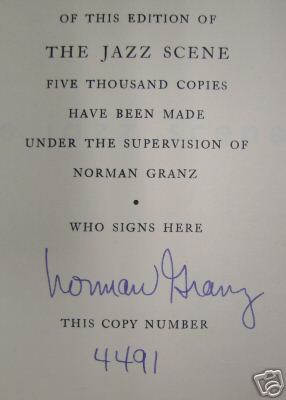
Here is a wonderful collection of jazz music and photographs made under the direction of Norman Granz. There were only 5,000 copies of this set made, and each is numbered and signed by Norman Granz.
About Norman Granz:
Born on August 6, 1918, Norman Granz began promoting Monday night jam sessions at the 331 Club in Los Angeles using local players augmented by star sidemen from the touring big bands. In 1944, at age 26 and while working as a film director at Metro-Goldyn-Mayer film studios, he ordered a poster that was supposed to read "Jazz Concert At The Philharmonic Auditorium." Lacking sufficient space, the Los Angeles printer made it read "Jazz At The Philharmonic." Granz approved this, then borrowed $300 to present the concert that the poster advertised. Ten years later, Jazz At The Philharmonic, Inc. had a turnover of four million dollars!
The release of the first Jazz At The Philharmonic (JATP) records brought Granz national prominence. These were the first authorized records of live jazz, and they created a sensation. Their spectacular sales allowed Granz to begin his first JATP national tour in 1946. When the group arrived in New York for its concerts in May and June, they found an audience now accustomed to concert jazz, and the concerts were a huge success. As with the prior Los Angeles performance, the New York concerts were recorded for eventual release on record.
From 1946 through 1949, Jazz At The Philharmonic had two national tours each year. In the fall of 1948, Granz entered into an agreement with Mercury Records to press and distribute both Jazz At The Philharmonic performances and a new series of studio recordings. Though he was aware of the publicity value that recordings had in promoting his concerts, he also signed and recorded artists who never toured with JATP, such as Bud Powell, Johnny Hodges, and Anita O'Day. While the recordings appeared on the Mercury label, Granz retained ownership of the masters. His first release was "The Jazz Scene," a deluxe, limited edition, 12 inch 78 RPM album.
When the Mercury agreement expired in 1953, Granz went independent and introduced his Clef label, which became home to most of his JATP stars. He also introduced the Norgran and Down Home labels for modern and traditional jazz. In addition to his accumulated roster of some of the most important jazz artists of the time; saxophonists Charlie Parker, Lester Young, Flip Phillips, and Illinois Jacquet; pianists Bud Powell and Oscar Peterson; the Count Basie band; drummer Gene Krupa; and, of course, Billie Holiday; he expanded and signed Stan Getz, Dizzy Gillespie, Ben Webster, and Lionel Hampton in 1953. Soon after, Buddy DeFranco, Louis Bellson, Tal Farlow, and Sonny Stitt, among others, joined the label.
In 1956, Ella Fitzgerald arrived. Granz had been her personal manager for some time, though she had a recording contract with Decca. When the Decca contract expired, he decided to consolidate all of his labels under the Verve Records banner. Henceforth, all previous recordings on Granz's various labels were retroactively referred to as Verve recordings. Fitzgerald's abilities suggested that she be recorded in a pop context as well as jazz, hence the Songbook series was introduced to feature the work of specific composers. Granz kept his artists' pay well above average. Ella Fitzgerald drew $5,000 a week. In 1960, Granz sold his Verve holdings to MGM, Inc., the film company. He became a resident of Switzerland.
About This Album:
This album, which is up for auction here, measures approximately 15 inches wide and 12 inches tall. It's a multi-ring binder that's about 1.5 inches thick. It's covered with black cloth with the words "the jazz scene" in gold on the center of the front. It also has "produced by norman granz" in gold in the bottom right corner of the front cover. There are no markings on the spine or back. On the inside front and back covers you'll find excellent black-and-white photographs taken by Gjon Mili, who took most of the photos that appear in this album. The exceptions are Ralph Burns who was photographed by Harold Trudeau, and Bud Powell and Max Roach, who were photographed by Paul Nodler. There's an original drawing on the first, fold-out page, done by David Stone Martin. This was made in 1949 using recordings from Radio Recorders in Hollywood, California, Asch Studios in New York City, and Carnegie Hall Recorders in New York City. The album is filled with great notes written by Norman Granz.
The first section is called "The Duke Ellington Sides" and features 15x12 photographs of Duke Ellington, Harry Carney, and Billy Strayhorn. The record in this section features Harry Carney on baritone saxophone, Billy Strayhorn on piano, Freddy Guy on guitar, Sonny Greer on drums, and Oscar Pettiford on bass. The songs are Frustration and Sono, both written by Duke Ellington.
The next section is called "The Neal Hefti Sides" and features a photograph of Neal in a very artistic pose. These recordings feature Tony Aless on piano, Shelly Manne on drums, Curley Russell on bass, Diego Iborra on bongos, Flip Phillips and Pete Mondello on tenor saxophones, Murray Williams and Sonny Salad on alto saxophones, Manny Alban on baritone saxophone, John La Porta on clarinet, Al Porcina, Ray Wetzel, and Douglas Mettone on trumpets, Bill Harris and Bart Varcelona on trombones, Vincent Jacobs on french horn, Sam Caplan, Harry Katzman, Gene Orloff, Zelly Smirnoff, Sid Harris, and Manny Fiddler on violins, Fred Ruzilia and Nat Nathanson on Violas, and Joe Benaventi on Cello. The songs are Repetition with Neal Hefti and Charlie Parker, and Rhumbacito, both written by Neal Hefti.
The next section is split between two legends, "The Lester Young Side" and "The Coleman Hawkins Side." Here you'll find photographs of Lester Young, Buddy Rich, and Coleman Hawkins. Lester Young handles the tenor saxophone, Buddy Rich, of course, delivers the drums, and Aye Guy is on piano. The songs are I Want To Be Happy by Lester Young, with Picasso by Coleman Hawkins on the flip side.
The next section is also split between "The Ralph Burns Side" and "The George Handy Side." Here's where you'll see photographs of Ralph Burns and George Handy. Performers on these sides are numerous, including the legendary Red Callendar on bass. The songs are The Bloos by George Handy with soloists Bill Harris and Herbie Steward. On the flip side you hear Introspection by Ralph Burns with solos by Bill Harris, Herbie Steward, and Sonny Berman.
Next we have "The Charlie Parker Side" and "The Willie Smith Side." You're going to love the photographs of Charlie Parker and Willie Smith working their horns. Willie Smith performs Duke Ellington's Sophisticated Lady on one side, while Charlie Parker does The Bird (of course) on the flip, with solos by Charlie Parker, Hank Jones and Ray Brown.
Now we come to "The Machito Side" and "The Bud Powell" side, with photos of Machito and Max Roach with Bud Powell. Performers include Renee Hernandez, Roberto Rodriguez, Ubaldo Nieto, Jose Madera, Eugene Johnson, Alfred Skerritt, Leslie Johnakins, Mario Bauza, Robert Woodlen, Frank Davila, and others. You're gonna groove to Cherokee by Bud Powell on one side, and Tanga by Machito on the flip, featuring solos by Flip Phillips and Eugene Williams.
The final section will literally take your breath away. There are absolutely stunning photographs of Louis Armstrong with Roy Eldridge, Lester Young with Dickie Wells, Ella Fitzgerald, Gene Krupa, Teddy Wilson with Benny Goodman, Stan Kenton, Harry Edison with Illinois Jacquet, Oscar Pettiford, Mary Lou Williams, Count Basie, Art Tatum, Sarah Vaughan, Dizzy Gillespie with Duke Ellington, John Simmons, Billy Holiday (YES!), and Charlie Parker (yes! Yes! YES!).
This is an amazing piece of jazz history -- so much so that it belongs in a museum. The condition is excellent considering that it's well over 50 years old now. There are some minor scuffs and wear spots on the cover. The printing on the cover is quite faded, but still very easy to read. The records are in great shape with no chips, cracks, gouges, or noticable scratches or scuffs. The photographs could be removed and framed and they'd look fantastic. There are only a few specks on some of them, which may have been there from the beginning. The pages were originally a yellow-cream color, and they've only become slightly darker over time. There are some light pencil marks on some of the text. It looks like someone was transcribing the notes and marked the places where they had to stop. There's just the slightest hint of rust on the metal loose-leaf binder, along the side.
I personally hate to see this one leave my collection. So, if nobody bids on it, it won't break my heart!
The winning bidder will pay 100% of the actual shipping costs, but I will pack this album carefully at my expense for you. I'm not responsible for items lost in shipping, the winner is also encouraged to pay the additional fees for postal insurance or delivery confirmation. I will ship these anywhere in the world, but winning bidders outside the USA should consider the extra shipping costs that may be involved.
If you really want this, please be careful to make your proxy bid high enough so you don't lose them to a last-minute bidder (sniper). I prefer PayPal, but I can take credit card payments by phone and will accept any other safe form of payment (please don't send cash in the mail).
Feel free to contact me with questions, if you like. However, I do not end auctions early and will not split up this set for separate sale.